
Every autumn, Norwegian supermarkets fill with bottles of red and brown Christmas soda. ‘Julebrus' is a century-old tradition that inspires nostalgia, regional rivalries, and some surprisingly strong opinions.
Norwegians love their Pepsi Max. It's practically a national obsession. But every autumn, another soft drink begins competing for attention in the supermarket aisles.
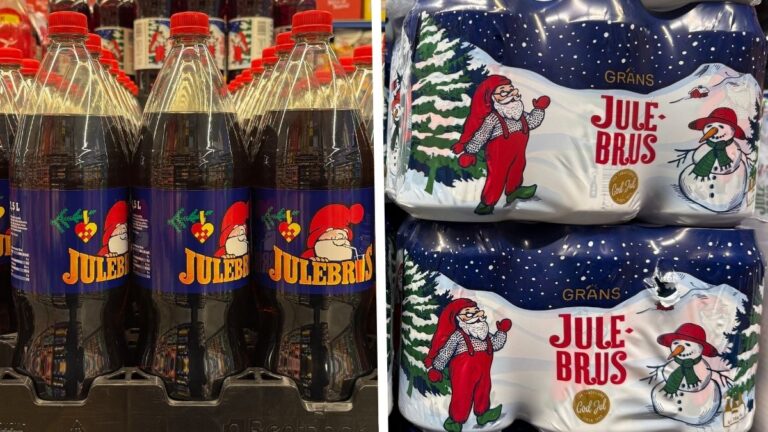
Julebrus, literally meaning “Christmas soda”, is one of Norway's most distinctive festive traditions. It arrives in shops during October, usually long before anyone has started putting up Christmas decorations, and disappears again after the holiday season.
For many Norwegians, that first bottle of julebrus is a sign that Christmas is on its way.
But don't make the mistake of assuming all julebrus is the same. There are dozens of varieties, with different colours, flavours and regional loyalties. Asking a Norwegian which julebrus is best can start a surprisingly passionate discussion.
So what exactly is julebrus, where did the tradition come from, and why do Norwegians care so much about what is essentially fizzy pop?
What Is Julebrus?
Unlike Coca-Cola or Pepsi Max, julebrus isn't a specific drink made to a standard recipe. It's a category of carbonated soft drinks produced especially for the Christmas season.
Most varieties are sweet, fruity and completely alcohol-free. They're enjoyed by children and adults alike, whether at family gatherings, alongside Christmas dinner, or simply as a treat during the festive season.
The two most familiar colours are red and golden-brown, although the flavours can be quite different.
Red julebrus often has a berry flavour, commonly raspberry or redcurrant. Brown varieties tend to have a fuller, mixed-fruit taste, sometimes resembling the Norwegian soft drink known as champagnebrus.
But there are exceptions. Individual producers have developed their own recipes, and some have experimented with other colours and flavours.
According to Lille norske leksikon, Norway had more than 70 varieties of julebrus in 2024. Not bad for a drink that is available for only a few months each year.
The Surprising History of Julebrus
It's tempting to think of julebrus as a relatively modern marketing invention. After all, supermarkets are full of products designed to make us spend more money at Christmas. But the tradition is much older than you might expect.

One of the earliest documented references dates from 1912, when Opdals Mineralvandfabrik at Rise in Trøndelag advertised a special julebrus for the Christmas season.
The advertisement was uncovered by researchers at Julebrustest.no, who have investigated the history of Norway's Christmas soda.
Although it's unclear exactly what that early drink tasted like, the advertisement demonstrates that the idea of a special Christmas soft drink existed more than a century ago.
During the following decades, local breweries and mineral water producers began developing their own versions.
Julebrus became more widespread during the 1950s and 1960s, when Norway still had numerous regional breweries producing drinks for their local markets.
One of the most important developments came in 1972. Hamar Bryggeri decided to create a new brown julebrus that would stand apart from the bright red, sweet varieties already available.
According to the brewery's historical account, the intention was to produce an alcohol-free Christmas drink that resembled beer when poured into a glass. The result was a tremendous success.
Today, Hamar and Lillehammer Julebrus is the country's bestselling Christmas soda, although it's now produced and distributed by Ringnes.
The Great Red Versus Brown Debate
If there's one thing you should know about julebrus, it's that Norwegians have opinions about its colour.
Some insist that proper julebrus must be bright red. Others wouldn't dream of drinking anything other than the golden-brown version they remember from childhood.
The distinction isn't purely visual. Red julebrus is typically sweeter and more obviously fruity, often with a raspberry flavour. Brown julebrus tends to be more rounded, with a taste that some people compare to champagnebrus.
Of course, there isn't one universal recipe for either colour. In 2025, drinks producer Ringnes said that Norwegian preferences were divided approximately evenly between red and brown julebrus.
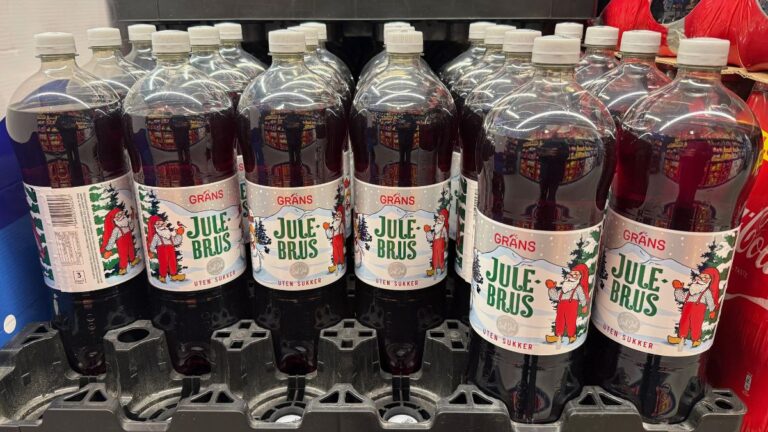
The argument is usually good-natured, but it can become surprisingly competitive.
Every year, Norwegian newspapers, magazines and websites publish julebrus taste tests. Products are awarded scores, winners are declared, and readers inevitably disagree with the results.
For newcomers to Norway, the obvious solution is to try both colours and decide for yourself. Just be prepared for someone to tell you that you've chosen incorrectly.
Norway's Regional Julebrus Traditions
Perhaps the most interesting thing about julebrus is how strongly it is associated with regional identity.
Historically, local breweries served their surrounding communities. Many developed their own Christmas drinks, with distinctive recipes and labels that customers came to recognise.
Those regional loyalties have survived, even as the Norwegian drinks industry has become increasingly dominated by larger producers.
Hamar and Lillehammer Julebrus, originally associated with the inland Mjøsa region, is now widely available across the country.
Here in Trondheim, E.C. Dahls Julebrus has a particularly strong following. Introduced in 1979, the golden-brown drink is a familiar part of the Christmas season in Trøndelag.
On the west coast, Hansa's red julebrus has long been associated with Bergen, while Oskar Sylte's Rudolf & Nissens Julebrus is a favourite in Møre og Romsdal.
Further north, Mack produces a red julebrus strongly associated with Tromsø and northern Norway.
Southern Norway has its own traditions, including the golden-brown CB Julebrus from Kristiansand. Elsewhere, producers such as Aass, Borg and Berentsens have established their own seasonal favourites.
Supermarket chain MENY's guide to Norwegian julebrus provides a good overview of the different regional varieties.
Of course, nobody is obliged to drink the julebrus from their hometown. But for many people, their favourite is simply the one they grew up drinking, and that's an important part of understanding the obsession.
How Big Is Norway's Julebrus Obsession?
The scale of julebrus consumption in Norway is quite remarkable. According to Lille norske leksikon, more than 21 million litres of julebrus were sold in Norway in 2024. That's equivalent to more than 63 million standard 330ml bottles.
Ringnes revealed that its bestselling Hamar and Lillehammer Julebrus alone sold seven million litres in 2025.
In the final week before Christmas, julebrus becomes an especially significant part of the soft-drink market. Ringnes has previously stated that approximately one in four soft drinks sold in Norway during that week is julebrus.
It's an extraordinary achievement for a product that spends most of the year absent from supermarket shelves. Those sales figures help explain why the drinks begin appearing so early.
Why Does Julebrus Arrive in October?
For some people, the arrival of julebrus is something to celebrate. For others, it's a sure sign that Christmas commercialisation has gone too far.
Either way, the bottles usually begin appearing in Norwegian supermarkets around the middle of October. That's more than two months before Christmas Eve, the main day of celebration in Norway.
The early arrival encourages people to start buying their favourites, sometimes long before they have given any thought to Christmas dinner or decorations.
But the limited season is also part of julebrus's appeal. Pepsi Max is available whenever you want it. Julebrus, traditionally at least, is something you have to wait for. There's a sense of anticipation that an everyday soft drink simply cannot recreate.
New Flavours, Familiar Traditions
The Norwegian soft-drink industry has changed considerably in recent years, particularly with the enormous growth of sugar-free alternatives.
Julebrus is changing too. Many established varieties are now available without sugar, while producers continue experimenting with new flavours and colours.
In 2026, Fanta joined the market with a limited-edition, sugar-free red julebrus. The company even acknowledged Norway's red-versus-brown argument when announcing the launch.
Meanwhile, Roma Brusfabrikk introduced a white julebrus called Snøfnugg, demonstrating just how far producers are prepared to move beyond the traditional colours. Yet the established favourites remain enormously popular.
There's an interesting contradiction here. Consumers seem happy to experiment with new products, but many are fiercely protective of the original drinks they remember. Changing the recipe of a much-loved julebrus would be a risky business.
Is Julebrus Unique to Norway?
Julebrus as Norwegians know it is a distinctly Norwegian tradition, although neighbouring countries have their own festive soft drinks.
Sweden's equivalent is julmust, a dark, non-alcoholic drink made with malt extract and hops. Despite the similar seasonal appeal, julmust tastes quite different from most Norwegian julebrus varieties.
Iceland also has a Christmas drinks tradition, with many people enjoying a mixture of malt drink and orange soda.
The similarities are fascinating. Across the Nordic countries, people have developed strong emotional attachments to drinks that appear primarily during the Christmas season.
But Norway's remarkable variety of regional julebrus brands gives its tradition a character all of its own.
More Than Just a Soft Drink
After years of living in Norway, I've come to realise that many of the country's strongest Christmas traditions aren't necessarily the grandest or oldest. They're the familiar little rituals repeated every December.
The same Christmas dinner, the same television programmes, the same decorations, and perhaps the same bottle of julebrus on the table.
A particular flavour can bring back memories of childhood Christmases, family gatherings and long winters.
That emotional connection is something the drinks industry understands very well. But it's also something that can't easily be manufactured. It's why a relatively ordinary bottle of fizzy pop can generate such extraordinary enthusiasm.
And why, despite all the new flavours and varieties appearing each year, many Norwegians will continue buying exactly the same julebrus they've always bought.
So, which julebrus is your favourite? Are you firmly on the red or brown side of the debate? Or do you have a regional favourite that deserves more attention? Let us know in the comments.