

Yes, you can visit Hell in Norway. This small place near Trondheim Airport is famous for its name, but there is more to Hell than a railway station sign.
Norway is full of unusual place names, but for English speakers, few are more memorable than Hell.
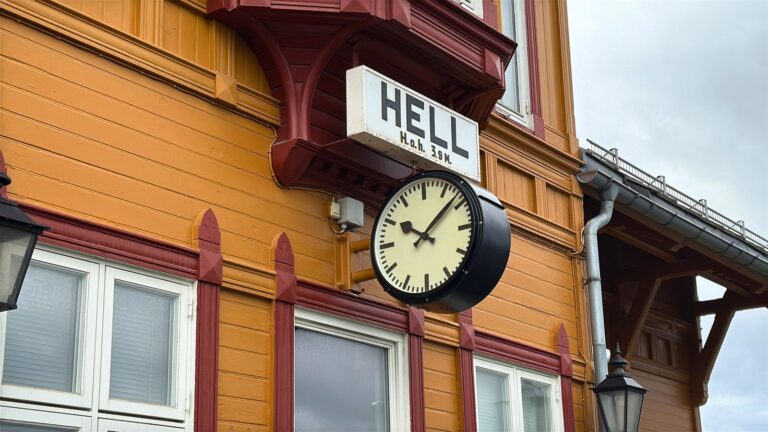
Yes, Hell is a real place in Norway. It sits in Stjørdal municipality, close to Trondheim Airport Værnes, and it is very easy to reach from Trondheim by train.
In fact, you can buy a one-way ticket to Hell, step off at the station, take a photo, and then tell everyone back home that you have been to Hell and back. In winter, Hell really does freeze over, too.
All the jokes are obvious, and I have made most of them myself over the years! But after living in Trondheim for such a long time, I realised I had never really looked beyond the famous railway station sign.
So, I went back to Hell to see what the place is really like.
A Small Place Near Trondheim Airport
Hell is best known to visitors because of its name, but to locals it is simply a residential area on the edge of Stjørdal, just across the river from Trondheim Airport.
Many people pass close by without thinking about it. The E6 road, the railway, the airport and the hotels around Værnes all make this a busy transport area. Yet the village itself feels surprisingly quiet.
Away from the main roads, you find typical Norwegian houses, gardens, cyclists, and ordinary everyday life. That contrast is part of the charm. For tourists, Hell is a joke and a photo opportunity. For the people who live there, it is just home.
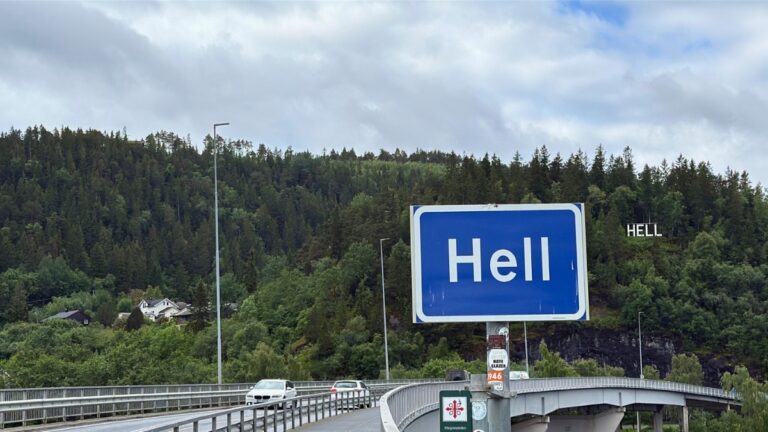
The name is not as dramatic as it looks to English speakers. Hell is usually explained as coming from the Old Norse word hellir, meaning a rock overhang, cliff cave, or shelter beneath a cliff.
Once you see the rocky hillside above the village, that explanation starts to make sense.
The modern Norwegian word for the fiery place of punishment is helvete. The word hell in Norwegian can also mean luck, which adds yet another layer of confusion for visitors.
Hell Railway Station
For most visitors, Hell station is the main attraction.
The local train from Trondheim stops at Hell on its way towards Trondheim Airport Værnes and Stjørdal. The journey from Trondheim takes about 35 minutes, which makes Hell an easy side trip if you are staying in the city, or if you have time to spare before a flight.
The station is small, but it must be one of the most photographed railway stations in Norway. The simple blue station signs are the obvious draw, but there is another sign that attracts attention too.
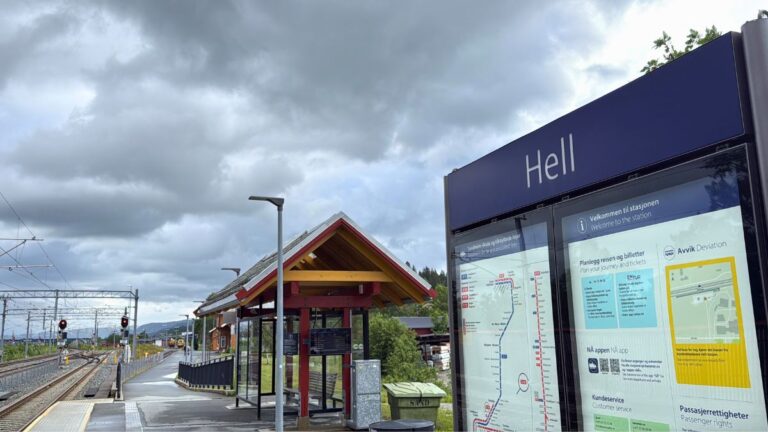
On the old goods building, you can still see the words “Hell Gods-Expedition.” This is not quite as strange as it looks.
“Gods” means goods or freight in Norwegian, so the phrase refers to freight handling. But for English speakers, of course, it looks like something else entirely.
Hell station is also more important on the railway map than its size suggests. This is where the railway from Trondheim splits, with one route continuing north through Stjørdal and onward along the Nordland Line, and another heading east on the Meråker Line towards Sweden.
Most casual visitors won’t care about that. They come for the sign, take the photo, and leave. I understand why. But if you have a little more time, there is more to see.
Hell Hotel And Hell Shopping Centre
The most visible commercial side of Hell is actually not quite in Hell.
Across the Stjørdalselva river, on the Sandfærhus side, you will find the Scandic Hell Hotel and Hell Senteret. Strictly speaking, they are not in the village itself, but with a name like Hell, it is easy to understand why the branding stuck.
Scandic Hell is a large conference hotel close to the airport, and it plays a major role in the annual Blues in Hell festival.
The festival has become one of the best-known cultural events associated with the place, bringing blues musicians and music fans to Hell each year.
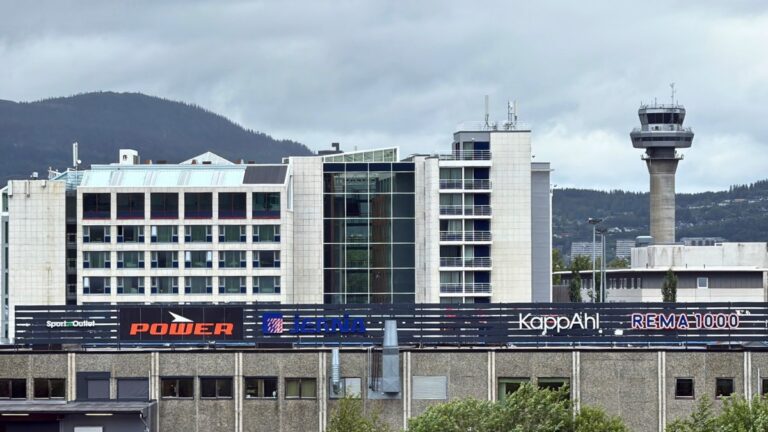
Nearby, Hell Senteret looks fairly dark and dated from the outside, but inside it is brighter and more spacious than I expected. There is a supermarket, sports shops, clothing stores, a café and other everyday services.
In other words, it is a fairly typical small Norwegian shopping centre. Still, there is something amusing about buying an ice cream in Hell!
To reach the village proper from the shopping centre and hotel area, you cross Hell Bru, the road bridge over the Stjørdalselva. From the bridge and nearby roads, you can also spot the large white ‘HELL' sign on the wooded hillside above the village.
For years, I had seen that sign from planes coming in to land at Trondheim Airport. But I had never actually walked up to it. That was about to change.
Rock Carvings In Hell
From Hell station, I walked up through a residential street, past ordinary houses and gardens, until I saw a sign pointing towards helleristninger, or rock carvings.
The Hell rock carvings are not exactly one of Norway’s major tourist attractions. They are signposted from the village, but they are easy to miss if you only come for the railway station.
The trail into the forest is short, but it is not completely effortless. On my visit, there had been recent rain, so parts of the path were slippery. There were also a few short, steep sections where I had to pay more attention than expected.
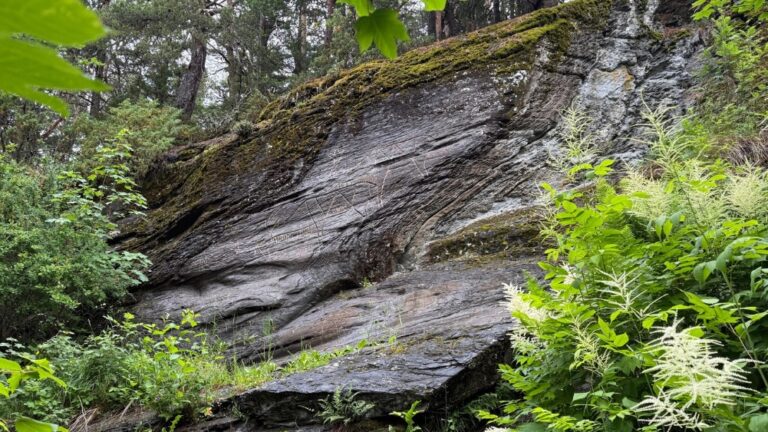
Before long, the path led to the rock carvings.
These carvings are thought to date from the Stone Age, and the figures are usually interpreted as reindeer. They are not as dramatic as the famous rock art at Alta in Northern Norway, where thousands of carvings form part of a UNESCO World Heritage Site.
Hell is much smaller and quieter.
The carvings can also be difficult to see, especially in ordinary daylight. But that does not make them uninteresting. In fact, their quiet setting is part of what makes them memorable.
Thousands of years ago, the landscape here would have looked different. Sea levels were higher, and places that are now inland and wooded may have been much closer to the shoreline. These carvings were not necessarily hidden away in the forest as they appear today.
They are a small reminder that Hell is part of a much older story than its modern name suggests.
Unfortunately, the site also has a more recent and sadder chapter. In 2016, the carvings were vandalised. It was treated as serious damage to cultural heritage, and it is a reminder of just how fragile places like this can be.
If you visit, treat the site with care. Look, take photos, but do not touch the carvings or the rock face.
Hiking To The Hell Sign
I had visited the Hell rock carvings once before, about a decade ago. But at the time, I did not realise you could continue beyond them towards the big Hell sign on the hillside.
Looking back, it seems obvious. The sign is right there above the village. But somehow, I had missed it. This time, I kept going.
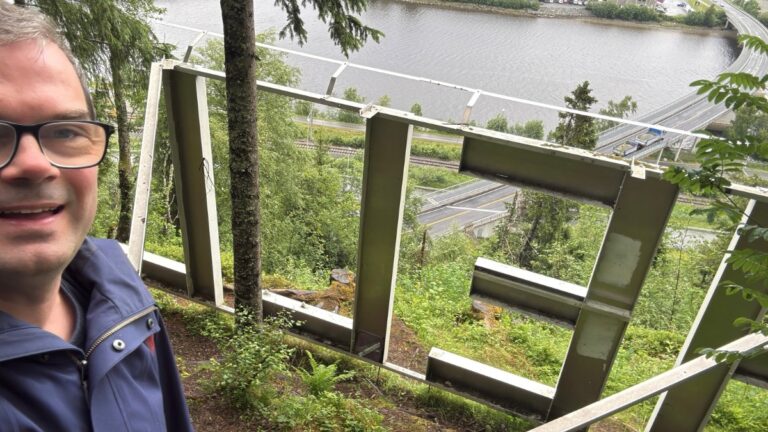
Past the carvings, the trail becomes narrower and less obvious. It is not a long hike, but it does feel a little more adventurous than you might expect from a quick visit to a place by an airport.
The path climbs through the trees, and then suddenly the forest opens up onto a rocky outcrop. The view is a real surprise.
From here, Hell looks completely different. The village sits below you, the railway runs through it, the fjord stretches out beyond, and Trondheim Airport lies just across the river. You can see how road, rail, river, fjord and airport all squeeze into this small patch of landscape.
Most visitors think of Hell as a joke. A station sign. A quick photo. A funny story to tell people later. But from this viewpoint, it becomes clear that Hell is also a scenic little place.
From the rocky outcrop, the trail continues through the trees. It switchbacks in places and can be awkward underfoot, especially after rain, but it does not take long before the sign finally comes into view.
Hell. Not seen from a plane window this time. Not from the train. Not from the road. I had actually hiked to Hell!
Should You Visit Hell?
Hell is not somewhere I would ever tell visitors to Norway to add to their itinerary. If you have only a day in Trondheim, there are far more important things to see, from Nidaros Cathedral to Bakklandet and the riverside walks.
But if you enjoy unusual places, travel oddities, railway stations, or short local walks, Hell is a fun and easy side trip.


Very informative article, thank you David.
We went through a similar reaction as the train from the airport to Trondheim station was going through Hell (!) and we were taking the obligatory photos of the station and having the typical tourist comments and reactions.
Fast forward to next morning, at the hotel’s crowded breakfast room and we could not help overhearing the main topic of discussion of the guests at next table was… Hell.
A very observant lady pointed out Hellman’s mayonnaise. This name has the same root but sounds ordinarily normal to English speakers.
At that point I made the realisation it is the logical semantics wh make this village a (relative) tourist attraction.
I think next time I am in Hell, I will visit the wall
Also visit Hegra Fortress, very exiting with also a museum.
My family immigrated to Minnesota from Hell. My father moved to Oregon many years ago. Our last name is Hellie. My mom was a genealogist and wrote a book on all the Hellie families in America they had a family reunion in Minnesota and relatives flew over from Hell. Thanks for your tour of Hell.
Also (and as a cruriosity) from Hell is Mona Grudt who was miss Norway and miss Universe in 1990
My uncle and grandparents (father born in Canada) immigrated from Hell Norway. Last name Hansen. I would love to know more about my family. I have not had much luck tracing lineage.
Norway has a digitalarkivet (archive). It is a website the government runs. It has all types of governmet records. Good luck.
I seen my family tree and my great grandmother came from hell Norway. Olsen was her last name. One thing nice about internet you can see towns like this.
Interesting to see messages of people from Hell..:-)
We also have family on our grandmothers maternal side from Ydstines:
Olaf Andreas Lorentsson, NESS Ydstines, Stjordalshalsen, Nord-Trondelag, Norway married to
Beret Eriksdatter BJORGUM
I wanted to see where the: “Road to no where” is and I found out it is located in Iqaluit (NunaVut) in Canada and I went and it is very rare experience to the road exists but it goes around and you come back where you started and it is the biggest tourist attraction and funny part is the sign of Road to No where is often missing and the culprits are mostly tourists. However now you can buy T-Shirts, post cards and frig magnets but town Hell seems to be more funnier and I love to go, I was in Trondheim but did not know about it at that time. There is a small town called “Nowhere Else” near Tasmania, it would great story to visit to see towns like these.
Hello Karyn, we also have family on our grandmothers maternal side from Ydstines:
Olaf Andreas Lorentsson, NESS Ydstines, Stjordalshalsen, Nord-Trondelag, Norway married to
Beret Eriksdatter BJORGUM
I thought Hell railway station was Albury Station when you had to change trains when travelling from Sydney to Melbourne or vice versa
As a US Marine I visited your town several times during the 80’s & 90’s and was really shocked to find Hell frozen over. Yes I bought many post cards and mailed them from Hell. The roundabout in down town Hell can be crazy on a Friday night because some of the teens / young folks were partaking of some spirits turned the roundabout into a slip and slide on ice it was crazy.
A couple of years ago we went on holiday to the town of Poo (Spain). Just booked my 2026 driving tour of Norway so that we can go to Hell… and back. Very excited 🙂