
Allow at least a few hours to explore Bergen’s lakeside collection of Norwegian masterpieces, contemporary exhibitions, craft, and design.
Just a few minutes’ walk from Bergen’s train and bus stations, Kode is one of the most substantial cultural attractions in the city.
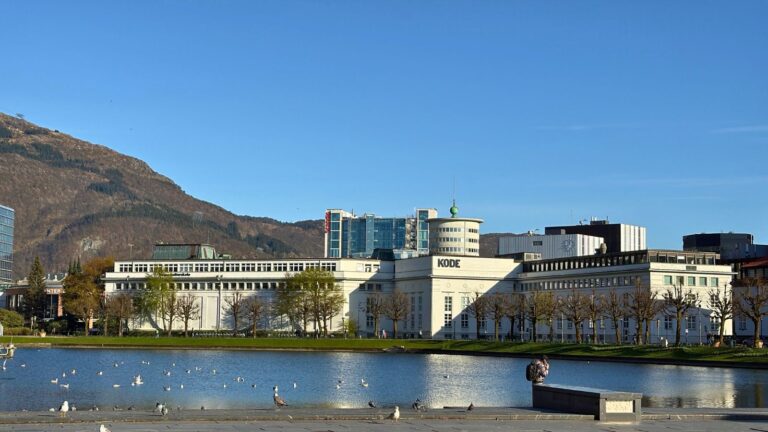
Often referred to simply as Bergen’s art museum, Kode is actually a group of museums. Three of its four city-centre buildings stand in a row beside the small lake Lille Lungegårdsvannet, while the fourth is just across the road.
The compact location makes it easy to move between them, but visitors should not assume they can rush through the entire collection in an hour. Each building has a different focus, while temporary exhibitions mean the experience changes throughout the year.
A standard admission ticket covers all the open city-center art museums on the same day. Before arriving, check the current exhibition program and decide which buildings most closely match your interests.
Understanding the Kode Museum Names
Older guidebooks and articles—including earlier versions of this one—refer to the buildings as KODE 1, KODE 2, KODE 3, and KODE 4.
Kode has since returned to using the historic names of the individual buildings:
- KODE 1 is now Permanenten
- KODE 2 is now Stenersen
- KODE 3 is now Rasmus Meyer
- KODE 4 is now Lysverket
Knowing both sets of names can still be useful when reading older travel guides or reviews.
Rasmus Meyer: Munch, Dahl, Astrup, and Norwegian Art
For most first-time visitors, Rasmus Meyer is the best place to begin. Across two floors, the museum traces the development of Norwegian art through the 19th and early 20th centuries.
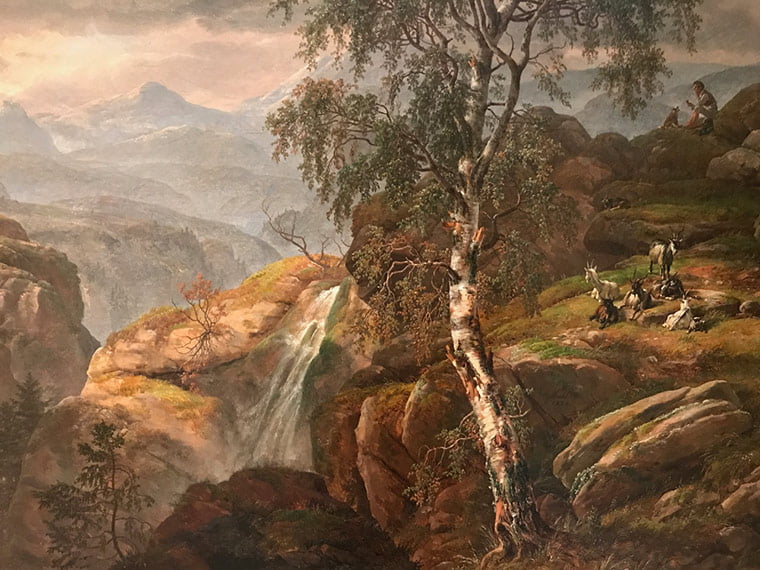
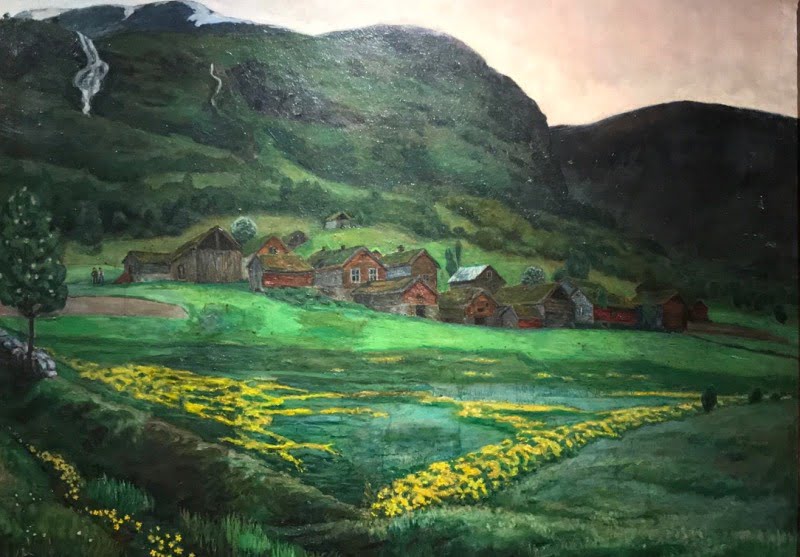
Its galleries contain paintings by many of the country’s best-known artists, including J.C. Dahl, Hans Gude, Harriet Backer, Christian Krohg, Kitty Kielland, Erik Werenskiold, and Nikolai Astrup.
Dahl’s dramatic landscapes helped establish the visual language of Norwegian national romanticism, while Astrup later brought a more personal and colourful approach to the landscapes and rural life of western Norway.
Seeing their paintings within the same collection helps illustrate how Norwegian art developed from romantic visions of the country into the more individual styles of the early 20th century.
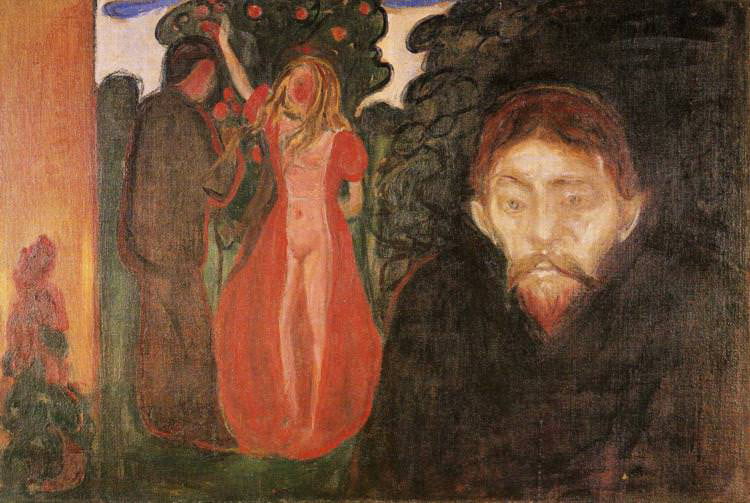
The museum’s biggest draw is its Edvard Munch collection, one of the most important outside Oslo. Rasmus Meyer collected Munch’s work in close cooperation with the artist, building a collection intended to represent the different stages of his career.
Among the best-known paintings are Jealousy, Melancholy, Woman in Three Stages, and Evening on Karl Johan Street.
Even visitors with only a passing interest in art are likely to find Rasmus Meyer manageable and rewarding. The historic interiors and relatively intimate scale make it feel more like a carefully assembled private collection than an overwhelming national gallery.
Stenersen: Changing Exhibitions
Stenersen is Kode’s main venue for temporary exhibitions. The museum stages several new exhibitions each year, covering international and Norwegian contemporary art, architecture, photography, graphic art, craft, and works drawn from Kode’s own collections.
This makes Stenersen difficult to summarise in advance. Depending on when you visit, you could encounter a major retrospective, an experimental installation, a design exhibition, or an introduction to an artist you have never heard of.
It is worth checking the program before your trip rather than assuming the museum will contain a particular permanent collection.
Stenersen is also home to Kode’s principal museum shop and a café, making it a useful place to take a break between buildings.
Permanenten: Craft, Design, and a Grand Interior
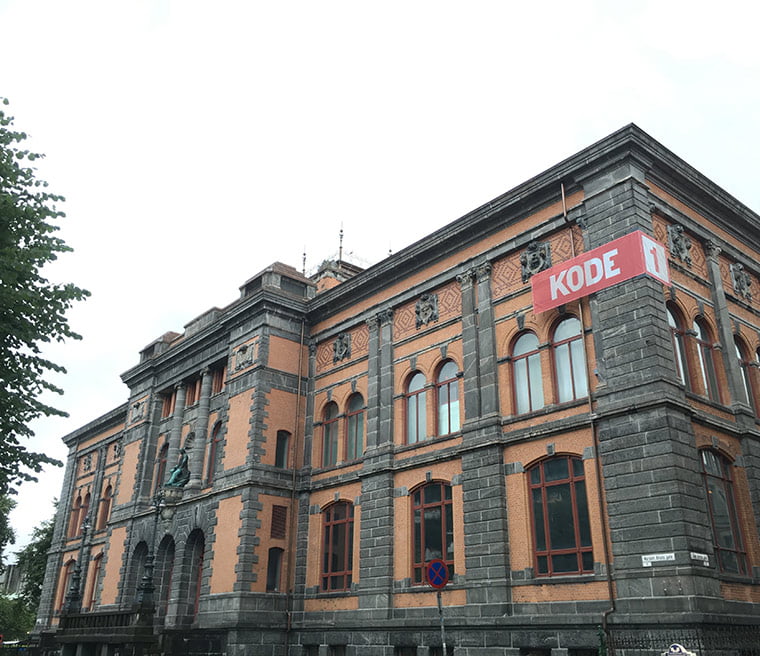
The most architecturally imposing of Kode’s four central buildings is Permanenten.
Built in the late 19th century, the monumental Neo-Renaissance structure was designed as a permanent exhibition space for art and industry. Its elaborate exterior immediately distinguishes it from the more functional museum buildings beside the lake.
Today, Permanenten is associated primarily with craft and design, although the exhibitions on display change. Kode’s wider collections include decorative art, furniture, textiles, ceramics, precious metals, and objects from different periods and parts of the world.
The building itself is part of the experience. Its broad staircase, ornate rooms, and historic details provide a striking setting for both traditional craft and modern exhibition design.
Families should also look out for creative activities and workshops aimed at children. The program varies, but the emphasis is generally on encouraging younger visitors to experiment with materials and ideas inspired by the museum.
Lysverket: A Museum in Transition
At the end of the lakeside row stands Lysverket, recognizable by its long white facade and circular tower.
Unlike the other Kode buildings, Lysverket was not originally designed as a museum. Completed in 1938, it served as the headquarters of Bergen’s municipal electricity company, Bergen Lysverker.
For many years, Lysverket housed major parts of Kode’s permanent collection, including international modernism, historic European and Norwegian art, and a popular presentation of works by Norwegian artist Nikolai Astrup.
The building is now awaiting major refurbishment. Until that work takes place, Lysverket hosts selected temporary exhibitions rather than the broad permanent displays described in many older Bergen guides.
It may still be well worth visiting, but check what is currently on display before making it the centerpiece of your plans.
The building is also home to Lysverket restaurant. Run by chef Christopher Haatuft, the Michelin-starred restaurant serves modern Norwegian cuisine with a strong emphasis on seafood and ingredients from western Norway.
It is a destination restaurant rather than a casual museum café, so advance reservations are needed.
How Long Should You Spend at Kode?
Allow at least a few hours for a worthwhile visit.
With two to three hours, most visitors should concentrate on Rasmus Meyer and one additional building chosen according to the current exhibitions. Those particularly interested in Munch or Norwegian art may want to spend most of that time in Rasmus Meyer alone.
A half-day visit makes it possible to explore three or four buildings at a more comfortable pace, provided they are all open, and still leave time for coffee or lunch.
Trying to see everything simply because one ticket covers all the buildings can quickly lead to museum fatigue. A more enjoyable strategy is to prioritise one permanent collection and one or two temporary exhibitions.
Practical Information
The four city-centre museums are close to Bergen station, the Byparken light rail stop, and Festplassen.
Opening days and hours vary by season, while individual buildings or galleries may close while exhibitions are being changed. Always check the latest information before traveling.
Large bags, umbrellas, and bulky outerwear must generally be left in museum cloakrooms or lockers. The buildings have elevators and accessible toilets.
Photography for personal use is usually permitted without flash, although restrictions may apply to individual exhibitions.
Kode also operates three composer homes outside central Bergen: Edvard Grieg’s Troldhaugen, Harald Sæverud’s Siljustøl, and Ole Bull’s Lysøen. These require separate travel planning and should not be considered part of a quick tour of the lakeside museums.
Kode rewards visitors who plan selectively. For an introduction to Norwegian art, start with Rasmus Meyer. Then choose between contemporary exhibitions at Stenersen, craft and design at Permanenten, or whatever temporary exhibition is occupying Lysverket.
Even without visiting every building, Kode offers a valuable look at how Norwegian art developed and how Bergen became one of the country’s most important cultural centres.


Great summary. Thank you!