
Towering cliffs, thundering waterfalls, and small working communities define Åkrafjorden. This is one of western Norway’s most dramatic fjords, but one that remains grounded in everyday life rather than postcard perfection.
Some fjords announce themselves loudly. the Åkrafjord (åkrafjorden) does not. It sits quietly in Vestland county, east of Haugesund, bypassed by many travellers rushing between bigger names.
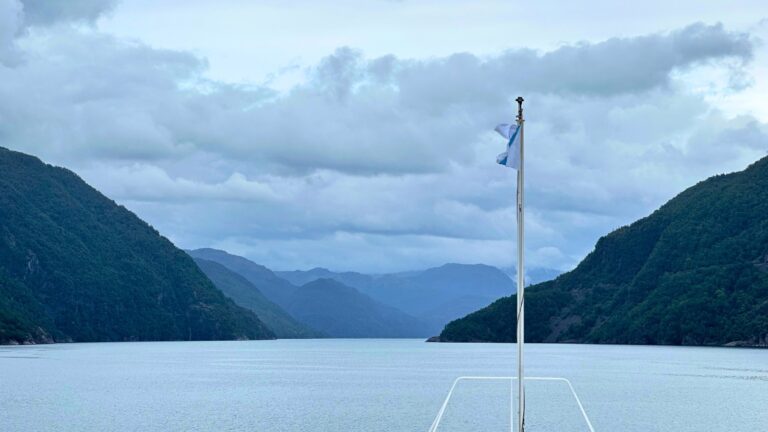
Yet those who take the time to follow the road along its shoreline quickly realise this is no lesser fjord. The scale is immense, the scenery relentless, and the human presence refreshingly unpolished.
The Åkrafjord is not a fjord curated for visitors. It is a fjord people still live with.
Where Åkrafjorden Is and Why It’s Different
Åkrafjorden cuts inland from the North Sea between Hardanger and Ryfylke, forming a natural corridor between coastal and inland western Norway.
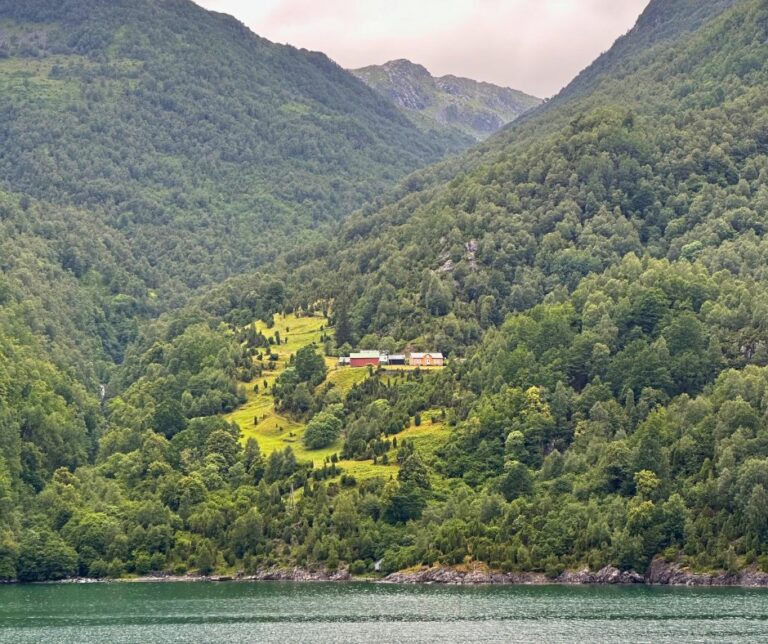
Steep rock walls rise sharply from the water, while narrow strips of land at the fjord’s edge support farms, houses, and small settlements.
Unlike fjords that end in famous villages or cruise terminals, Åkrafjorden never became a focal point for mass tourism. There are no grand lookouts, no fjord-side museums designed to catch passing traffic.
What you encounter instead is continuity: roads built to serve locals, farms clinging to slopes, and boats still used for practical travel rather than sightseeing. That ordinariness is part of its appeal.
Langfossen and the Power of Water
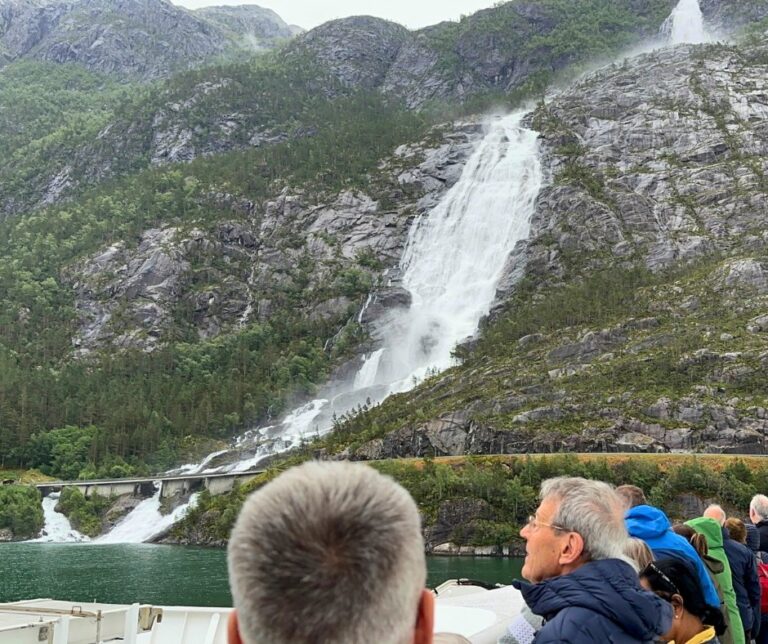
Åkrafjorden is home to one of Norway’s most extraordinary waterfalls, Langfossen. With a total drop of 612 metres, Langfossen is among the country’s tallest waterfalls and flows directly down into the fjord itself.
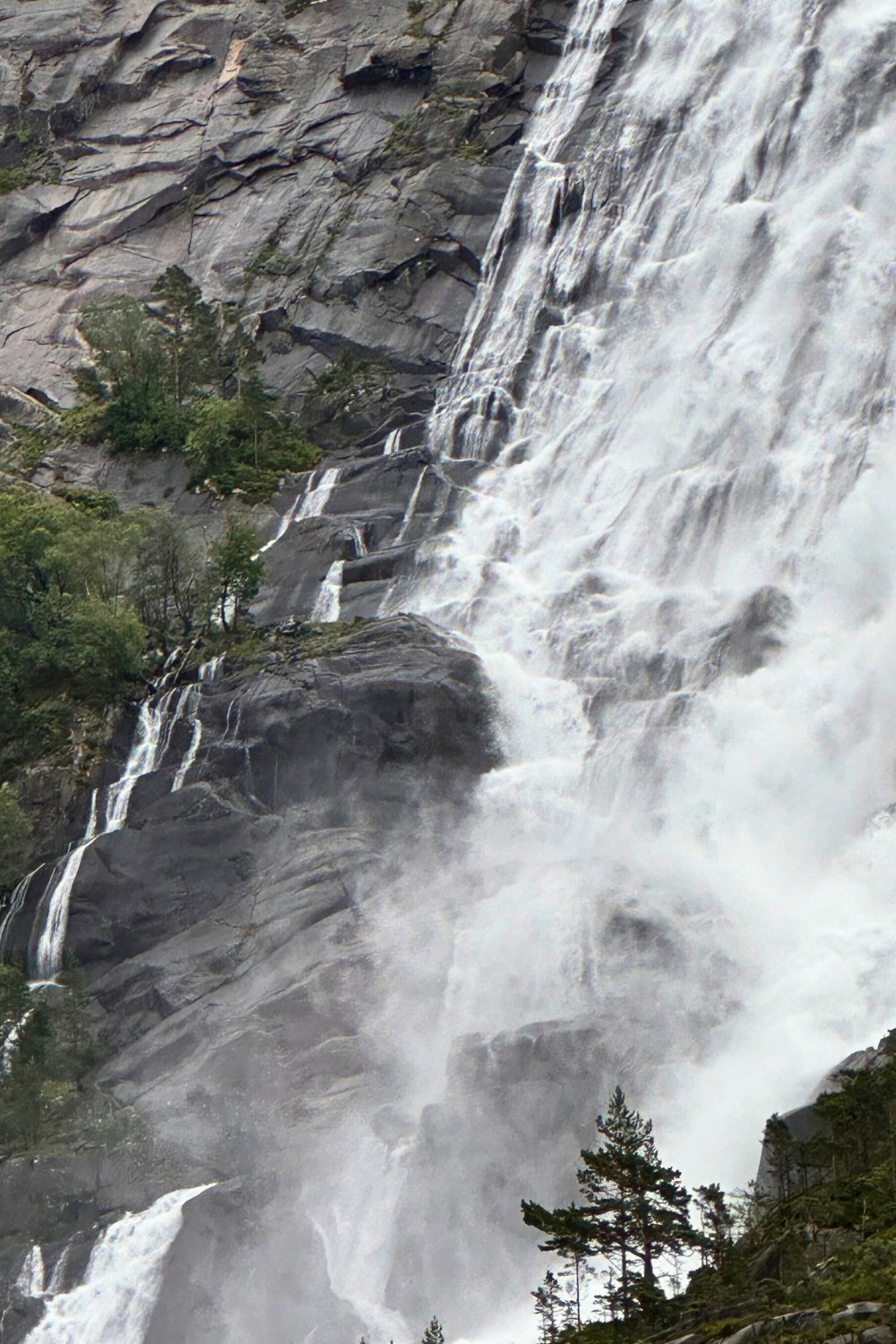
What makes Langfossen unusual is not just its height, but its accessibility. The E134 highway runs directly across the waterfall, allowing drivers to experience its full force at close range.
On wet days, spray fills the air. In spring and early summer, meltwater transforms the cascade into something almost overwhelming.
Yet even Langfossen does not dominate Åkrafjorden in the way a single attraction might elsewhere.
It is part of a wider pattern. Smaller waterfalls tumble down the cliffs throughout the fjord, particularly after rain, reinforcing the sense that water is the defining force here.
A Fjord Shaped by Work, Not Tourism
For generations, life along Åkrafjorden revolved around farming, fishing, and forestry.
The terrain left little room for expansion, encouraging self-reliance and careful use of limited land. Many farms were accessible only by boat until roads arrived in the twentieth century, and even today, the landscape dictates daily rhythms.
Hydropower has also played a role. Water captured from the surrounding mountains feeds power stations that supply electricity far beyond the fjord itself. This industrial presence is understated but significant, another reminder that Åkrafjorden contributes to Norway in practical ways, not just scenic ones.
This mix of agriculture, energy production, and settlement gives Åkrafjorden a grounded feel. It is spectacular without being theatrical.
Experiencing Åkrafjorden Today
Most visitors experience Åkrafjorden by road, following stretches of the E134 as it winds along the water’s edge. The journey is cinematic without being choreographed. Cliffs close in, the fjord narrows, and views open and close unpredictably.
The Åkrafjord can also be experienced from the sea, including as part of a cruise itinerary from Haugesund. Some cruise excursions venture inland towards the fjord, while smaller ships may include Åkrafjorden as part of a dedicated scenic cruising programme.
That was my experience aboard Fred Olsen Cruise Lines' Balmoral, when the ship sailed slowly into the fjord. As Langfossen came into view, passengers filled the open decks, drawn outside by the sound of falling water and the sheer scale of the cliffs.
Seen from the water, Åkrafjorden feels enclosed, powerful, and immediate in a way that’s hard to replicate from the road.
Hiking opportunities exist, but they are less formalised than in more developed fjord regions. Trails tend to be local routes rather than headline hikes, and the terrain can be steep and demanding. This is a place where walking is exploratory rather than curated.
When to Visit Åkrafjorden
Åkrafjorden changes character with the seasons, often dramatically.
Spring and early summer are defined by water. Snowmelt swells the waterfalls, Langfossen is at its most powerful, and the fjord feels alive with movement. This is the most visually impressive time to visit, though weather can be unpredictable.
Summer brings longer days and calmer conditions, making road trips and boat journeys easier. Even then, Åkrafjorden rarely feels busy. Traffic exists, but it is functional rather than touristic.
Autumn adds colour and contrast. Forested slopes shift from green to gold, and rainfall often revives waterfalls after drier periods. Winter is quieter still. Snow dusts the mountains, daylight shortens, and the fjord takes on a more introspective mood.
Why Åkrafjorden Matters Today
Åkrafjorden does not compete with Norway’s most famous fjords. It does not need to. Its value lies in what it represents: a fjord that remains part of everyday Norway.
People live here, work here, and move through the landscape without the sense that they are performing for visitors. The scenery is extraordinary, but it is not packaged or simplified.
For travellers willing to slow down and accept that not every place needs an itinerary, Åkrafjorden offers something increasingly rare.
It is a reminder that Norway’s fjords are not just destinations, but environments where life continues, quietly and persistently, beneath towering cliffs and falling water.