
Harald Fairhair is remembered as the Viking king who united Norway, but historians are increasingly questioning whether the familiar story is history or legend, or a bit of both.
For generations, Norwegian schoolchildren have learned the story of Harald Fairhair. He was the ambitious Viking king who vowed not to cut his hair until he had united Norway.

After winning the Battle of Hafrsfjord, traditionally dated to 872, he became Norway’s first king. It is a compelling story, complete with romance, rivalry, dramatic vows and a nation-building victory.
It is also a story many people in Norway still know today. Harald Fairhair appears in history books, tourist interpretation and even in the traditional royal lineage.
The Royal Court describes Harald Fairhair as commonly regarded as Norway’s first king, having united several petty kingdoms into a single realm around the end of the 800s.
But there is a problem. The more closely historians look at Harald Fairhair, the less certain the story becomes.
A recent article from Science Norway asked a striking question: did the legendary Viking king Harald Fairhair really exist at all? The answer is not a simple yes or no. Rather, it opens a window into how Viking Age history is pieced together from saga literature, poetry, archaeology, later political needs and educated guesswork.
The King Everyone Knows, But No One Recorded
The first challenge is the silence.
There are no surviving written sources from Harald Fairhair’s own lifetime that clearly mention him. That matters because important rulers and events in Europe were often recorded in annals written at courts and monasteries.
Bjørn Bandlien, professor of medieval and Viking Age history at the University of South-Eastern Norway, told Science Norway that these contemporary annals mention Danish kings and Viking groups from western Norway, but not a Norwegian king called Harald Fairhair.
That does not prove he never existed. Much of Viking Age Scandinavia lived in an oral culture, and the absence of evidence is not the same as evidence of absence.
But it does mean the familiar story of Harald as Norway’s first national king cannot be treated as a straightforward fact.
Most of what we “know” about Harald comes from sources written much later, especially the Icelandic sagas. The most famous of these was written by Snorri Sturluson in the 13th century, roughly 300 to 400 years after Harald is supposed to have lived.
That gap is crucial. Imagine trying to write a detailed biography today of a person who lived in the 1600s, using stories passed down orally, political traditions and fragments of old poems. That is the kind of historical challenge we are dealing with.
Snorri’s Harald Was More Than A Historical Figure
Snorri Sturluson was not writing in a neutral vacuum. He visited Norway during a time of political tension, when questions of kingship, territory and legitimacy mattered deeply.
According to Science Norway, Snorri may have linked Harald to Vestfold and to a long royal line in order to strengthen the idea of a continuous Norwegian monarchy stretching back into the Viking Age.
Such a past was politically useful in the 13th century, when claims over areas such as Vestfold and Viken were contested.
In other words, Harald Fairhair was not only a remembered Viking leader. He became a foundation figure. That does not mean Snorri simply invented him. It does mean his version of Harald served a purpose.
The saga king was a way of explaining how Norway came to be ruled by kings, and why later rulers could claim legitimacy through ancestry, conquest and divine or heroic descent.
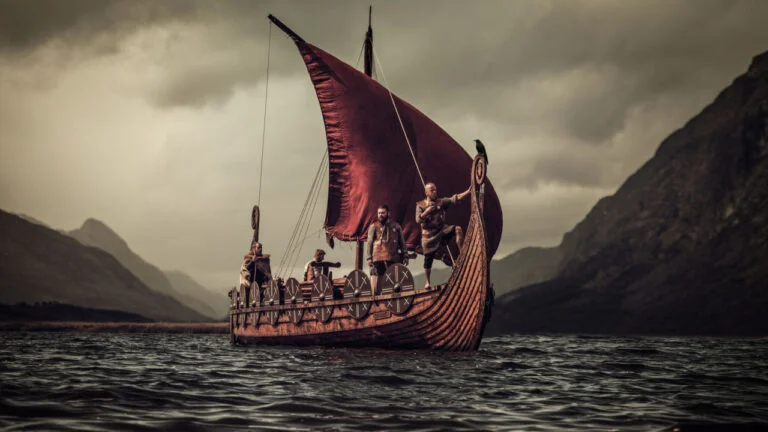
Modern historians are much more cautious. Several have questioned whether the later Norwegian kings really descended from Harald at all.
Science Norway points to the historian Claus Krag among those who have challenged the idea of a continuous Fairhair dynasty.
What The Sagas Say
The traditional story is irresistible.
Harald, a petty king, wants to marry Gyda, the daughter of a king in Hordaland. She refuses him unless he conquers all of Norway. Harald then vows not to cut or comb his hair until the task is complete.
After years of campaigning, he wins the Battle of Hafrsfjord and becomes king. Only then does he trim his hair, gaining the nickname Harald Fairhair.
It is the kind of story that sticks in the memory. That is precisely why historians are wary of it.
Bandlien argues that the famous hair vow is best understood as a literary device used by saga writers to tell a good story. There is even a possibility that the “Fairhair” element was borrowed or confused with another Harald, perhaps Harald Hardrada, who lived much later.
Store norske leksikon still presents Harald as a king in Norway from around 865 until his death around 930 to 933, while also making clear that the traditional image of him as the first king of all Norway rests heavily on saga tradition.
That distinction is important. Harald may well have existed. He may even have been a powerful ruler. But the sweeping national story attached to him is much harder to prove.
Was There Really A Battle At Hafrsfjord?
Marked today by a striking sword sculpture, the Battle of Hafrsfjord is central to the traditional narrative. It is usually presented as the great battle that united Norway. Today, historians are far more cautious.
There are no confirmed archaeological finds or contemporary written sources that verify the battle in the dramatic form described by Snorri.
The most important source is the skaldic poem Haraldskvadet, but skaldic poetry is difficult to interpret. The verses are short, fragmentary and preserved through later written texts.
That does not mean nothing happened at Hafrsfjord. Bandlien told Science Norway that a major naval conflict in the region is not unlikely. There may well have been a battle involving groups from Agder, Sogn and Ryfylke.
But if such a battle took place, it was probably not about “uniting Norway” in the modern sense. It may have been about something more practical and immediate: control of coastal routes, resources and trade.
That is a very different story, but in many ways a more believable one.
Norway Did Not Yet Exist As We Know It
One reason the Harald Fairhair story is so slippery is that “Norway” itself was not a unified country in the 9th century.
The coastline was dotted with power centres, petty kings, chieftains and local elites. Authority was personal, negotiated and often fragile. A powerful ruler might control routes, collect tribute, form alliances and command warriors, but that is not the same as governing a nation-state.
Store norske leksikon’s broader history of Norway presents Harald as the first Norwegian king, but describes him as probably a western Norwegian king with power based around royal estates along the coastal sailing route from Rogaland northwards.
This fits the emerging picture from archaeology and source criticism. Instead of one heroic king suddenly creating Norway, historians now tend to see a longer, messier process. Power grew through trade, warfare, marriage alliances, tribute, gift-giving and control of strategic places.
Why Avaldsnes Matters
If there was a historical figure behind the Harald Fairhair legend, many scholars now look to southwestern Norway.
Avaldsnes on Karmøy is especially important. Its position beside the Karmsundet sound made it a strategic place for anyone who wanted to control traffic along the Norwegian coast.
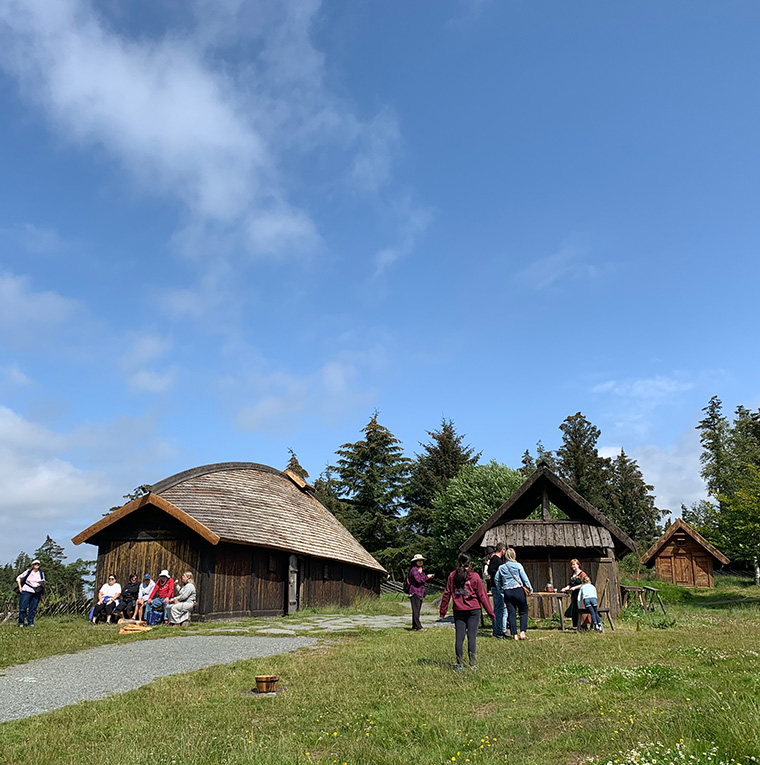
Ships moving along the route known as Nordvegen, the “north way” that gave Norway its name, passed through this area.
Avaldsnes is described by local heritage authorities and tourism sources as a power centre from the Bronze Age into the High Middle Ages, with a location that allowed rulers to monitor and benefit from coastal traffic.
Science Norway’s article points to archaeological discoveries at Avaldsnes showing that it was a significant power base in the 9th and 10th centuries. There are signs of shipbuilding, wealth and international contact.
This is where the story becomes especially interesting. A ruler based at Avaldsnes would not need to be “king of Norway” in the later medieval sense to be hugely important. Control of the coastal route could bring wealth from trade, tolls, tribute and alliance networks.
Goods from the north, such as furs, reindeer antlers, hides, walrus products and other valuable materials, could move south through these networks.
A chieftain who controlled part of that route could use wealth to reward followers, build alliances and maintain a warrior retinue.
That sounds less like a fairy tale and more like the political economy of the Viking Age.
Was Norway’s First King Someone Else?
If Harald Fairhair was not the clear-cut first king of Norway, who was?
One alternative is Haakon Jarl, who ruled from Lade in Trøndelag in the late 10th century.
Adam of Bremen, an important 11th-century source for Scandinavian history, did not mention Harald Fairhair as Norway’s first king. Science Norway notes that Adam instead wrote of Norway being ruled by chieftains until Haakon Jarl.
Another candidate is Harald Hardrada, who ruled from 1045 to 1066. Historian Hans Jacob Orning has argued that Harald Hardrada may be a better candidate for the figure who truly united Norway into a single kingdom.
Orning also suggests that Hardrada, not Fairhair, is more likely to be the ancestor of the later Norwegian royal house.
This may sound surprising, because Harald Hardrada is usually remembered internationally for something else: his failed invasion of England in 1066, ending at the Battle of Stamford Bridge.
But in Norwegian history, his role in strengthening royal power was also significant.
The bigger point is that Norway’s unification was not a single moment. It was a process. The neat story of one king, one battle and one kingdom is easier to remember, but history rarely works so tidily.
Why The Story Became So Important
Harald Fairhair’s fame was not only created in the Middle Ages. It was reinforced much later.
In the 19th century, Norway was trying to define itself after centuries of union with Denmark and then Sweden. The country needed a proud, independent past. The sagas offered exactly that.
Viking kings, dramatic battles and ancient independence became useful symbols. Harald Fairhair stood at the front of that story as the man who had supposedly created the Norwegian kingdom.
This national-romantic use of the Viking Age shaped monuments, schoolbooks and public memory. Harald became more than a historical question. He became part of Norway’s self-image.
That is why the debate matters. It is not simply about whether one Viking king had long hair. It is about how nations build origin stories, and how those stories survive even when historians become more cautious.
So, Did Harald Fairhair Exist?
The honest answer is: probably, but not necessarily in the way most people imagine.
There may have been a powerful Viking Age ruler called Harald, perhaps based in southwestern Norway, possibly connected to Avaldsnes and the coastal trade routes.
He may have won important battles, built alliances and become powerful enough for later generations to remember him.
But the Harald Fairhair of popular memory is a much more complicated figure. The vow not to cut his hair is probably literary. The idea that he united all of Norway after one decisive battle is doubtful. The royal genealogy attached to him is uncertain. Even his origin, whether in Vestfold, Sogn, Karmøy or elsewhere, has been debated.
What remains is a fascinating mix of history and legend.
In some ways, that makes Harald Fairhair more interesting, not less. The uncertainty forces us to look beyond the old king lists and ask better questions.
How did power work in Viking Age Norway? Why did coastal routes matter so much? How did local chieftains become kings? And why did later Norwegians need Harald to be the father of the nation?
The legendary king may or may not have looked like the man in the sagas. But the debate around him reveals something just as valuable: Norway was not born in a single battle. It emerged slowly from a world of ships, trade, alliances, rival chieftains and stories that grew larger with every retelling.