
A spontaneous 24-hour trip from Trondheim to Gdańsk cost just NOK 1,000, but delivered powerful history museums and one of Europe’s most atmospheric old towns in its winter coat.
Gdańsk’s Old Town feels almost theatrical on first encounter. Tall, narrow merchant houses line cobbled streets, church towers rise improbably high above the rooftops, and the Motława river curves past warehouses and cranes that hint at centuries of maritime trade.
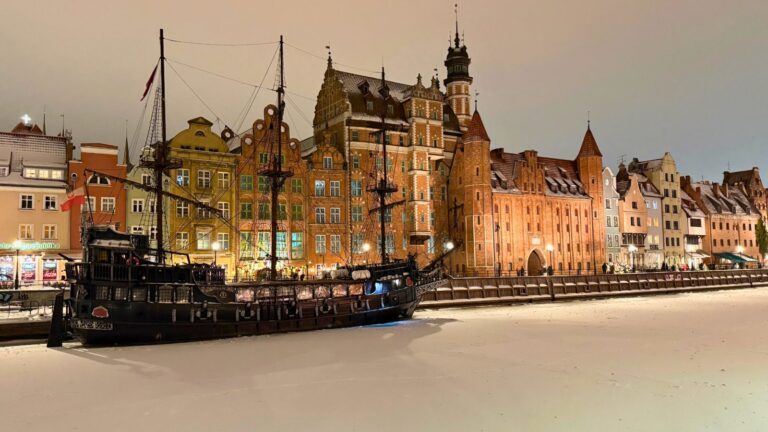
In winter, with snow on the ground and ice edging the water, it feels even more atmospheric. This was my introduction to Gdańsk, a city I had barely considered visiting until I stumbled across a remarkably cheap flight.
I had just 24 hours. From Trondheim to Gdańsk and back, including flights, transport, and a high-quality hotel in the heart of the Old Town, the total cost came in at approximately 1,000 Norwegian kroner.
That alone made the trip feel like a small victory, but what surprised me most was just how much I managed to see and experience in such a short time.
A Personal Reason To Go
My grandfather was Polish, and although I have always been curious about his homeland, I have only visited Poland once before. When I spotted direct Wizz Air flights from Trondheim to Gdańsk for around NOK 360 return, I didn’t hesitate. It was an instant booking.
Flying with an ultra low-cost carrier does mean compromises. In my case, I was limited to a small under-seat bag, but for a one-night trip that was no problem at all. The bigger downside was the flight schedule.
An 8.20am departure from Trondheim Airport Værnes was manageable, but the return flight left Gdańsk at 5.40am the following morning. Painful, yes, but it would get me back to Trondheim early enough to be at my desk before 9am.
The outbound flight was surprisingly comfortable. I hadn’t paid for seat selection or priority boarding, yet ended up with an empty seat next to me.
The flight was just over half full and mostly Polish, which immediately made it feel like a route serving locals rather than tourists.
First Stop: Modern Polish History
Rather than heading straight into the city centre, I took an Uber from the airport to the European Solidarity Centre, around 20 minutes away. With limited time, my plan was to start outside the Old Town and walk my way in.
Polish history beyond the Second World War was something of a blind spot for me, but as a cruise ship destination speaker working on Baltic itineraries, I knew this was a subject I needed to understand better.
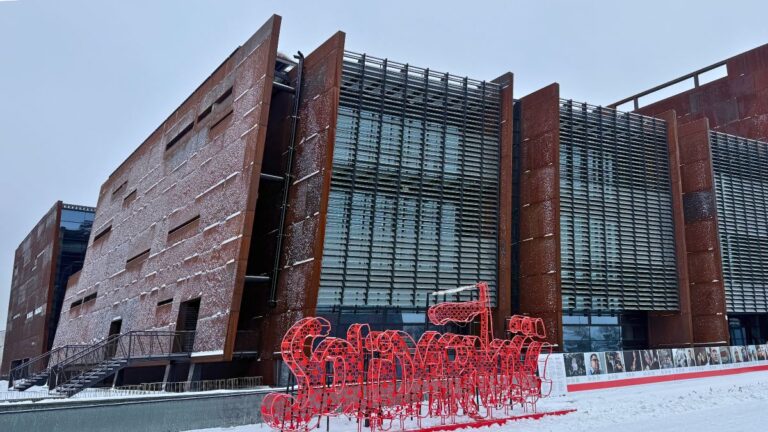
The European Solidarity Centre turned out to be one of the most impressive modern history museums I’ve visited in a long time.
The museum tells the story of Solidarność, the worker-led trade union movement that emerged in Gdańsk in the 1980s and played a crucial role in the collapse of communist rule in Poland.
The building itself is striking, industrial in feel and deliberately evocative of shipyard architecture. Inside, the exhibition is rich and immersive, with archive footage, original documents, soundscapes, and carefully chosen imagery.
An excellent audio guide is available in two versions, a full 2.5-hour tour and a shorter 1.5-hour option. I opted for the abridged version, which still gave a strong sense of the movement’s scale, courage, and lasting impact.
It is a thoughtful, quietly powerful museum that avoids triumphalism while still leaving you with a sense of hope.
The Weight of the Second World War
Around a 20-minute walk away is the Museum of the Second World War, housed in another bold piece of architecture.
Much of the museum lies deep underground, and while it is not literally a bunker, the descent into the exhibition space adds to the emotional weight of the experience.
This is not a museum you rush through. It takes a comprehensive look at the war, with a particular focus on Poland and the civilian experience, while also placing events in a wider global context.
The balance between factual explanation and personal stories is handled exceptionally well.
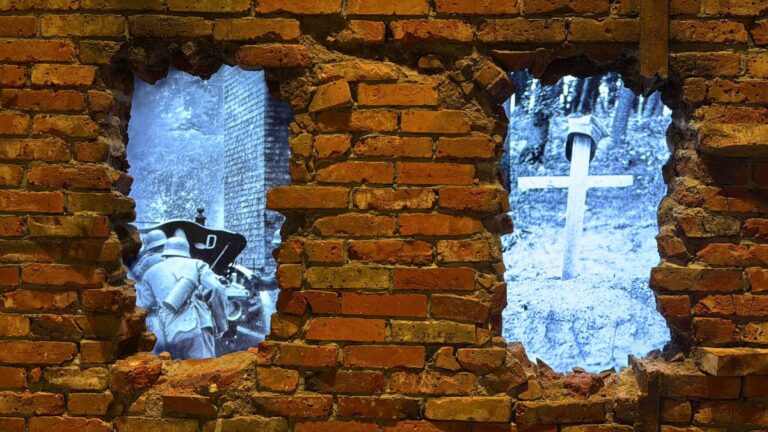
It feels strange to talk about “highlights” in a museum like this, but many of the exhibits are deeply affecting.
The sheer scale of suffering, displacement, and destruction is laid bare in a way that is at times uncomfortable and upsetting, but also essential. You come away with a clearer understanding not just of what happened, but of how profoundly it shaped modern Europe.
Taken together, the European Solidarity Centre and the Second World War Museum tell a story of immense trauma followed, decades later, by resilience and renewal.
If I were to do it again, I might reverse the order and visit the war museum first, then end on the more hopeful note of Solidarity. But with only a day to spare, logistics won out.
Entering the Old Town of Gdansk
As I continued my walk towards the Old Town, the city slowly transformed. Streets became narrower, the buildings taller, and the atmosphere more enclosed in the best possible way.
Then, almost suddenly, I was surrounded by what felt like a chocolate-box version of a historic European city.
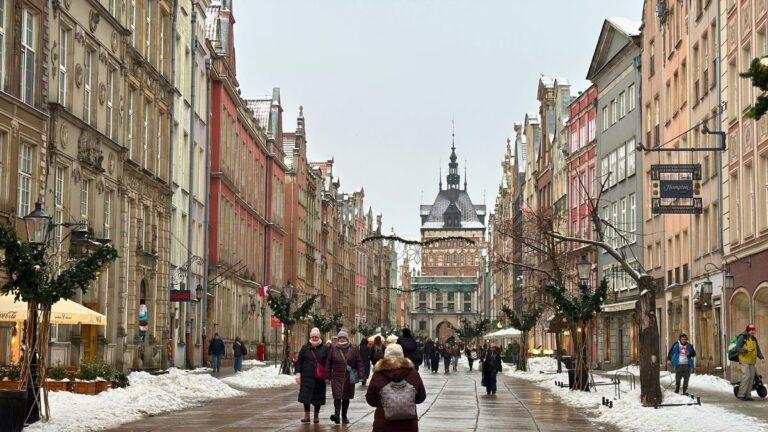
The Motława river was partially frozen, which came as a surprise and neatly explained why Baltic cruises are very much a summer affair. Snow covered the squares and rooftops, adding to the sense of being somewhere slightly unreal.
The weather was colder than I expected. When I left Trondheim that morning it was minus sixteen degrees, dropping to around minus thirteen later in the day. In Gdańsk it was only minus two, but the damp air made it feel almost as cold.
Trondheim’s dry winter cold is far more forgiving. I was grateful I had packed my warmest clothes.
Staying in the Heart of the City
I checked in to the Radisson Blu Gdańsk, a modern hotel tucked neatly into the Old Town.
My room overlooked Długi Targ, the city’s famous main street, and the view alone justified the choice. Watching the street slowly fill with people as evening approached was a highlight in itself.
Architecturally, this part of Gdańsk is fascinating. The style is often described as Northern European or Hanseatic, reflecting the city’s long history as a major trading port within the Hanseatic League.
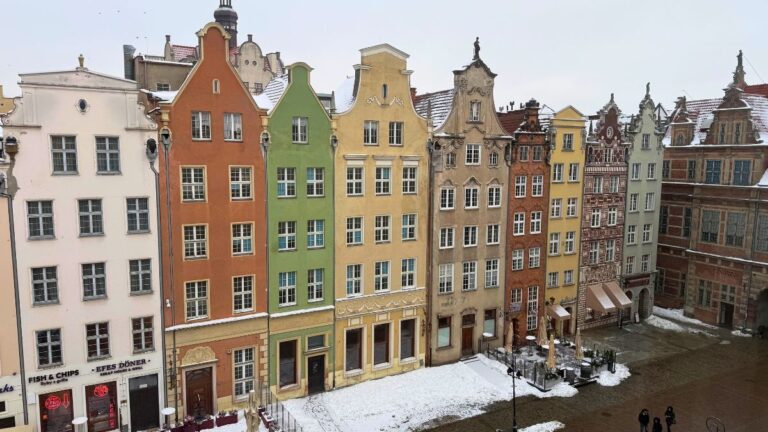
If parts of it reminded me of Riga and Tallinn, that’s no coincidence. All three cities share this merchant-city heritage, though Gdańsk feels a little grander and more monumental in places.
Churches, Food, and Evening Light
St Mary’s Church dominates the Old Town skyline, and stepping inside is genuinely jaw-dropping. The interior is vast and soaring, taller than you expect, though more restrained in decoration than many southern European churches.
You can pay to climb the tower for views over the city, but with the temperature dropping and fatigue setting in, I saved that for a future summer visit.
Finding somewhere to eat was effortless. Gdańsk offers everything from traditional Polish pierogi to international comfort food, and prices were refreshingly reasonable. After dinner, I headed back out to explore as the city lit up.
Across the river, the former warehouse district has been redeveloped into a lively strip of bars and restaurants. It was busy even on a cold winter evening and offered some of the best photo opportunities of the trip, looking back towards the illuminated Old Town.
Other Things To Do in Gdansk
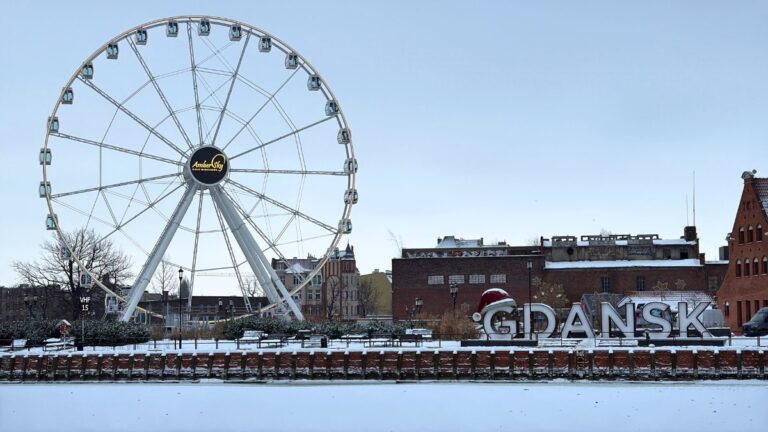
With more time, there is plenty I would have added. Amber is a big deal in Gdańsk, thanks to the Baltic Sea’s rich amber deposits, and the city is known as the world capital of amber craftsmanship. There is even an amber museum dedicated to it.
In summer, boat trips along the river and out towards the coast are popular, and there are numerous smaller museums that would be worth exploring. This was very much a reconnaissance trip rather than a comprehensive visit.
Back to Reality
The downside of a 24-hour budget trip is the early morning alarm. A pre-booked Uber collected me around 4.15am and took me to the airport just over an hour before departure. Security was surprisingly busy, so the extra buffer was welcome.
Boarding began at 5.05am and we left on time, landing early in Trondheim. I was back at my desk in the city centre by 9am, working on videos through very bleary eyes.
This was my first visit to Gdańsk and my first experience flying with Wizz Air. I would happily do both again. For short trips, the value is hard to beat, even once you factor in baggage costs.
Unfortunately, Trondheim–Gdańsk is the only Wizz Air route from my local airport, but travellers based in Oslo or Bergen have more options.
I’ll be back in Gdańsk twice this summer, docking in nearby Gdynia while giving talks on Baltic Sea itineraries. Next time, I plan to slow down, climb that church tower, and see the city in a very different season.