
With a new Netflix adaptation bringing his dark storytelling to a global audience once again, interest in Jo Nesbø is surging.
Yet long before streaming platforms discovered Nordic noir, Nesbø had already built a reputation as one of Scandinavia’s most compelling storytellers.
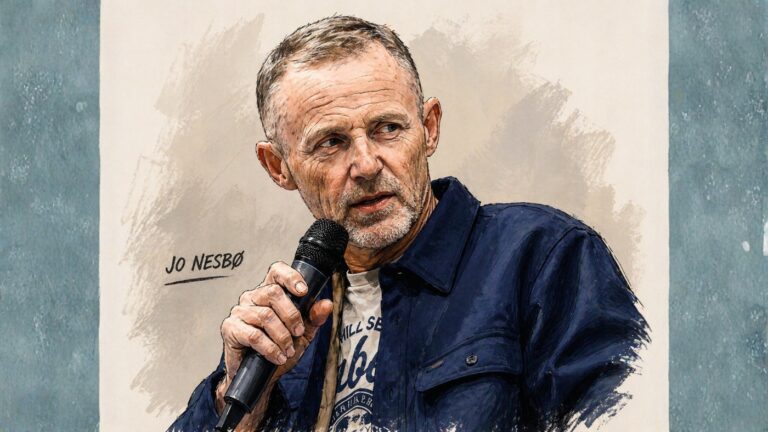
From professional football and chart-topping music to, of course, his global literary success, his career path is anything but conventional.
These 15 facts reveal not just what he has done, but how those experiences shaped the stories millions now read around the world.
1. He Didn’t Start Out as a Writer
Born in Oslo in 1960 and raised in Molde, Nesbø’s early life gave little indication of a future in crime fiction.
His upbringing was relatively typical of middle-class Norway, but creativity was always present. He learned guitar at school and showed an early interest in storytelling through music rather than prose.
Academically, he took a very different route. He studied economics at the Norwegian School of Economics, one of the country’s most respected institutions. This led him into corporate life, working as a stockbroker, while also freelancing as a journalist.
That combination of analytical thinking and narrative instinct would later become a defining feature of his writing. His plots are intricate, but always grounded in human behaviour.
2. He Was a Professional Footballer
Before music or writing took hold, football was Nesbø’s first serious ambition. He played for Molde FK, competing at a high level in Norway. By all accounts, he had real potential.
But his career was cut short by a cruciate ligament injury, a devastating blow at a young age. In interviews, Nesbø has often pointed to this moment as a turning point.
Without that injury, his life may have followed a completely different trajectory. Instead, it forced him to look elsewhere, opening the door to music and eventually writing.
3. He Became a Rock Star in Norway
In the early 1990s, Nesbø co-founded the band Di Derre.
The group quickly became a household name in Norway, known for witty, observational lyrics and catchy melodies. Their songs often painted small, relatable pictures of Norwegian life, full of humour and subtle commentary.
Nesbø served as lead singer and primary songwriter. His ability to tell stories through music is often overlooked, but it’s easy to see how those skills later translated into fiction.
Even today, Di Derre continues to perform, and Nesbø occasionally returns to the stage. For many Norwegians, he is still as much a musician as he is an author.
4. A Trip to Australia Changed Everything
By the mid-1990s, Nesbø was juggling multiple careers and burning out.
He decided to take a break and travel to Australia. What was meant to be time off became something else entirely.
Removed from Norway, he found the space to write. The distance allowed him to reflect not only on his own life, but also on Norway itself. That sense of detachment is something many writers describe as crucial.
During this period, he began work on Flaggermusmannen (The Bat), his debut novel. The story’s setting in Australia is no coincidence. It mirrors the place where the idea first took shape.
5. He Created One of Fiction’s Most Complex Detectives
Nesbø’s breakthrough came with the creation of Harry Hole.
Hole is not a traditional detective. He is flawed, often self-destructive, and deeply human. His struggles with alcohol, authority, and relationships are central to the narrative, not just background detail.
This complexity is what sets the series apart. Readers aren’t just following a case. They are following a person slowly unravelling, then rebuilding, then unravelling again.
The character also reflects a broader shift in crime fiction, away from neat resolutions and towards psychological realism.
6. His First Book Was Submitted Under a Pseudonym
Despite his success in music, Nesbø worried that publishers might dismiss him as a celebrity trying his hand at crime fiction writing. So he submitted his manuscript anonymously.
It was a calculated move, and it paid off. The book was accepted on its own merits, winning the Riverton Prize for Best Norwegian Crime Novel. This early validation helped establish his credibility as a serious writer from the outset.
7. He Helped Globalise Nordic Noir
Nesbø is often mentioned alongside authors like Stieg Larsson when discussing the rise of Nordic noir.
While Scandinavian crime fiction existed long before him, Nesbø helped bring it into the global mainstream. His books combined bleak landscapes with fast-paced storytelling, making them accessible to international audiences.
At the same time, he retained a strong sense of place. Norway is not just a backdrop in his novels. It is an active part of the story.
8. He Has Sold Tens of Millions of Books
Nesbø’s commercial success is extraordinary, even by international crime fiction standards.
He has sold more than 50 million books worldwide, with his work translated into over 50 languages. That reach is significant not just in Europe, but also in major English-language markets such as the UK and the United States, where translated fiction often struggles to break through.
Several of his novels, including The Snowman and The Leopard, have topped bestseller charts across multiple countries. In the UK in particular, Nesbø has achieved the rare feat of becoming a consistent chart-topper as a translated author, something usually reserved for native English-language writers.
For a Norwegian-language author, this level of global success is highly unusual. Norway’s population is small, and its domestic book market is limited, meaning international appeal is essential for this kind of scale.
It also places Nesbø in an elite group of crime writers whose names alone can sell books, alongside figures like Stieg Larsson and other giants of the genre.
9. He Also Writes for Children
Although Harry Hole dominates his bibliography, Nesbø has repeatedly stepped outside the dark world of crime fiction.
His Doctor Proctor series, beginning with Doctor Proctor’s Fart Powder, is aimed at younger readers and could hardly be more different in tone. The books are playful, chaotic, and full of absurd humour, featuring eccentric inventions, outrageous scenarios, and a cast of memorable characters.
Yet beneath the silliness lies the same storytelling skill that defines his crime novels. The pacing is tight, the plots are carefully structured, and the characters are vividly drawn. It’s just that instead of murder investigations, the stakes might involve time travel, gold heists, or, as the title suggests, highly unusual scientific experiments.
The series has been translated into numerous languages and remains popular in Norway and beyond. It was also adapted into a Norwegian film starring Kristoffer Joner, introducing the characters to a wider audience.
What makes this particularly interesting is not just that Nesbø writes for children, but that he does so without diluting his voice. The humour, imagination, and occasional darkness still feel distinctly his.
It’s a reminder that, at his core, Nesbø is not just a crime writer. He’s a storyteller who is comfortable moving between genres, audiences, and tones with ease.
10. He Reimagined Shakespeare
In 2018, Nesbø took on the challenge of rewriting Macbeth as part of the Hogarth Shakespeare project.
His version transforms the story into a noir-inspired tale set in a corrupt, dystopian city in the 1970s.
Themes of ambition, power, and moral decay remain, but the setting and tone are unmistakably his. It’s a reminder that even when working with classic material, Nesbø approaches storytelling on his own terms.
11. Several of His Books Have Been Adapted for Screen
The most successful adaptation so far is Headhunters, widely praised for its pacing and tension.
By contrast, the Hollywood adaptation of The Snowman, starring Michael Fassbender, failed to capture the atmosphere of the novel and was heavily criticised.
These mixed results highlight how difficult it is to translate Nordic noir to the screen, particularly when shifting from Norwegian to international production contexts.
12. He Is Now Bringing Harry Hole to Netflix Himself
Streaming platforms have adapted Jo Nesbø’s work before, but his latest project marks a major shift.
With Jo Nesbø’s Detective Hole, released on Netflix in 2026, Nesbø is no longer just the original author. This time, he played a central role behind the scenes, working as both writer and showrunner.
The series is based primarily on The Devil’s Star, while also drawing on elements from earlier books to build a broader story. Crucially, this hands-on involvement means the on-screen version of Harry Hole feels much closer to the character readers know.
That’s a notable change from earlier adaptations such as The Snowman, where Nesbø had limited creative input.
Rather than focusing only on a single case, the series leans into Harry himself—his personality, his flaws, and his past—making it feel less like a straightforward adaptation and more like an extension of the books.
For longtime fans, that makes this Netflix series something different: not just another crime drama, but a version of Harry Hole shaped directly by his creator.
13. His Writing Is Deeply Connected to Oslo
Many of Nesbø’s novels are set in Oslo, but not the polished version seen in travel brochures.
Instead, he takes readers into the city’s backstreets, late-night bars, and anonymous apartment blocks, where the mood is colder and far less predictable. This is a city of long winters, blurred morals, and lives quietly coming apart.
Crime, addiction, and inequality run through these stories, not as background detail, but as part of the fabric of everyday life.
14. He Is Known for Relentless Productivity
Nesbø has maintained a steady output for decades.
While many authors struggle to balance quality and quantity, he has managed both. His books are tightly plotted, yet produced at a consistent pace.
This discipline reflects his broader career. Whether in music, finance, or writing, he has always approached his work with focus and intensity.
15. He Remains One of Norway’s Most Influential Cultural Figures
Few Norwegian artists have achieved such broad impact.
Through his books, music, and screen adaptations, Nesbø has shaped how Norway is perceived internationally. His work presents a version of the country that is darker, more layered, and more human than the typical postcard image.
And with new adaptations continuing to emerge, his influence shows no sign of fading.
Jo Nesbø’s success isn’t just about crime fiction. It’s about storytelling that feels real. Stories that explore flawed people, difficult choices, and uncomfortable truths.
Whether you discover him through a Netflix series or a novel picked up on a whim, his work offers something deeper than a typical thriller. It offers a glimpse into the shadows behind one of the world’s most outwardly stable societies.


I have read several of Jo Nesbo’s books and enjoyed each one and presently waiting for his latest to come out in paperback. With each story I feel I’m back in Oslo searching the location of the story or wherever he goes.
Thanks for an interesting article on Mr. Nesbo. As an older woman, I say to him, Keep them coming..
His books are beyond interesting! Love the way he portray all his characters in detail. A person who can write so deeply about the emotional feelings of any person must have had experiences similar to the expression of such depth. Invariably I find descriptions so fitting it feels as if he is describing what I felt at the time. Only good research on the writer’s side, or as I mentioned, personal experience?
Please carry on writing Jo Nesbo as I am one of your greatest fans! All the best from South Africa!
I have read every harry hole book and own them all. And now have a friend reading them hope for more harry hole.
ain’t it a shame The Kingdom. You can do better
Jo Nesbø’s father, Per Nesbø, served in the Norwegian SS Police division on the Leningrad front in WWII. The Harry Hole novel ‘The Redbreast’ is based upon Per’s war experiences, which he related to his son. Per justified his war service because he believed the USSR was a greater threat to Europe than N@zi Germany.
This could also explain the moral ambiguity present in Jo’s writing: after all, the Finnish nation as a whole fought on the Axis side in the 1941-44 Continuation War, thereby being the only liberal democracy to do so.
It is easy for nations on the periphery of global conflicts like the UK and USA to choose both a side to fight for, and when to enter the war, but central European nations had bad choices forced upon them. Some Norwegians in 1940/41 might have felt abandoned by their own Government and Royal Family, not to mention their allies, particularly after the loss of North Norway resulting from the withdrawal of troops from Narvik. Narvik had been captured by the Germans in the early days of the invasion, but was liberated by Norwegian, Polish, French and British troops in the first seaborne operation the allies carried out in WWII. The evacuation, brought about after the invasion of the Low Countries, ceded the ground and control of the Northern Seas to Germany for five bitter years of occupation.