
Far from Scandinavia, in a city better known today for coffee, tech and grunge, Seattle is home to the National Nordic Museum. Here’s why.
At first glance, the idea may seem a little strange. Why would the United States have a National Nordic Museum? And why would it be in Seattle, thousands of miles from Norway and the other Nordic countries?
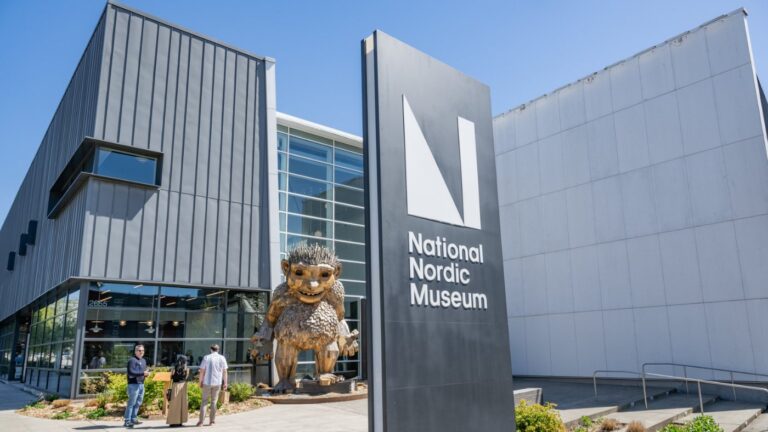
The answer lies in the story of migration. More specifically, it lies in the story of Nordic migration to the Pacific Northwest, where the landscape, economy and opportunities of the late 19th and early 20th centuries attracted thousands of people from northern Europe.
For Norwegians in particular, Seattle and the surrounding region offered something familiar. There was coastline, fishing, boatbuilding, timber, rain and a maritime economy.
For people leaving coastal Norway in search of work and a new life, the Pacific Northwest made a certain kind of sense.
That history is why the National Nordic Museum exists. It is not simply a museum about Scandinavia in America. It is a museum about what happened when Nordic people crossed the Atlantic, settled in a new place and carried parts of their culture with them.
Why Ballard?
The museum is located in Ballard, a neighbourhood in northwest Seattle with especially strong Scandinavian roots.
Ballard was once a separate city before being annexed by Seattle in 1907. Its location beside Puget Sound made it a natural centre for fishing, shipbuilding and maritime work. Those industries attracted many Scandinavian immigrants, including a large number of Norwegians.
HistoryLink, a detailed online encyclopaedia of Washington State history, describes Ballard as a place that “soon became known as a Scandinavian settlement.”
Norwegians worked in fishing and maritime industries, opened stores, built homes and started businesses. The Norwegian presence was not just cultural or symbolic. It was built into the working life of the neighbourhood.
This is the key to understanding the museum. It is not randomly placed in a fashionable part of Seattle. It stands in a neighbourhood where Nordic identity was once part of everyday life.
That legacy is still visible today in Ballard’s Nordic shops, community organisations and old family stories. Seattle’s 17 May parade is among the largest Norwegian Constitution Day celebrations outside Norway, and its roots go back to the late 19th century.
From Immigrant Memory To National Museum
The National Nordic Museum began life as the Nordic Heritage Museum. Its official roots go back to 1979, when it was founded to honour the legacy of Nordic immigrants who came to the Northwest around the turn of the 20th century.
The museum opened to the public in 1980 in the old Webster School building in Ballard. According to HistoryLink, the idea of a Nordic museum in Seattle had been discussed as early as 1932, especially among Norwegians in the city.
A more concrete push came after the 1975 Norwegian Immigration Sesquicentennial, which marked 150 years of organised Norwegian emigration to the United States.
One striking detail from that period is the visit of King Olav V of Norway to Seattle in 1975. He saw an exhibition on Norwegian immigration at the Museum of History & Industry and reportedly noted the lack of a permanent home for such material. That helped strengthen the case for a museum dedicated to Nordic heritage in the region.
For many years, the museum was housed in the former school building. It functioned not only as a museum, but also as a community centre, with folk music, literary events, exhibitions, Nordic festivals and a growing collection of objects, photographs and oral histories.
But the old building had limitations. It lacked the climate control and professional storage needed for a growing collection. Eventually, the museum moved to a new purpose-built facility on NW Market Street in Ballard, which opened to the public on 5 May 2018. The project had taken around 15 years to plan, fund and build.
In 2019, the institution was officially designated the National Nordic Museum by the United States government. That transformed what had begun as a local heritage project into a museum with a national role.
What The Museum Tries To Do
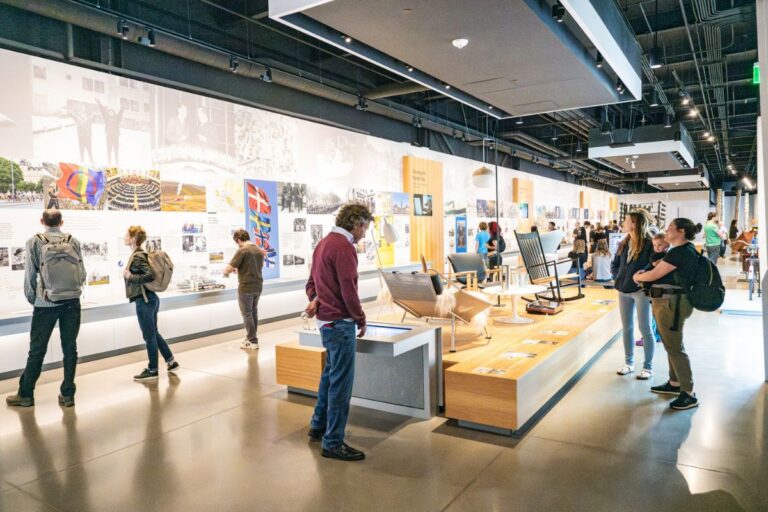
The museum’s core exhibition is called Nordic Journeys. It explores Nordic history and culture over 12,000 years, from prehistoric migrations and the Viking Age to modern Nordic societies and the immigrant experience in North America.
This broad scope is important. The museum is not just a nostalgic display of bunads, ships and immigrant trunks, although those kinds of objects are part of the story. It also tries to explain how Nordic culture developed, how people moved, and how identity changes when it is carried from one place to another.
The building itself reinforces this idea. Its central hall is designed as a kind of symbolic fjord, with galleries on either side representing the Nordic homelands and Nordic America. The visitor physically crosses between the two, mirroring the journey made by immigrants.
That may sound a little too architectural on paper, but reviewers have responded positively to the effect. Condé Nast Traveler says the museum “feels larger than it is,” helped by “cavernous rooms bathed in natural light.”
The same review describes the museum as a “deep-dive into the fascinating world of Nordic culture,” with a focus not only on the Nordic countries, but also on Nordic immigration to the Pacific Northwest.
More Than A Norway Museum
For Life in Norway readers, the Norwegian story is naturally the most interesting thread. But the museum is deliberately Nordic rather than Norwegian.
The story of Nordic Seattle includes Norwegians, Swedes, Danes, Finns and Icelanders, all of whom shaped the region in different ways. The museum flies all five flags and presents the region as a connected but diverse cultural area.
Still, Norway’s role in the museum’s story is hard to miss. Norwegian immigrants were prominent in Ballard’s fishing and maritime industries.
Norwegian organisations, newspapers, choirs and clubs helped sustain cultural life. Norway’s Constitution Day became, and remains, one of the most visible expressions of Nordic identity in Seattle.
In that sense, the museum tells a story that is deeply relevant to Norway. It shows what Norwegian identity looked like after emigration. It asks what people kept, what they adapted, and what changed over time.
That is a different kind of Norwegian history from the one usually told in Norway itself.
What Visitors Say
Although this article is not meant as a travel guide, the visitor experience helps explain why the museum has gained attention beyond the local Nordic-American community.
Seattle’s Child, reviewing the museum from a family perspective, noted the “massive relief map of Scandinavia” near the entrance and described the galleries as filled with “thoughtfully curated cases full of artifacts, pictures, and maps.”
Condé Nast Traveler also highlights the museum’s oral history catalogue, calling it “an engaging way to hear the stories of people who emigrated over the past 180 years.”
The museum also hosts temporary exhibitions, cultural events, lectures, films, classes and family programming. In other words, it is not only preserving the memory of Nordic immigration. It is also trying to keep Nordic culture active and relevant in a North American setting.
For those of us looking from Norway, the museum is interesting because it turns the usual perspective around. We often think of Norwegian history as something that happened within Norway’s borders.
But millions of people with Norwegian and Nordic roots live elsewhere because their ancestors left. The National Nordic Museum tells that story from the other side of the ocean.


Fabulous article about the National Nordic Museum from the Norwegian perspective.
I joined the National Nordic Museum Board of trustee in 2017 just before the opening of our state of the art NNM to tell our Nordic story. I completed my nine year term this year and still remain very active in supporting the museum.
Both my husband and I are of Norwegian descent, having grandparents that settled in Ballard in the late 1800s from Norway.
This article gives us a great tool as we continue to fundraise to support our NNM mission,“sharing Nordic culture, values, and ideas with all people to inspire new futures”
THANK YOU!
Electa Anderson
Nordicmuseum.org
I wonder if i can find some information of my great-great-grandfather, Steffen Jørgensen, in the Nordic museum. He left Norway in the end of 1800, and lived around Seattle. He is buried in Lopez Island in 1906.