
Found in some larger cities, ‘kolonihager' are communal gardens that offer city dwellers space to cultivate plants, build cabins and foster community in the heart of the city.
It’s a bright summer morning in Oslo, the kind where the light feels endless. I’m standing at the bus stop opposite my house when I notice movement on the pavement.
A hen, yes, an actual hen, is strutting purposefully down the street. Then it begins jumping, repeatedly crashing into a wooden fence as it tries to get back into the leafy haven it came from.
A man waiting beside me joins the effort to catch it. We look like a pair of confused city dwellers out of our depth in a rural farce. Then I spot someone behind the fence tending to a garden and shout over: “Are you missing a hen?”
She nods, laughing. The bird is gently guided around the corner and safely back into its pen, one of several nestled within the immaculate grounds of Solvang Kolonihager.
A happy ending, and a perfect introduction to a very Norwegian phenomenon.
The Norwegian Version of the British Allotment
Coming from the UK, I thought I knew what allotments were all about. Rows of vegetable patches, sheds in every possible colour and design, retirees gossiping over tea, and the quiet satisfaction of coaxing something edible from a patch of city soil.
In Norway, the same spirit thrives but in a uniquely Norwegian form. A kolonihage isn’t just a place to grow vegetables.
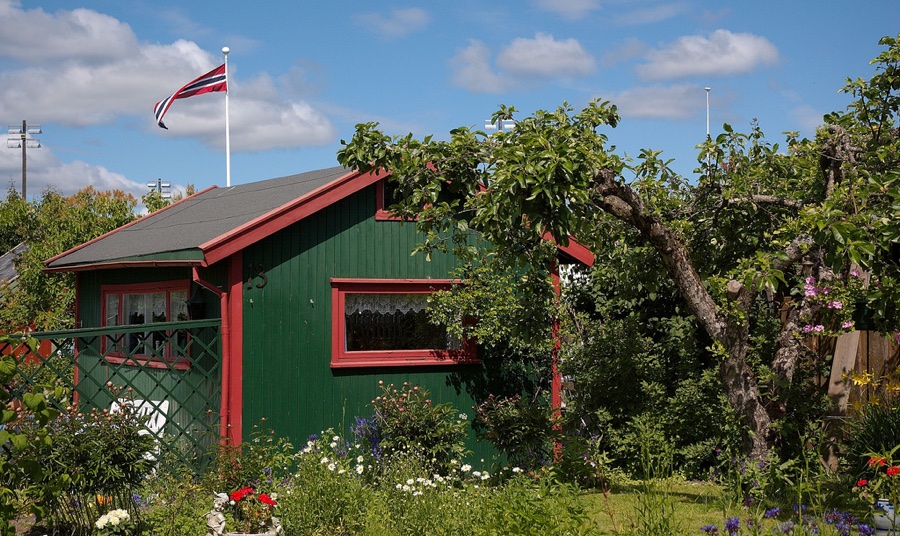
It’s a miniature village: a collection of small wooden cabins, each surrounded by lush gardens, colourful flowers and vegetable plots, arranged along winding gravel paths.
Before I realised what these places were, I often looked across the road from my Oslo flat and wondered about the little “community of houses” hidden among the trees.
The lawns were perfect, the gardens bursting with life. Only later did I learn that these were kolonihager, an allotment system with deep roots in Norwegian social history.
A Century of Urban Gardening
The concept of the kolonihage arrived in Norway more than a century ago. The first was established in Kristiania (today’s Oslo) in 1907, as industrialisation transformed the capital and the population began to swell.
Apartment blocks rose quickly, green spaces disappeared, and ordinary workers lost the connection to nature that had once been central to Norwegian life.
The solution was simple and brilliant. Like similar movements across Europe, kolonihager were created to give people living in cramped urban housing access to their own plot of land.
Initially, the gardens were strictly practical: they were meant to help families grow food and save money during tough times.
Over the years, the concept evolved. Running water and electricity were added, and residents were eventually allowed to build small wooden cabins (hytter) for weekend use. The atmosphere shifted from subsistence to recreation.
Today, these garden villages remain a beloved feature of Norwegian cities, with their mix of practicality, tradition and summer escapism.
Community Life and Shared Responsibility
Each kolonihage operates as a small community, complete with its own governing board, shared rules and social calendar. There are communal paths to maintain, flowers to plant in public areas, and annual summer events that bring members together.
The Norwegian Allotment Association (Norsk Kolonihageforbund, or NKHF) describes its mission as creating communities where people “share in a joint enterprise and have time to help beyond their own doorstep.”
That spirit of cooperation is still central today. It’s not just about growing vegetables, it’s about cultivating community too.
Walk through one of these places on a sunny afternoon and you’ll sense that immediately. People stop to chat by the hedges, children play among fruit trees, and the smell of freshly cut grass mixes with grilling sausages. It feels like a different world from the city outside the gate.
The Long Wait for a Tiny Cabin
Given their charm, it’s hardly surprising that demand far outstrips supply. Owning one of these small garden cabins is a dream for many city residents, but it’s not easy to achieve.
The land itself is owned by the local municipality (kommune), and each cabin is leased on a long-term basis.
The catch? You can’t use a kolonihage as your official address. Residents must already live in the same municipality, and the cabins are strictly for seasonal use – no one is allowed to live there year-round.
Prices are capped to keep the system fair. In 2006, for example, the NKHF limited cabin sale prices to NOK 250,000, which is far below market value.
That affordability is one reason waiting lists are notoriously long, often stretching 10 to 20 years. For many, getting a plot is a lifetime goal, not a short-term plan.
Green Oases in a Modern City
There are currently 14 kolonihager and two smaller parsellhager (individual garden plots) across Norway. Most are concentrated in Oslo, but you’ll also find them in Stavanger, Drammen and Trondheim, amongst other places.
Solvang Kolonihager, where my runaway hen story unfolded, is among the most famous. Established in 1916, it covers a large area in western Oslo and is divided into four sections, each with its own gate, communal facilities and governing board.
In summer, the gardens overflow with life: sunflowers nod in the breeze, strawberry plants spill from raised beds, and the cabins glow in cheerful shades of red and yellow.
Many kolonihager open their gates to the public during the summer months. Visitors can stroll along the paths, admire the gardens, or stop at a small café or kiosk for coffee and waffles. It’s a gentle, distinctly Norwegian way to experience urban nature, part countryside, part community.
Why Kolonihager Still Matter
In a time when housing prices soar and green space is increasingly precious, kolonihager serve a vital role. They provide a mental escape from city life, a physical connection to nature, and a social network that bridges generations and backgrounds.
They are, in many ways, a window into Norwegian values: cooperation, modesty, and respect for the land. And while they began as a response to industrialisation, they’ve found new relevance in an era of sustainability and urban pressure.
Whether you visit as a curious traveller or dream of tending your own plot, the kolonihage remains one of Norway’s most charming traditions, It's a living example of how even in the heart of a city, Norwegians still find a way to keep nature close.
Visiting a Kolonihage
If you’re in Oslo, start with Solvang or Etterstad Kolonihager, both easily accessible by public transport and welcoming to visitors during the summer.
In Trondheim, the Lademoen Kolonihage lies just a short walk from the city centre, while Stavanger’s Eiganes Kolonihage offers a taste of coastal garden life.
Ttake your time, and respect the privacy of those lucky enough to have a plot. You might even meet a friendly hen along the way.