
How a country without political power turned to nature, folklore, and language to build a national identity that still shapes Norway today.
In the early 19th century, Norway faced an unusual problem for a European nation. It had a people, a landscape, and a growing sense of political self-awareness, but it lacked the cultural infrastructure normally used to define a nation.
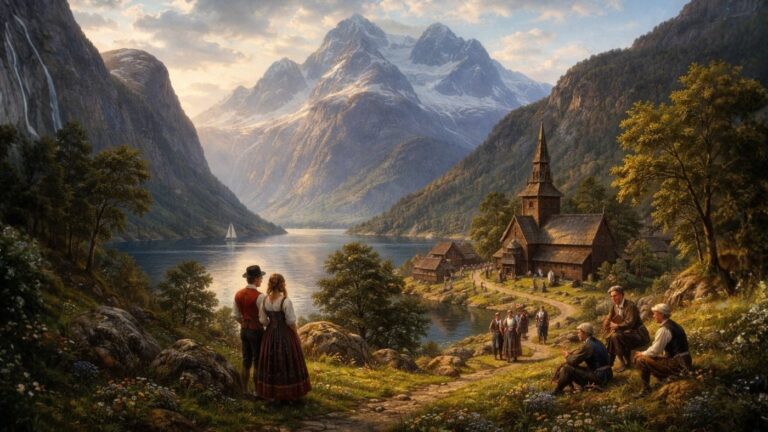
There was no royal court, no long-standing elite class, and no dominant written language that felt distinctly Norwegian. For centuries, political and cultural authority had been exercised from elsewhere.
When Norway entered the 19th century, it did so with institutions but without a shared cultural voice. National romanticism emerged as the response.
A Nation Reawakening Without Full Power
The Napoleonic Wars reshaped Europe, and Norway’s fate changed almost overnight. In 1814, Denmark was forced to cede Norway to Sweden. For the first time in centuries, Norway found itself separated from Danish rule.
That separation mattered. Norway adopted its own constitution in 1814, establishing a parliament and legal framework that allowed political participation and debate.
Yet sovereignty remained limited. Norway entered a new union with Sweden, retaining internal autonomy but lacking full control over foreign policy and defence. This created a strange and fertile tension.
Norway was no longer a province, but it was not fully independent either. Political identity was beginning to take shape, but cultural identity lagged behind.
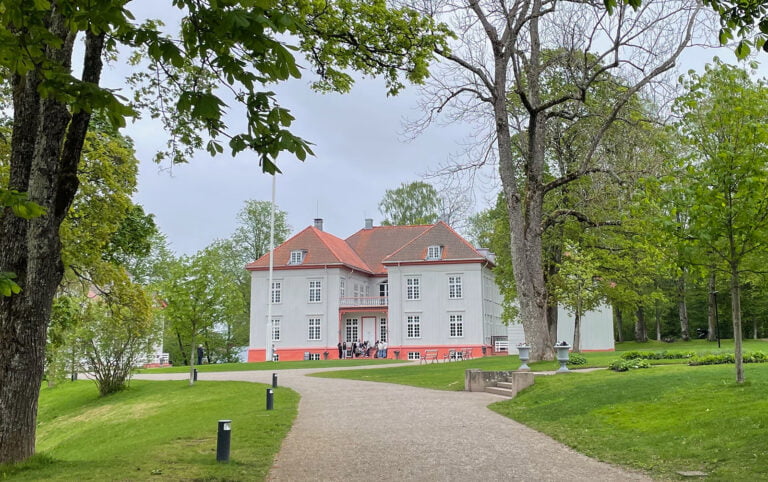
The question facing Norwegian intellectuals, artists, and thinkers was not simply who are we? but how do we prove that we exist as a nation at all?
National romanticism offered an answer.
Why Romanticism Took Hold in Norway
Romanticism swept across Europe in the late 18th and early 19th centuries as a reaction against Enlightenment rationalism and industrial modernity. It privileged emotion over reason, nature over machines, and tradition over abstraction.
In Norway, romanticism took on a different character.
Here, it was not merely a critique of modernity. It became a tool for cultural reconstruction. Norway lacked many of the symbols through which nations traditionally asserted themselves.
There was no continuous royal lineage, no unified literary canon, and no dominant urban elite culture to draw upon.
What Norway did have was landscape, rural life, oral tradition, and language in its many spoken forms. National romanticism turned these into assets.
Rather than imitating continental models of nationhood, Norwegian thinkers looked inward. They treated what had once been seen as peripheral or provincial as the core of national identity. In doing so, they redefined what it meant to be Norwegian.
Nature as the Heart of Identity
Few elements were as central to Norwegian national romanticism as nature. Mountains, fjords, forests, and weather were not depicted merely as scenery. They became symbols of endurance, independence, and moral strength.
The dramatic landscape was framed as something that shaped the people themselves, fostering resilience, self-reliance, and closeness to the land.
This idea had deep roots. Norway’s geography had long influenced settlement patterns, economic life, and social organisation. National romanticism elevated these realities into virtues. Harsh terrain became proof of character. Rural isolation became authenticity.
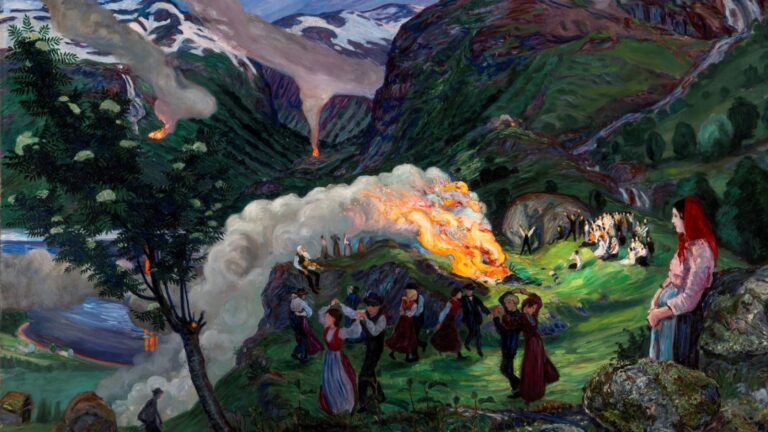
In art and literature, nature was rarely neutral. It was imbued with meaning, often presented as timeless and untouched, even as the country slowly modernised.
This vision of Norway as a land defined by its environment remains remarkably powerful today, visible in everything from tourism marketing to political rhetoric.
Folklore and the Search for a Norwegian Past
If nature provided the setting, folklore provided the voice.
Throughout the 19th century, scholars and collectors set out to preserve Norway’s oral traditions. Folk tales, legends, and songs were gathered from rural communities and presented as expressions of a shared cultural heritage that predated foreign rule.
The most famous of these collectors were Peter Christen Asbjørnsen and Jørgen Moe. Their collections of Norwegian folk tales became foundational texts, shaping how generations of Norwegians imagined their past.
These stories were not treated as curiosities. They were framed as evidence of a distinct national character, preserved among rural communities during centuries of political subordination. Folklore offered continuity where official history seemed fractured.
Importantly, this was a selective process. Certain stories and traditions were elevated, others ignored. The Norway that emerged from these collections was cohesive and recognisable, but also carefully curated.
Language and the Question of Belonging
Language became one of the most emotionally charged arenas of national romanticism.
For centuries, written Norwegian had largely followed Danish norms. Spoken language, however, varied widely across regions and retained strong local characteristics. National romanticism transformed this diversity into a cultural resource.
Scholars and reformers argued that language was central to identity. If Norway was to be a nation, it needed forms of written expression that reflected Norwegian speech and experience rather than imported standards.
This period laid the groundwork for later language reforms and debates, including the development of Nynorsk and the gradual Norwegianisation of Bokmål. While these reforms unfolded over decades, their intellectual roots lay firmly in the 19th-century romantic movement.
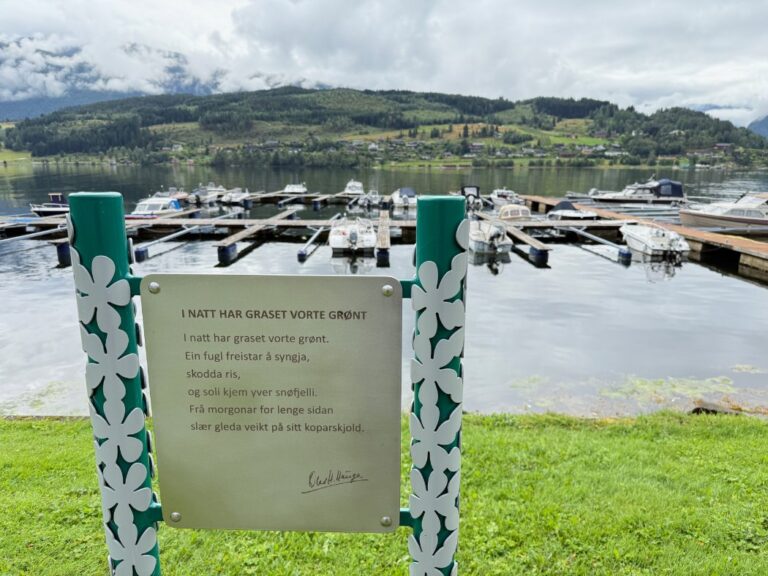
Language was no longer just a means of communication. It became a symbol of cultural independence.
Art, Rural Life, and the Idealised Past
Visual art played a crucial role in shaping national romantic imagery.
Painters such as Adolph Tidemand and Hans Gude collaborated to create scenes of rural life set against dramatic landscapes. Their works depicted weddings, festivals, and everyday moments in a Norway that felt timeless and rooted.
These images helped define what “Norwegian” looked like.
Peasant clothing, traditional customs, and rural interiors were elevated as symbols of authenticity. The countryside became the moral centre of the nation, even as urbanisation slowly gathered pace.
This was not documentary realism. Poverty, hardship, and social inequality were often softened or omitted. National romanticism presented an idealised vision of rural Norway, one that served cultural and political purposes.
It offered a shared image of the nation at a moment when unity mattered more than accuracy.
Who Was Left Out
National romanticism was powerful, but it was not inclusive. Urban life played a limited role in the national story, despite growing towns and emerging industries.
More significantly, the movement largely marginalised the Sámi people, whose cultures, languages, and histories did not fit neatly into the romanticised vision of a homogeneous Norwegian nation.
When Sámi culture appeared in national romantic contexts, it was often exoticised rather than integrated. This exclusion reflected broader patterns of state expansion and cultural hierarchy that continued into the 20th century.
Recognising these omissions does not diminish the importance of national romanticism. It clarifies its function. The movement was less about describing Norway as it was, and more about defining Norway as its emerging elites wanted it to be.
The Long Shadow of National Romanticism
By the end of the 19th century, national romanticism had achieved much of what it set out to do.
Norway possessed a recognisable cultural identity grounded in landscape, language, and tradition. When full independence came in 1905, it arrived in a country that already understood itself as a nation, even if political sovereignty had long lagged behind cultural confidence.
The legacy of national romanticism did not end there. Its ideas continue to shape how Norwegians talk about nature, rural life, and authenticity. They influence debates about development, environmental protection, and cultural belonging.
National romanticism taught Norwegians how to see themselves. It offered coherence where history had provided fragmentation, and meaning where political power had long been absent. In doing so, it helped create modern Norway.