
Norway’s long-debated Stad Ship Tunnel is set to go ahead after all, following a dramatic reversal in the country’s revised national budget negotiations.
The project, planned through the narrowest part of the Stad peninsula in western Norway, has been discussed for decades.
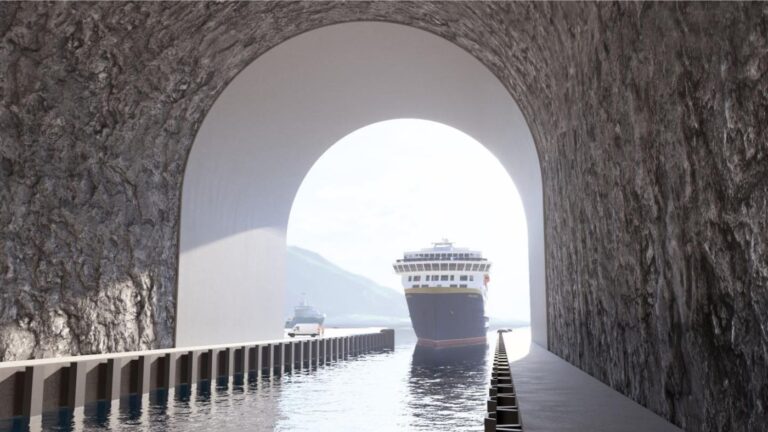
If completed, it would become the world’s first full-scale ship tunnel, allowing vessels to avoid one of the most exposed stretches of sea along the Norwegian coast.
But in recent months, the project has become a symbol of Norway’s complicated relationship with major infrastructure spending. Costs have risen sharply, political support has shifted, and the tunnel has repeatedly moved from likely to doomed and back again.
Now, following budget negotiations between the red-green parties in the Norwegian parliament, the Stad Ship Tunnel is once again on the table.
Stad Ship Tunnel To Be Built
Senterpartiet’s Bjørn Arild Gram announced the news during the presentation of the revised national budget agreement, describing it as part of a wider boost for the construction and civil engineering sector.
“To coastal Norway: Stad Ship Tunnel will be built,” he said.
The agreement gives the tunnel a total cost framework of NOK 8.6 billion, along with a start-up allocation of NOK 150 million.
That does not mean construction will begin tomorrow, but it does mean the project has survived the latest attempt to stop it. The money is intended to keep the project moving forward, including through the tender and contract process.
For supporters of the tunnel, especially in coastal communities in western Norway, the announcement will come as a major relief. For critics, it will raise familiar questions about cost, priorities, environmental impact and whether Norway should be committing billions to one highly unusual transport project.
A Tunnel For Ships
The Stad Ship Tunnel is planned through Stadlandet in Vestland county, between Moldefjorden and Vanylvsfjorden.
The idea is simple, even if the engineering is anything but. Instead of forcing ships to round Stad, a peninsula known for dangerous weather and wave conditions, the tunnel would provide a protected passage through the land.

Kystverket, the Norwegian Coastal Administration, says the tunnel would be 1.7 kilometres long, or 2.2 kilometres including entrance areas. It would be 50 metres high and 36 metres wide, large enough for vessels up to the size of the coastal route ships operated by Hurtigruten and Havila Kystruten.
Stadhavet, the stretch of sea outside Stad, is notorious among seafarers. The area is exposed to wind, currents and waves from several directions, making conditions unpredictable and sometimes dangerous.
That is the central argument for the project. Supporters say the tunnel would improve safety, reliability and regularity for coastal shipping, fishing vessels, aquaculture, passenger traffic and other maritime industries.
A Political U-Turn
The latest decision is striking because it comes only weeks after the government appeared to have killed the project again.
In May, Prime Minister Jonas Gahr Støre and Finance Minister Jens Stoltenberg said there was no money set aside for the Stad Ship Tunnel in the government’s proposal for the revised national budget.
The government argued that stopping the project would free up funds and reflect a broader shift away from starting large new transport projects in favour of maintenance and upkeep. The problem was cost.
The tunnel’s estimated price had risen far beyond the level previously approved by parliament. Kystverket’s updated estimate put the cost framework at NOK 8.6 billion. Although that was lower than earlier estimates of around NOK 9.6 billion, it was still more than NOK 3 billion above the framework previously approved by the Storting.
That made the project politically vulnerable. At a time when many transport budgets are under pressure, and when Norway faces competing demands for road, rail, defence, welfare and climate spending, the Stad Ship Tunnel became an easy target.
But the revised budget was not decided by the Labour government alone. Negotiations with other parties changed the outcome.
Arbeiderpartiet’s Tuva Moflag explained the reversal by pointing to the nature of budget negotiations. The government had negotiated with parties for whom the tunnel was an important issue, she said, and in such negotiations there is give and take.
In other words, Stad survived because other parties fought for it.
A Long And Uncertain Story
Few Norwegian infrastructure projects have had quite such a stop-start journey.
The Stad Ship Tunnel has been studied, debated and promoted for years. It has attracted international attention because of its unusual scale and concept. Promotional images of large ships sailing through a mountain have helped turn it into one of Norway’s most eye-catching proposed engineering projects.
At the same time, the project has long divided opinion.
For local and regional supporters, the tunnel is about safety, coastal industry and securing better maritime transport along a difficult stretch of the Norwegian coast. It is also seen as a potential boost for tourism and regional development.
For opponents, the project is an expensive prestige scheme with uncertain benefits. Some question whether the safety and efficiency gains justify the cost. Others argue that Norway has more urgent transport needs, especially when many county roads, bridges and tunnels require maintenance.
The latest budget agreement does not end those arguments. In fact, it may intensify them.
What Happens Next?
The inclusion of Stad Ship Tunnel in the revised national budget gives the project renewed political backing and an initial allocation of funds. However, major practical and financial steps remain before ships can actually sail through Stadlandet.
The project still needs to pass through the next stages of procurement and contract work. The full funding will also need to be handled through future budget processes.
That means the tunnel is not yet a finished deal in the everyday sense. But politically, the message from the latest agreement is clear: after yet another reversal, Norway’s ship tunnel is alive again.
Whether it becomes one of Norway’s most remarkable engineering achievements or one of its most controversial spending decisions remains to be seen. For now, the Stad Ship Tunnel has once again proved remarkably hard to sink.