
Researchers have found unexpectedly high levels of environmental pollutants in trout from Lake Gjende. Melting glaciers may be releasing pollution stored in the ice decades ago.
Lake Gjende is famous for its striking turquoise colour and its location beneath Besseggen, one of Norway’s most popular mountain hikes.
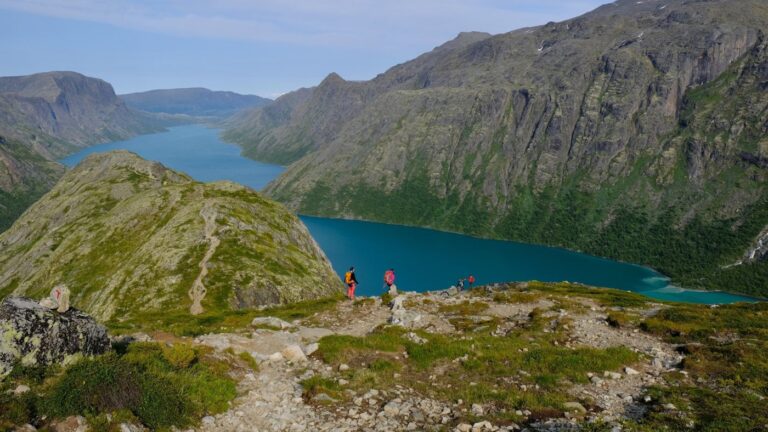
Yet researchers have discovered that the apparently pristine lake contains more pollution than expected. Norway's glaciers may be partly responsible.
Tests on trout from Gjende found unusually high concentrations of environmental contaminants compared with fish from other Norwegian mountain lakes. These included mercury and PCB compounds, which break down extremely slowly and can accumulate in animals and people.
Jan Ludvig Lyche, a researcher at the Norwegian University of Life Sciences (NMBU), told NRK that the concentrations were higher than researchers would normally expect in a remote mountain environment.
The findings were included in the latest annual study of pollutants in Norwegian lakes, published by the Norwegian Environment Agency in December 2025.
Pollution in Remote Mountain Lakes
Lakes close to towns and industrial areas generally contain more pollutants than lakes in remote parts of Norway.
Some pollution still reaches isolated areas through the atmosphere. However, the findings from Gjende and several other high-altitude lakes were considered surprising because they are far from major settlements and known sources of pollution.
Higher levels were also recorded in Storevatnet in Lom, Bygdin and Hornsvatnet.
All of these lakes receive meltwater from glaciers. Researchers believe this could offer a possible explanation. Pollutants transported through the air in previous decades may have been deposited on snow and glaciers, where they remained trapped in the ice.
As Norway’s glaciers shrink, those historical pollutants could be released into rivers and lakes.
Lyche stressed that the Environment Agency study did not directly investigate the connection between glacier melt and the results. However, international studies have previously found pollutants in water flowing from glaciers.
Old Chemicals Remain in the Environment
One of the substances detected in unexpectedly high concentrations was PCB7, a group of PCB compounds.
PCBs were once widely used in products including paints and electrical equipment. Their use was banned in Norway in the late 1970s, but the chemicals remain present throughout the environment.
They degrade very slowly and can build up in living organisms over time.
Researchers also found more mercury in the Gjende trout than expected. Mercury does not break down naturally and can become concentrated in fish.
The Norwegian Food Safety Authority generally advises people not to eat freshwater trout weighing more than one kilogram. Its main recommendation is to eat a varied diet so that one type of food does not become the source of excessive exposure to pollutants.
No Immediate Health Warning
The results do not mean that eating fish from Gjende presents an immediate health risk.
According to Lyche, the measured levels were not high enough to suggest major health effects or a serious food safety problem, especially as most people eat relatively little locally caught trout.
Nevertheless, researchers view the findings as an important warning. If glacier melting continues to accelerate, more of the pollutants stored in the ice could be released. That could lead to increasing contamination in some of Norway’s mountain lakes in the years ahead.