
Channel 4 will air a new three-part television series following Lorraine Kelly on a journey along Norway’s coast aboard Hurtigruten ships.
Titled ‘Lorraine Kelly’s Norwegian Odyssey', the series begins on Thursday 15 January and is produced by Captive Minds as a branded documentary in partnership with Hurtigruten.
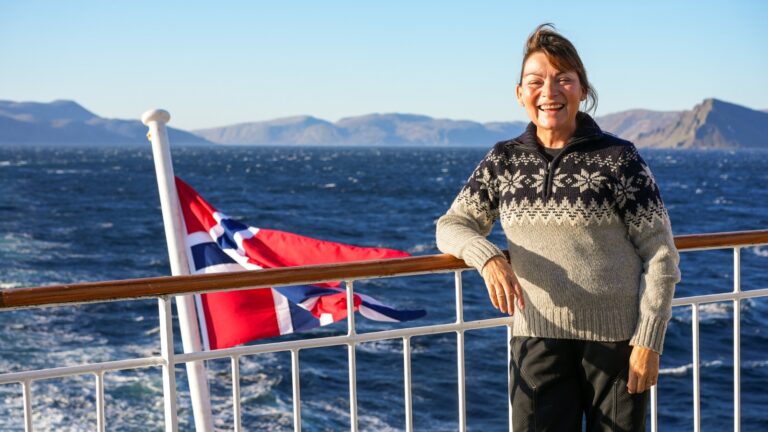
While presented in the style of a traditional travel documentary, the programme forms part of Channel 4’s growing slate of commercially funded factual content, where brands underwrite production in return for editorial integration.
Over three episodes, Kelly travels north along the coastline on different Hurtigruten ships, calling at selected ports along the way.
The series focuses on landscapes, wildlife, local food traditions and cultural history, with a particular emphasis on Norway’s Norse past and its historical links to Scotland. The final episode centres on a winter sailing in search of the Northern Lights.
“This is a deeply personal journey for me, having grown up fascinated by Viking legends and stories,” said Kelly in a press release. “Norway’s history is so closely entwined with Scotland’s that it felt like stepping into those very stories.”
“Boarding Hurtigruten’s ships and spending time with their knowledgeable Norwegian crew, who truly live and breathe this dramatic coastline, really brought Norway’s deep-rooted heritage to life. I loved discovering how the country’s mythical past continues to echo through this wild and spectacular land.”
What Is Norway’s Coastal Route?
Although Hurtigruten operates the ships featured in the series, the journey itself follows Norway’s famous coastal route rather than a conventional cruise itinerary.
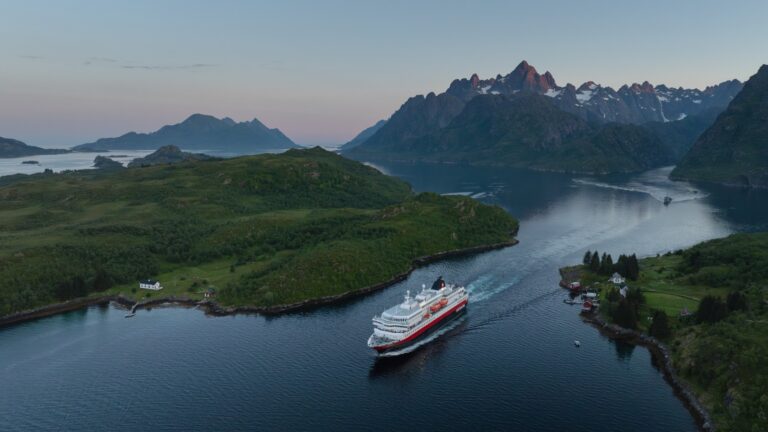
Norway’s coastal route is a long-established transport corridor linking dozens of small towns and cities along the country’s exposed western and northern seaboard.
Daily sailings connect communities that were historically difficult to reach by road, particularly before the development of modern tunnels and bridges.
The route was established in 1893 as a government-supported coastal service designed to move passengers, mail and cargo reliably year-round.
Multiple shipping companies operate or have operated sailings over the decades, with today’s routes continuing to serve a practical transport function alongside tourism.
Modern vessels still follow the same basic pattern: southbound and northbound sailings between Bergen and Kirkenes, stopping at up to 34 ports in total. While some passengers travel the full length of the route, many locals use it for short hops between neighbouring towns, especially in the north.
What to Expect in the Series
While Channel 4 has not released a detailed episode itinerary, filming details reveal a route that goes beyond simple port calls and leans into experiences tied closely to place, season and local culture along the Norwegian coastline.
The journey begins in western Norway, where Kelly is filmed sailing deep into the fjords aboard Hurtigruten’s MS Richard With. These narrower fjord passages, often inaccessible to larger cruise ships, are a defining feature of coastal route sailings and offer a slower, more intimate view of Norway’s landscape.
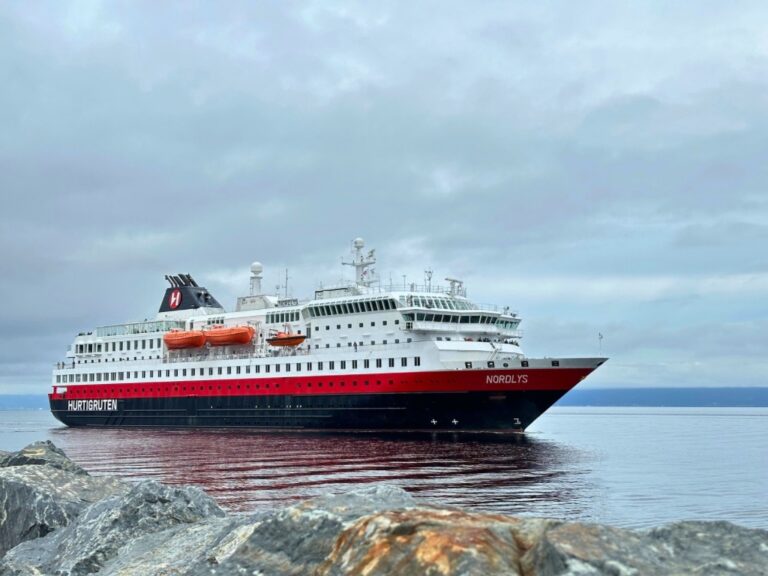
In Trondheim, the series shifts focus from scenery to activity. Kelly is shown kayaking on the river and fjord before exploring the city’s fine dining scene.
Further north, filming moves to Lofoten, where Kelly takes part in seaweed harvesting alongside female entrepreneurs working at the intersection of sustainability, food production and coastal livelihoods.
In neighbouring Vesterålen, the programme turns to Indigenous culture. Kelly meets a Sámi reindeer herder and shares food and stories around a fire, offering viewers a rare mainstream-TV introduction to Sámi traditions, identity and everyday life in northern Norway.
The final leg of the journey takes place at sea under Arctic skies. Kelly is filmed sailing aboard MS Kong Harald, chasing the Northern Lights during a winter crossing. These overnight sailings, far from artificial light, are a key reason many travellers choose winter coastal voyages.
One of the northernmost stops includes a visit to the world’s northernmost whisky distillery, where Kelly samples Arctic-produced whisky, underscoring how unexpected industries are taking root in the far north.
Together, these locations and experiences paint a picture of the coastal route not just as a journey between ports, but as a thread connecting food culture, Indigenous heritage, modern entrepreneurship and Norway’s extreme seasonal contrasts.
Branded Travel TV on the Rise
Lorraine Kelly’s Norwegian Odyssey follows a familiar format for UK audiences. In recent years, Norway’s coast has been featured in similar presenter-led series fronted by household names, combining gentle travelogue storytelling with personal reflection.
What has changed is the funding model. Rather than being commissioned entirely by broadcasters, programmes like this are increasingly developed as branded entertainment, where destinations, cruise operators or tourism bodies play a direct role in production and promotion.
Alongside the broadcast, Hurtigruten is running UK travel-agent incentives linked to the airing of the series, reinforcing the programme’s commercial purpose even as it presents itself as a cultural and scenic journey.
For viewers, however, the appeal remains straightforward: a familiar face, slow travel, dramatic landscapes and a rare look at everyday life along one of Europe’s most distinctive coastlines. The series airs weekly on Channel 4 from 15 January.


We have been watching this series which shows spectacular landscapes, interviews with Norwegian living and working in that area. It would be far more enjoyable if we saw a lot less of Lorraine Kelly. After a while I found her very irritating with a high pitch laugh/giggling and some silly comments. You are right that that kind of program is closer to a travel promotion than a documentary. We love Norway and have Norwegian family links so it is always nice to see more of the country.
I do enjoy your articles which are very varied. Thanks