

Impress your family and friends with these fun facts about polar bears, a threatened species in the world’s northern region.
One of the world’s most iconic creatures, the awe-inspiring polar bear roams the frozen landscapes of the Arctic. Often seen as the ultimate symbol of the far north, these powerful animals have adapted to one of the harshest environments on Earth.
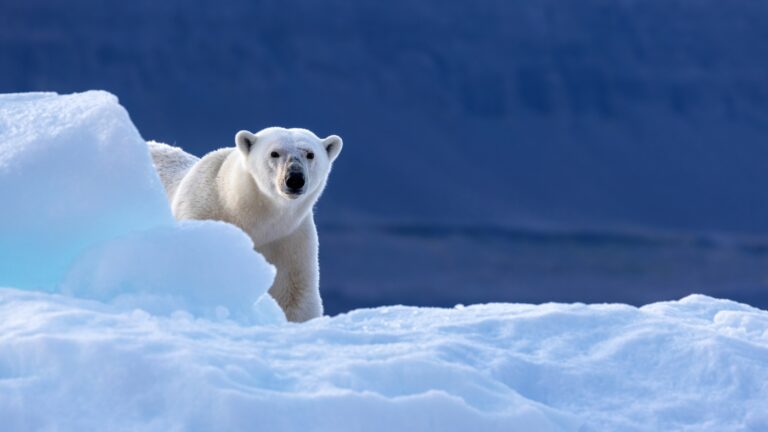
But how much do you really know about the true “King of the North”?
Top Polar Bear Facts
Polar bears share many characteristics with other bear species, but they also possess several unique adaptations that set them apart.
Their long, narrow head, relatively small compared to their massive body, helps them move efficiently through water. Their short, strong claws and large paws provide grip on ice and power in the sea.
Here in Norway, polar bears are found only on the Svalbard archipelago, primarily in areas where sea ice forms for much of the year. The highest densities are typically found along the eastern coast and in the remote northern fjords, where ice conditions are most stable.
These majestic animals are under serious threat from climate change. As their environment changes at an unprecedented rate, their survival is increasingly uncertain.
To celebrate these remarkable creatures and raise awareness of their plight, here are 21 fascinating facts about polar bears.
Population and Geography
Polar bears may roam a vast wilderness, but their numbers, distribution, and future are closely studied.
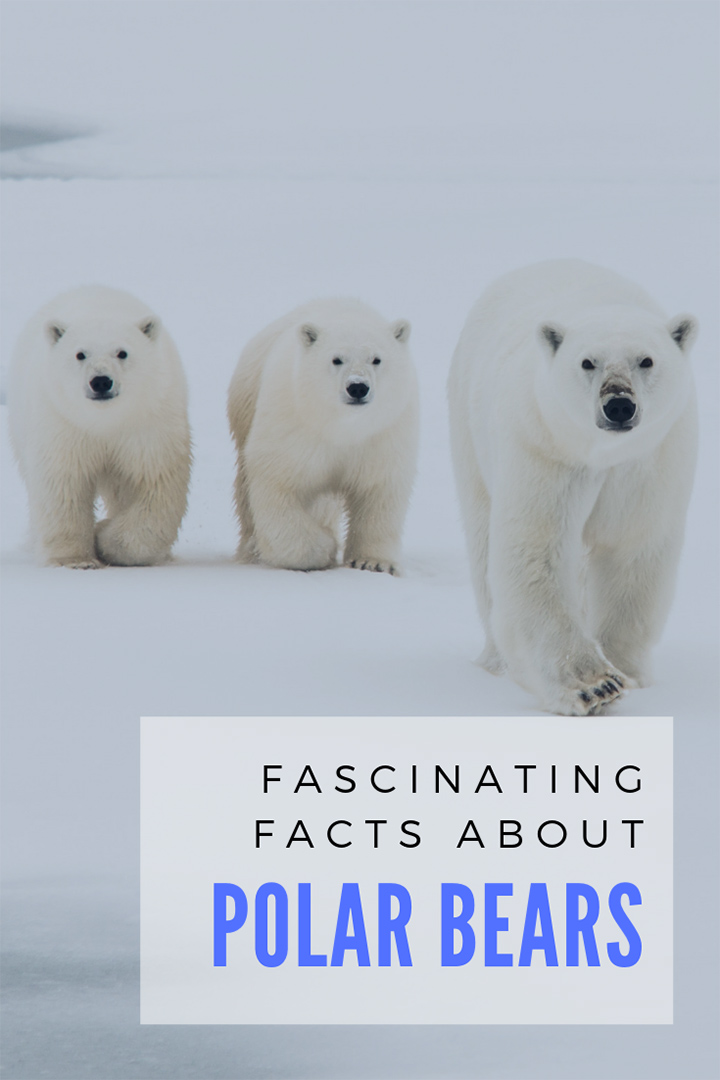
1. Climate change is threatening their habitat
Polar bears rely heavily on sea ice as a platform for hunting seals, their primary food source.
As Arctic temperatures rise, sea ice is forming later in the year and breaking up earlier in spring. This shortens the hunting season and forces bears to spend more time on land, where food is scarce.
One of the most significant shifts occurred in 2006, when a sharp decline in sea ice altered coastal conditions in parts of Svalbard. Since then, scientists have observed changes in bear behaviour, body condition, and reproductive success.
2. There are approximately 30,000 polar bears
The global population is estimated at around 26,000 to 31,000 individuals, but this figure is far from precise. The vast and remote nature of the Arctic makes accurate counting extremely difficult, and some subpopulations are better studied than others.
As a result, scientists rely on modelling, satellite tracking, and regional surveys to build a global picture.
3. They live in up to 19 subpopulations
Rather than one continuous population, polar bears are divided into 19 recognised subpopulations across the Arctic. These groups are shaped by sea ice patterns, geography, and migration routes.
One of the most important populations for Norway is the Barents Sea group, which includes Svalbard. A widely cited study estimated that between 1,900 and 3,600 bears live in this region, with many females denning on Svalbard itself.
4. Polar bears roam across five countries
Polar bears inhabit territory spanning five nations: Norway (Svalbard), Russia, the United States (Alaska), Canada, and Greenland (Denmark). Despite political borders, the bears move freely across sea ice.
These countries cooperate through international agreements to manage and protect the species, including the 1973 Agreement on the Conservation of Polar Bears.
5. A 30% population decline is expected by 2050
Many scientific models suggest that polar bear populations could decline by around 30% by mid-century if current warming trends continue. The greatest concern is for pregnant females, who depend on fat reserves built up during the hunting season.
If sea ice loss continues to limit access to food, fewer cubs may be born, and survival rates could fall. Some scientists warn the decline could be even more severe in certain regions.
6. Hunting began to be regulated in the 1950s
For centuries, polar bears were hunted by Indigenous Arctic communities for food, clothing, and tools, forming an important part of traditional ways of life. However, during the early 20th century, increased commercial hunting and trophy hunting by outsiders led to sharp population declines in several regions.
By the mid-20th century, concerns about the species’ survival began to grow. This prompted a wave of protective measures: the Soviet Union banned all hunting of polar bears in 1956, Canada introduced quotas in 1968, and Norway gradually implemented strict protections between 1965 and 1973, ultimately banning hunting entirely in Svalbard.
These efforts culminated in the 1973 international agreement between Arctic nations to protect polar bears and their habitat. Today, hunting is tightly controlled or banned in most regions, although limited subsistence hunting by Indigenous communities continues in parts of Canada and Greenland under strict regulation.
7. Bears are a real risk for residents of Longyearbyen
In Svalbard, polar bears are not just a symbol of the wild. They are a genuine and ever-present danger.
Sightings near Longyearbyen, the archipelago’s main settlement, are reported every year, particularly during winter and spring when sea ice can bring bears closer to inhabited areas.
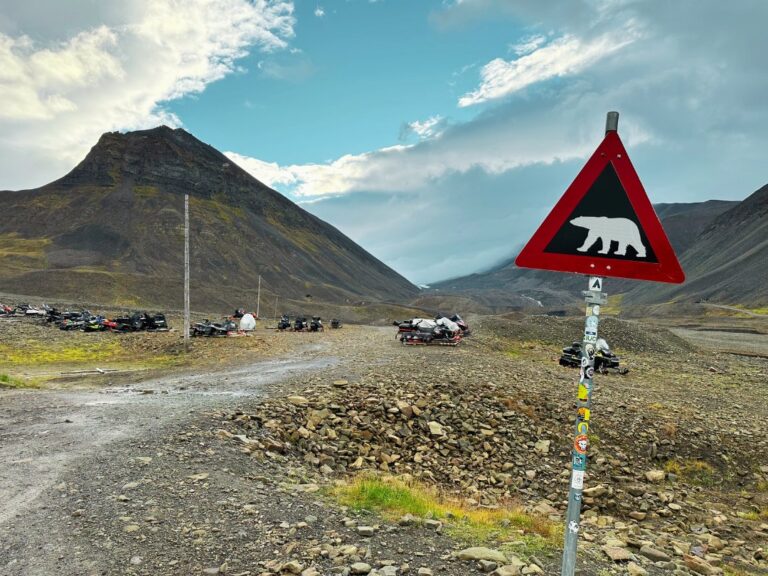
In some years, bears have wandered close to roads, cabins, and even the airport, prompting temporary closures and emergency responses. While encounters are rare, they do happen, and every incident is taken extremely seriously by local authorities.
For this reason, anyone leaving the settlement is legally required to carry a firearm for protection. Visitors are strongly advised to travel with experienced guides who know how to avoid encounters.
Polar Bears Themselves
The bears themselves From their skin to their size, polar bears are built for survival in one of Earth’s harshest environments.
8. Polar bears are actually black
Despite their white appearance, polar bears have translucent, hollow fur that reflects visible light, giving them their iconic snowy colour. This natural camouflage helps them blend into the Arctic landscape, making it easier to approach prey undetected.
Beneath this insulating layer, their skin is jet black, an adaptation that helps absorb and retain heat from the sun. Combined with a thick layer of body fat, this keeps them warm even in extreme sub-zero temperatures.
This combination of camouflage and thermal efficiency is key to surviving Arctic conditions, allowing polar bears to conserve energy while hunting and travelling across ice and open water.
9. DNA can be extracted from their footprints
Scientists can now extract DNA from something as simple as a polar bear’s footprint in the snow. This technique, developed by organisations including WWF, allows researchers to study populations without disturbing the animals.
Remarkably, snow samples can also reveal DNA from prey, such as seals, providing insight into recent feeding behaviour.
10. Male bears weigh up to 800 kg
Adult male polar bears typically weigh between 500 and 700 kilograms, although the largest individuals can exceed 800 kg. Their size varies depending on age, health, and access to food, with bears in areas of stable sea ice often growing larger than those in regions where hunting is more difficult.
This immense size makes them the largest land carnivores on Earth. Standing on their hind legs, a fully grown male can reach over three metres tall, an imposing sight even at a distance.
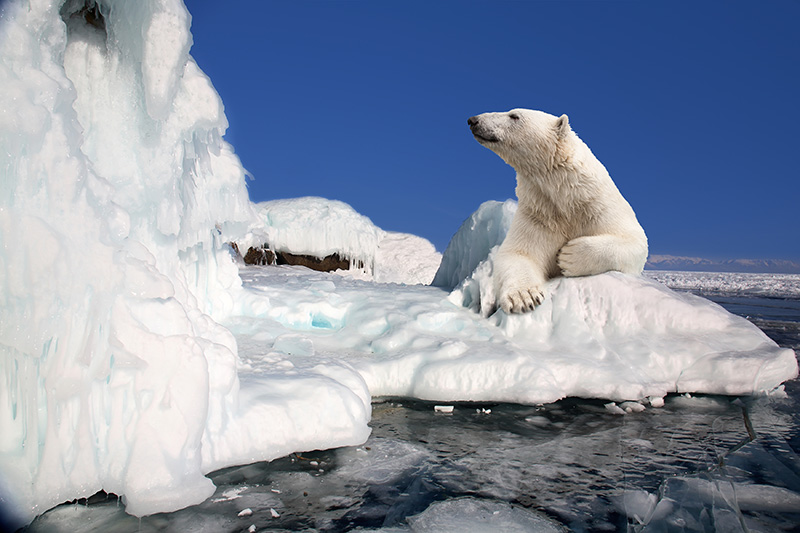
Their closest rival is the Kodiak bear, a subspecies of brown bear found in Alaska, although polar bears are generally considered slightly larger on average.
11. They are classified as marine mammals
Although they look like land animals, polar bears are officially classified as marine mammals because they spend most of their lives on sea ice and depend on the ocean for food.
They are the only bear species with this classification, reflecting just how specialised their lifestyle is.
12. Their preferred diet is the ringed seal
Ringed seals are the polar bear’s primary prey. Bears hunt them by waiting patiently at breathing holes in the ice or ambushing them as they haul out.
When food is scarce, polar bears will eat almost anything, including bird eggs, small mammals, vegetation, and carrion. However, these sources do not provide the high-fat diet they need to thrive.
13. Males grow to twice the size of females
Polar bears display strong sexual dimorphism. Adult males can be twice the weight of females and significantly longer, reaching up to three metres in length.
Females, while smaller, are equally well adapted to survival, particularly when raising cubs in challenging conditions.
More Fun Polar Bear Facts
Beyond the basics, these lesser-known details reveal just how remarkable polar bears really are.
14. Grizzly-polar hybrids exist
Hybrid bears, often nicknamed “grolar” or “pizzly” bears, have been confirmed through genetic testing. These rare animals result from mating between polar bears and grizzly bears, two species that historically had very little overlap in habitat.
The hybrids tend to show a mix of characteristics, such as the long neck of a polar bear combined with the hump and facial features of a grizzly. Behaviour can vary too, although many documented cases suggest they behave more like polar bears, likely because they are often born to polar bear mothers.
As climate change alters Arctic environments, grizzly bears are expanding their range further north, increasing the chances of overlap. As a result, these unusual encounters may become more common in parts of northern Canada and Alaska in the years ahead.
15. They have an outstanding sense of smell
A polar bear’s sense of smell is extraordinary. They can detect a seal nearly a kilometre away and even locate prey beneath thick layers of snow and ice.
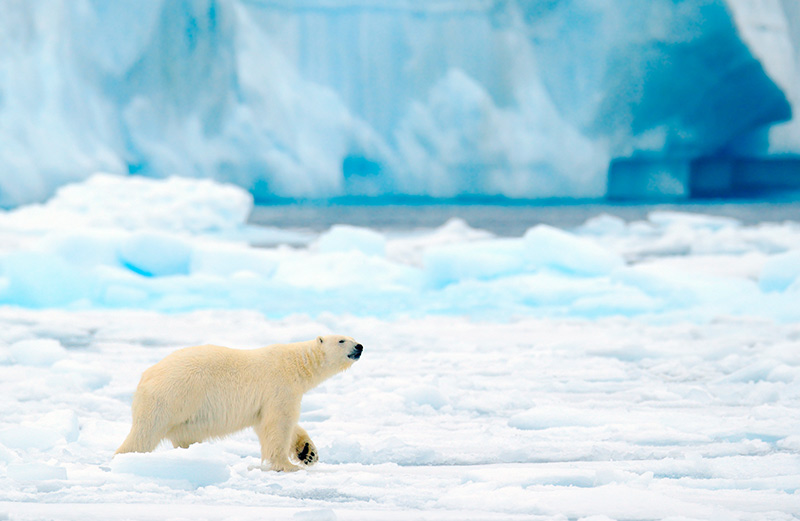
This ability is crucial for survival in an environment where food can be scarce and widely dispersed.
16. Polar bears have 42 sharp teeth
Their powerful jaws and 42 sharp teeth are perfectly adapted for a carnivorous diet. Incisors strip meat from bone, canines tear through thick skin and blubber, and molars help crush tougher material when needed.
Unlike many other mammals, polar bears are highly specialised hunters, feeding primarily on fat-rich prey such as seals. This means they are often more interested in the blubber than the meat itself, sometimes leaving behind large portions of a carcass once their energy needs are met.
Despite their formidable dental toolkit, polar bears often swallow large chunks of food rather than chewing thoroughly, especially when feeding quickly in competitive or exposed conditions.
17. Despite their size, polar bears have small tails
A polar bear’s tail measures just 7 to 12 centimetres, surprisingly small for such a massive animal. This compact size is not accidental but an important adaptation to life in extreme cold.
By reducing exposed body parts, polar bears minimise heat loss, helping them conserve energy in freezing Arctic temperatures. The same principle applies to their small ears and overall streamlined shape.
18. They can swim for hours
Polar bears are excellent swimmers, capable of covering vast distances in open water. They typically swim at speeds of around 10 km/h (6 mph) and can maintain this pace for hours.
Their large front paws act like paddles, while their hind legs function as rudders. Long-distance swims between ice floes are increasingly common as sea ice becomes more fragmented.
Polar Bears as Icons
Far beyond the Arctic, polar bears have become powerful symbols in culture, sport, and identity.
19. The polar bear features on Greenland’s coat of arms
The polar bear has long been a symbol of Arctic strength and resilience. It has appeared in Danish heraldry since 1666 and remains central to Greenland’s coat of arms.
The modern design, created by a Greenlandic artist in 1989, shows a white bear standing upright on a blue shield.
20. It is the mascot of multiple sports teams
Polar bears have inspired sports teams around the world. Examples include the German ice hockey club Eisbären Berlin and North America’s Charlotte Checkers.
They were also featured as mascots at the 1988 Winter Olympics in Calgary, highlighting their association with winter sports and northern identity.
21. It is the mascot of Hammerfest in Norway
Despite lying far south of polar bear territory, the town of Hammerfest proudly uses the polar bear as its symbol. The animal appears on the town’s coat of arms and in statues around the centre.
Visitors are often invited to join the Royal and Ancient Polar Bear Society. Despite the grand name, it is neither royal nor particularly ancient—but it remains a fun and memorable local tradition.


Hi David, I research a new topic to link to my future project every day I work..I learn’t much today about polar bears and their survival thanks to your facts and the wonderful documentary that I watched this morning. I have such a love of animals..how beautiful they are swimming under the water..but how sad we have lost so many over the recent years because of the climatic changes and their fierce struggle for survival…