

Just north of Oslo stands one of the most important buildings in Norwegian history. Eidsvoll Manor House is where the constitution that laid the foundations of modern Norway was created in the dramatic spring of 1814.
For all the historic places I've visited around Norway, it took me surprisingly long to make it to Eidsvoll. Yet few places played such a direct role in creating the Norway we know today.
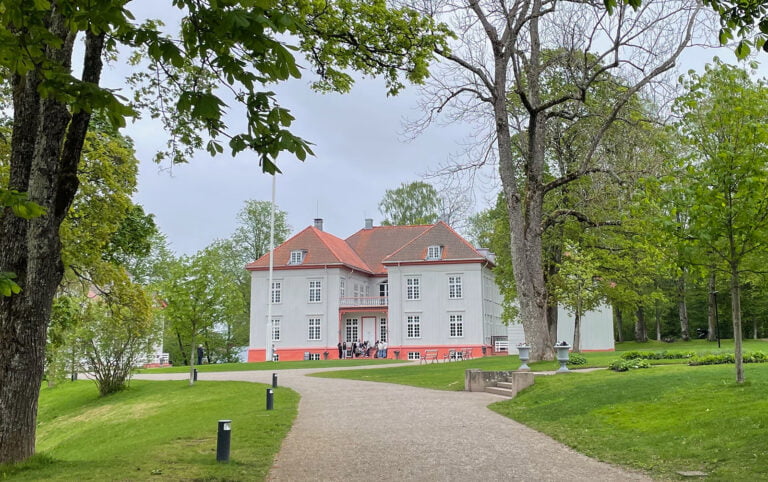
Eidsvoll Manor House, known in Norwegian as Eidsvollsbygningen, was the setting for six extraordinary weeks in the spring of 1814. Here, 112 representatives gathered to decide the future of Norway, write a constitution and elect a king.
Their work produced the Constitution of 17 May 1814, which remains the foundation of Norway's system of government today. In fact, it is the second-oldest written constitution in the world still in existence.
Today, the historic house and neighbouring visitor centre form the Eidsvoll 1814 museum, making this an intriguing day trip for anyone interested in Norwegian history.
Why 1814 changed Norway
Norway had been politically united with Denmark for centuries, but the Napoleonic Wars changed everything.
Under the Treaty of Kiel in January 1814, the Danish king agreed to surrender Norway to Sweden. Norwegians were not consulted.
That triggered a remarkable political response. Denmark's prince and representative in Norway, Christian Frederik, backed the idea that Norway should determine its own future. Elections were organised and representatives summoned to Eidsvoll.
Suddenly, this quiet place north of Oslo became the centre of Norwegian politics.
The six weeks at Eidsvoll
On 10 April 1814, 112 representatives gathered at Eidsvoll to decide Norway's future. Over six intense weeks, they debated independence, drafted a constitution and argued over what kind of country Norway should become.
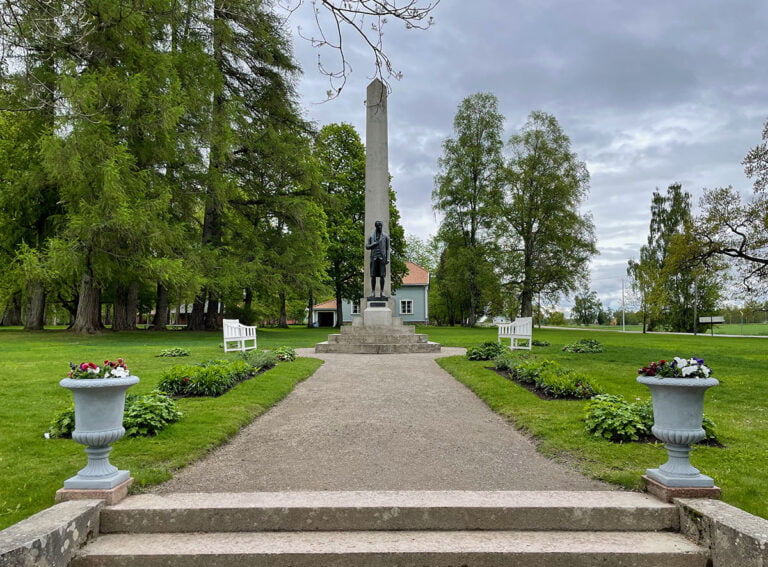
The constitution drew on Enlightenment ideas and earlier constitutional models, including those of the United States and France. It was progressive for its time, although far from democratic by modern standards.
The main work was completed on 16 May. The constitution was dated 17 May 1814, and Christian Frederik was elected king. That date remains Norway's national day.
Independence didn't last long
Norway's new independence was short-lived. Sweden rejected the Norwegian break with the Treaty of Kiel and invaded that summer. After a brief war, the two sides reached a compromise.
Norway entered a union with Sweden, but crucially retained its constitution and a considerable degree of self-government. The union lasted until 1905, while the constitution created at Eidsvoll endured.
That is what makes the manor house so significant today: the political experiment launched here in 1814 became the foundation of modern Norway.
From private home to national monument
There's something rather surprising about seeing Eidsvoll Manor House for the first time. For somewhere so important to Norwegian history, it doesn't look like a grand parliament building. That's because it wasn't one.
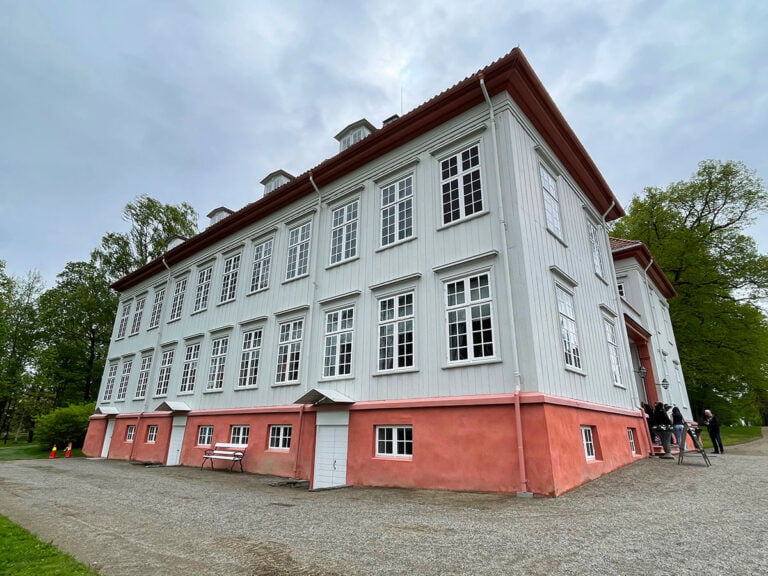
In 1814, this was the home of businessman Carsten Anker, the owner of Eidsvoll Ironworks and a close adviser to Christian Frederik. Anker had owned the estate since 1794.
The large neoclassical house became the temporary home of the constituent assembly simply because it offered the space required for such an unusual gathering.
Eventually, the property became an important national monument. The Norwegian state took ownership of the house in 1851, following a fundraising campaign to preserve it for the nation.
Inside Eidsvoll Manor House
You can't simply wander into Eidsvoll Manor House by yourself. Visits are made as part of a guided tour, and that's definitely the right way to experience it.
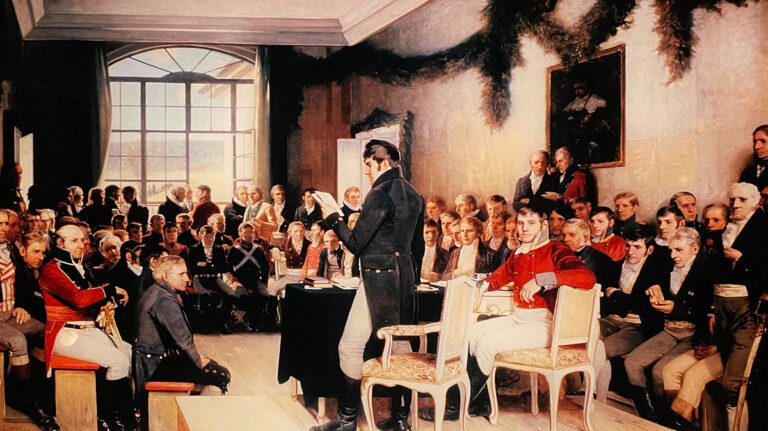
The highlight is Rikssalen, the large upstairs room in which the constituent assembly met.
It's a surprisingly intimate space considering the importance of what happened here. Sitting on the simple benches while a guide explains the arguments, alliances and enormous time pressure facing the representatives makes the events of 1814 feel much more tangible.
But don't make the mistake of thinking the rest of the house is merely a route to Rikssalen.
The tour gives you a much broader impression of life at Eidsvoll Verk in the early 19th century. There are formal reception rooms, private chambers and servants' areas, along with the kitchen and other reconstructed rooms in the basement.
The interiors deserve particular attention. Over the decades, many of Carsten Anker's original colours, wallpapers and furnishings were lost during various renovations.
Ahead of the bicentenary of the constitution in 2014, a major restoration project attempted to recreate the house as it appeared in 1814, using reconstructed wallpapers, textiles, colours and furnishings.
That makes the building interesting even if you're more interested in architecture and historic interiors than constitutional law.
One important thing to know: the original Constitution isn't kept here. The fragile document is preserved in the archives of the Norwegian parliament, the Storting, in Oslo.
Democracy at Wergeland House
Next door to the historic manor is the much more modern Wergeland House, which contains the museum's visitor centre and exhibitions.
Rather than simply retelling the events of 1814, the exhibitions place the Norwegian constitution within the much bigger story of democracy.
That includes the Enlightenment ideas that influenced the men at Eidsvoll, earlier constitutional developments in other countries, and the gradual expansion of political rights in Norway afterwards.
This is an important counterpoint to the historic house. The constitution of 1814 was groundbreaking, but Norway didn't suddenly become the inclusive democracy we know today. Political participation was limited, women could not vote, and some groups were explicitly excluded.
Visiting Eidsvoll 1814
Eidsvoll 1814 is at Eidsvoll Verk, about 60km north of Oslo and 21km north of Oslo Airport. It's important not to confuse Eidsvoll Verk with Eidsvoll itself when planning your journey.
For visitors without a car, the train makes this one of the easier historic day trips from Oslo.
Trains from Oslo S reach Eidsvoll Verk in around half an hour. From the station, it's approximately 1.8km to the museum, which takes around 15–20 minutes on foot.
Alternatively, Ruter bus 430 connects Eidsvoll Verk station with the museum area in just a few minutes. If you're driving, free parking is available at the museum.

Allow two to three hours for a comfortable visit. The guided manor-house tour itself takes around 45 minutes, while you'll also want time for the exhibitions in Wergeland House and perhaps a walk around the park and along the Andelva river. There's also an on-site cafe.
Because places on the manor-house tours are limited, booking a time in advance is now recommended.
Tours are normally conducted in Norwegian, although the museum states they can be adapted into English when needed. If an English-language experience is important to you, it's worth confirming this when booking rather than simply turning up and hoping for the best.
Is Eidsvoll 1814 worth visiting?
If you're interested in Norwegian history, absolutely.
There are places in Norway with much older stories, from Viking burial grounds to medieval churches and fortresses. But few have such a clear connection to the country that Norway eventually became.
The decisions made inside this relatively modest manor house in the spring of 1814 didn't deliver complete independence overnight.
What they did was arguably more important. They gave Norway a constitution, political institutions of its own, and a framework that survived union with Sweden and ultimately carried forward into an independent Norway.
More than 200 years later, that's quite a story to discover in what is today a quiet corner of Eidsvoll.


Looking forward to visiting. My 4th great-grandfather, Christopher Borgerson Hoen, was one of the Buskerud representatives.