
King Harald V’s funeral will bring large crowds, major transport changes and extensive security measures to central Oslo on 9 September. Here’s what you need to know if you plan to be in the Norwegian capital.
Norway will say its final farewell to King Harald V on Wednesday, 9 September, when his funeral takes place at Oslo Cathedral.
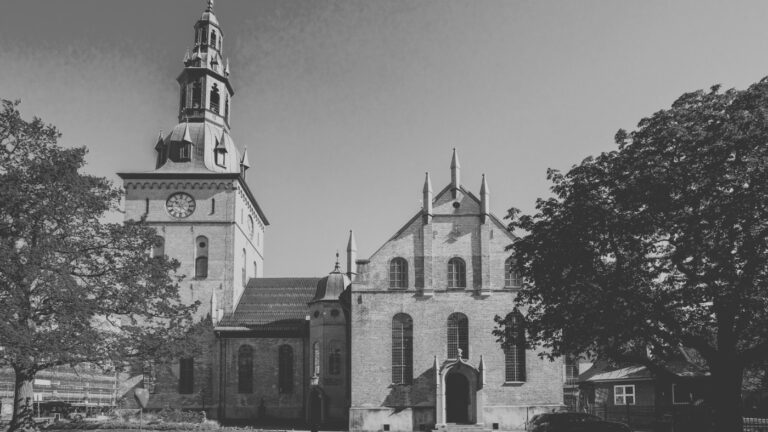
The service begins at 1pm, but the events will extend far beyond the cathedral. A ceremonial procession will carry the King’s coffin through central Oslo before the service, while a second procession will continue to Akershus Fortress afterwards.
Large crowds are expected throughout the centre, while extensive security measures and transport restrictions will affect both residents and visitors.
For anyone planning to be in Oslo that day, the most important advice is simple: allow plenty of time, expect to walk, and be prepared for a very different city centre from usual.
When is King Harald’s funeral?
The funeral service begins at 1pm on Wednesday, 9 September, at Oslo Cathedral (Oslo domkirke), close to Stortorvet in the heart of the capital.
The service will be led by Olav Fykse Tveit, presiding bishop of the Church of Norway. Oslo bishop Sunniva Gylver, cathedral organist Marcus André Berg and Oslo Cathedral Choir will also take part. The ceremony will follow the Church of Norway’s standard funeral liturgy.
Attendance inside the cathedral is by invitation. For most people in Oslo, the opportunity to participate will instead come from standing along the procession route or watching the ceremony on television or public screens.
Oslo municipality has confirmed that several large screens will be installed along the procession route, although their exact locations had not yet been announced as of 6 September.
The funeral procession through Oslo
Before the service, King Harald’s coffin will leave the Royal Palace on a military gun carriage.
The procession will travel from the Palace along Karl Johans gate, before turning left into Kirkegata and continuing to Oslo Cathedral. After the funeral service, the procession will continue to Akershus Fortress, where a private ceremony will be held at Akershus Castle Church.
The Norwegian Armed Forces will have a highly visible role throughout the day. Around 3,500 military personnel will be ceremonially involved, including approximately 1,900 soldiers lining the entire route from the Palace to the cathedral and onwards to Akershus Fortress.
A further 1,200 personnel will take part in honour guards or military bands.
Central Oslo becomes a pedestrian security zone
One of the biggest changes since the funeral was first announced concerns access to central Oslo.
Several parts of the city centre will be closed to vehicles and public transport, with preparations affecting the area from 6pm on Tuesday, 8 September, until 9pm on Wednesday, 9 September.
From 6am on the funeral day, the central area will be closed to normal road traffic. People entering the secured area around the procession route must do so on foot through checkpoints staffed by police.
Police are asking people to travel light and avoid bringing large bags or unnecessary items.
No bicycles, scooters or umbrellas
Cycling will not be permitted inside the pedestrian zone, and bicycles cannot be taken through the secured checkpoints around the procession route.
Electric scooters will be geofenced across the area from midnight at the start of Tuesday, 8 September, until 9pm on Wednesday. In practice, rental scooters will stop working as users approach the restricted area.
Perhaps more surprisingly, umbrellas are also banned inside the secured area.
Police say anyone arriving with an umbrella will not be allowed through the checkpoints, and there will be no facility to store them. If rain is forecast, bring a waterproof jacket instead.
Knives and similar objects should also be left at home. Police specifically mention work knives and knives worn as part of traditional clothing such as a bunad. Such items may be temporarily confiscated.
Expect a major police presence
The funeral will be one of the largest security operations Norway has hosted in recent years.
Police resources are being brought into Oslo from around the country, while Swedish and Danish police are also assisting Norwegian authorities. Police are working alongside the Norwegian Police Security Service, the Armed Forces, the Royal Palace and other agencies.
A significant number of foreign royals, heads of state and government representatives are expected to attend.
Norway has also temporarily reintroduced controls on its internal Schengen borders from 4 to 14 September. Police say the measure is intended to allow more targeted security checks and is expected to have little impact on ordinary travellers.
Temporary restrictions will also apply to the airspace over Oslo and surrounding areas, including drones.
Public transport will be heavily affected
Driving into central Oslo should be avoided, but public transport will not operate normally either.
Ruter recommends using the metro or train where possible, with Jernbanetorget the most useful station for anyone heading towards Oslo Cathedral. Stortinget metro station will be completely closed from 6am until 9pm.
Nationaltheatret station remains open, but the entrance from Johanne Dybwads plass will be closed. Metro trains stopping at Nationaltheatret will only operate eastwards towards Jernbanetorget; passengers travelling west should use another station.
Trams will not run through central Oslo at all. Several routes will be cut short on either side of the centre, while numerous city and regional buses will be diverted.
Several buses arriving from the west will terminate at Skøyen instead of Nationaltheatret, from where passengers can continue by train or alternative bus services.
Anyone travelling on 9 September should check the Ruter app immediately before leaving, as further changes can be introduced at short notice.
Travelling between Oslo Airport and the city
The disruption is not confined to central Oslo. Many international guests will arrive through Oslo Airport at Gardermoen, requiring police escorts between the airport and the capital.
Police have warned of temporary restrictions on the E6 in both directions from 8 to 10 September, including short-term closures of some entrances and exits while official motorcades pass.
Drivers are being encouraged to avoid the E6 where possible and to expect additional congestion on surrounding roads.
For visitors arriving by air around the funeral, the airport train or other rail services may therefore be a more predictable option than road transport.
Akershus Fortress will be closed
Visitors should also be aware that one of Oslo’s biggest tourist attractions will be unavailable around the funeral. The inner part of Akershus Fortress has already closed to the public.
The entire fortress will close at 9pm on Sunday, 6 September, and remain closed until 6am on Friday, 11 September. Akershus Castle will remain closed until 6am on 14 September.
King Harald’s coffin will be taken to the Royal Mausoleum at Akershus after the cathedral service, where he will be laid to rest in a specially designed sarcophagus.
Anyone visiting Oslo during this period should therefore remove Akershus Fortress from their sightseeing plans.
Oslo City Hall is also closed to ordinary visitors on 8, 9 and 10 September.
A minute’s silence across Norway
The funeral will also be marked throughout the country.
At 12 noon, an hour before the service begins, the Norwegian Armed Forces will fire a 21-gun mourning salute. Salutes will take place at Akershus Fortress and Norway’s other official saluting stations.
At 1pm, as the funeral begins, Norway will observe a national minute’s silence.
Public transport will take part too. Ruter says its vehicles will stop at the nearest suitable stop and remain stationary for the minute between 1pm and 1.01pm.
After the funeral, the Armed Forces will fire a double royal salute: two sequences of 21 shots separated by a one-minute pause.
The funeral day is not a public holiday. Schools and workplaces can decide individually how they mark the occasion, although Oslo schools will remain open.
Paying respects before the funeral
Anyone wanting a quieter opportunity to say farewell can do so before 9 September. King Harald is lying in state in the Palace Chapel, where members of the public can file slowly past the coffin.
Demand has been extremely high, with queues reaching as long as four hours, prompting the Royal Palace to extend the opening hours.
The Palace Chapel is open from 10am until 11pm on Sunday 6 September and Monday 7 September, and from 10am until 7pm on Tuesday 8 September.
The Royal Palace says queues tend to be shortest in the morning.
What about cruise passengers?
At the time of writing, the cruise call scheduled for Oslo on 9 September has not been cancelled. Phoenix Reisen still lists Amadea as arriving in Oslo at 8am and departing at 6pm on the funeral day.
However, passengers should expect significant changes to normal sightseeing arrangements.
Passengers going ashore independently should also expect walking routes through central Oslo to be restricted and public transport to operate differently from normal.
Visiting Oslo on 9 September
For visitors who happen to be in Oslo, the funeral will be an extraordinary moment in modern Norwegian history. It will also make normal sightseeing in the city centre difficult.
Expect closures and restrictions around the Royal Palace, Karl Johans gate, Oslo Cathedral and Akershus Fortress, together with large crowds and a substantial police and military presence.
Anyone hoping to witness the procession should arrive well in advance, travel light and follow instructions from police and event staff. Remember that bicycles, electric scooters and umbrellas cannot be taken into the secured area.
Those simply trying to travel through Oslo should allow considerably more time than normal or, if possible, avoid the centre altogether.
Norway has not buried a reigning monarch since King Olav V’s funeral in 1991. On 9 September, central Oslo will once again become the setting for a national farewell.