
Low mountains, endless lakes, old pine forest, and one of Scandinavia’s most intact wilderness landscapes define Femundsmarka National Park. This is a place for water, silence, and slow travel.
Femundsmarka does not offer the Norway of cruise brochures and souvenir calendars.
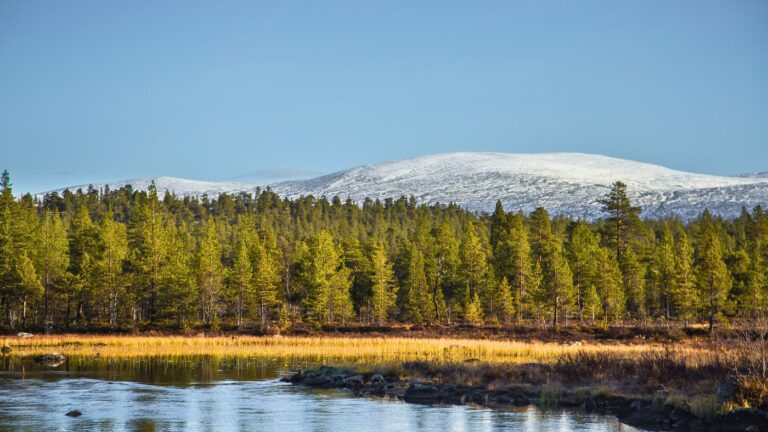
There are no sheer fjord walls, no famous roadside viewpoint, and no single summit that defines the experience.
Instead, this national park reveals itself slowly: through the sound of a paddle dipping into still water, the smell of old pine forest after rain, and the strange feeling that the modern world has slipped further away with every bend in the river.
For many Norwegians, Femundsmarka represents something increasingly rare: a large, coherent wilderness where travel happens at human pace. Often, that means by canoe rather than on foot.
This is not a national park to rush through in search of highlights. It rewards patience, preparation, and an appreciation for simple outdoor life.
Introducing Femundsmarka National Park
Established in 1971, Femundsmarka National Park lies in eastern Norway along the border with Sweden, east of the vast Lake Femunden. The park covers more than 570 square kilometres and protects a landscape of lakes, rivers, marshland, old pine forest, and gently rising mountains.
Compared with Norway’s more famous alpine parks, Femundsmarka feels modest at first glance. The mountains are not especially dramatic, and the terrain rarely announces itself with a single spectacular view. But that is part of its appeal.
The scale becomes clear only with time. Lakes stretch into the distance, forest tracks fade into open marsh, and the sense of remoteness deepens the longer you stay.
Together with protected areas on the Swedish side of the border, Femundsmarka forms part of one of the largest continuous wilderness areas in southern Scandinavia.
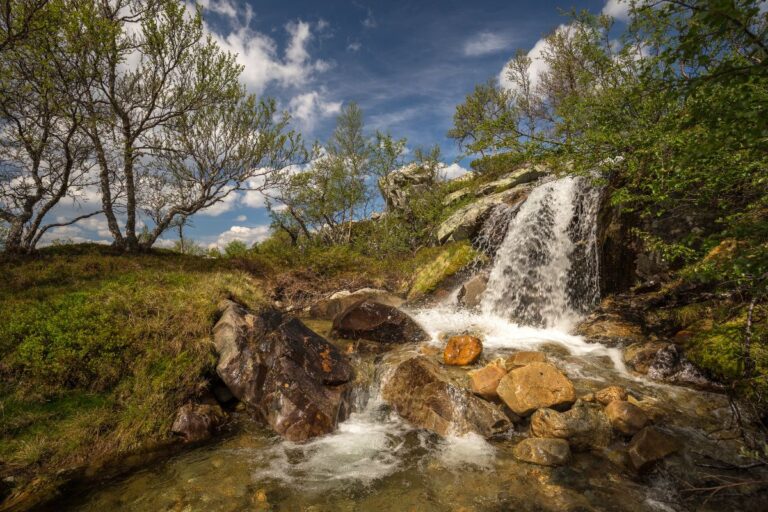
Large areas remain free from roads, power lines, and modern infrastructure, creating a rare feeling of uninterrupted space.
A Different Kind of Norwegian Wilderness
Femundsmarka has long been a borderland. The lakes and waterways once formed natural routes for movement between Norway and Sweden, while fishing, hunting, forestry, and seasonal use shaped the landscape over many generations.
This was never a heavily farmed region. Thin soils and a short growing season made agriculture difficult, so human activity remained relatively light compared with many other parts of Norway.
Traces of that history still exist in the landscape. Old timber-floating routes, simple cabins, fishing places, and other signs of past use remind visitors that Femundsmarka is not untouched wilderness in the absolute sense. It is a lived-in landscape, but one where nature still sets the terms.
Sámi reindeer herding has also played a role in the wider region, adding another layer to the area’s long history of seasonal movement and land use.
Canoeing in Femundsmarka
Femundsmarka is often described as Norway’s great canoeing national park, and the description fits. Water is not just part of the scenery here. It is the main route through the landscape.
The Røa watercourse is the classic artery of the park, linking lakes and river sections on the Norwegian side with the large Rogen lake across the Swedish border. On a map, the route can look deceptively simple. In reality, wind, water levels, and portages all shape the journey.
Some stretches are calm and sheltered, ideal for quiet paddling between forested shores. Others demand more care. Certain sections, especially lower down toward Femunden, include faster-flowing water and places where canoes must be carried.
Femunden itself can feel more like an inland sea than a lake. Long crossings should not be underestimated, particularly in wind.
For that reason, flexibility is essential. A good canoe trip here is not about covering distance quickly, but about reading the conditions, choosing sheltered camps, and allowing the weather to set the pace.
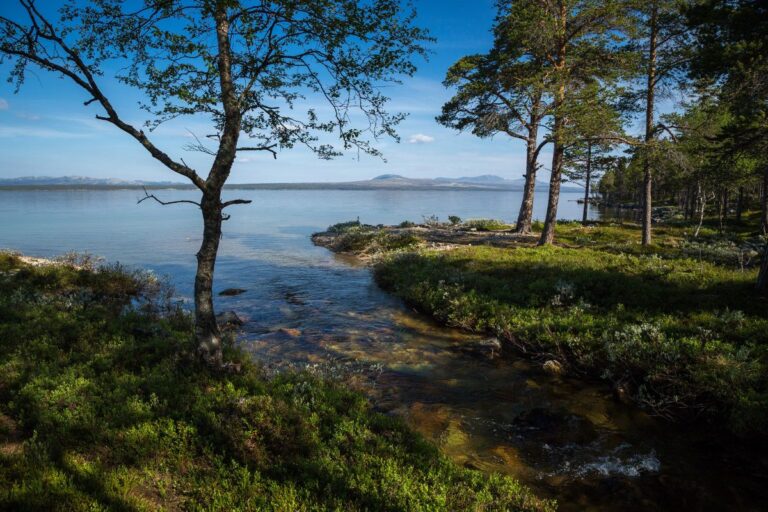
Canoe hire is available near the main access points, and routes can be adapted to suit different experience levels. Beginners should seek local advice before setting out, while experienced paddlers can plan multi-day trips lasting a week or more.
Hiking, Cabins, and Slow Travel
Although canoeing defines Femundsmarka’s identity, hiking remains an important way to experience the park.
Trails here are generally less formal than in Norway’s better-known mountain areas. Some follow old tracks, ridgelines, or natural corridors between lakes. Others require good map-reading skills and confidence in remote terrain.
Walking in Femundsmarka feels exploratory rather than prescriptive. Distances can be deceptive, as boggy ground, forest, and uneven terrain slow progress. This is not a park of quick ascents and dramatic summit photos, but one of gradual immersion.
The Norwegian Trekking Association maintains a small network of cabins and routes in the wider Femundsmarka area, including simple self-service cabins. Many visitors also choose to camp, taking advantage of Norway’s right to roam.
For casual visitors, shorter walks near access points offer a taste of the landscape. Longer routes are best suited to experienced hikers comfortable with self-sufficiency and changeable weather.
Wildlife and Old Pine Forest
Wildlife in Femundsmarka is rich but discreet. Moose are common in the wider area, though not always easy to spot. Beavers leave more obvious traces along waterways, where dams, lodges, and gnawed trees reveal their presence.
The park also supports more elusive animals, including lynx and wolverine. Bears may pass through the broader border region, but sightings are rare. This is not a place for guaranteed wildlife encounters. It is a place where animals can exist largely on their own terms.
Birdlife is especially important around lakes, marshes, and wetlands. Because of this, visitors should be careful around shorelines and islands during the nesting season.
One of Femundsmarka’s most distinctive natural features is its old pine forest. Some trees are weathered, twisted, and silver-grey with age. Among them grows wolf lichen, a striking yellow-green lichen associated with old pine forests. Its presence is one of many signs that this is an unusually intact woodland landscape.
Fishing is also popular, with trout and Arctic char found in many waters. A licence is required, and local regulations vary, so visitors should check before casting a line.
When to Visit Femundsmarka
Summer, from late June through August, is the main season for canoeing and hiking. Long daylight hours make extended trips possible, although sudden storms and strong winds can still sweep across the lakes. This is also when insects can be most noticeable.
Autumn is a beautiful time to visit. September often brings cooler air, fewer insects, and strong colours in the forest and marshland. Visitor numbers drop, and the sense of solitude becomes even stronger. Facilities and services may begin to close as the season progresses, so planning becomes more important.
Winter transforms Femundsmarka into a snowbound landscape. Frozen lakes create new routes, and ski touring replaces paddling. The silence can be extraordinary, but winter travel here is demanding and experience is essential.
Spring arrives late. Ice can linger on lakes well into May, while thawing ground makes access unpredictable. For many visitors, this is the least straightforward season.
How to Get There
The main gateways lie around Lake Femunden, especially Elgå in the south and access points along the western shore. Røros is the best-known town in the wider region and is often the most practical base for travellers arriving by public transport.
One of the most memorable ways to reach the park is by the historic M/S Fæmund II, which operates on Lake Femunden in the summer season. The boat links small lakeside communities and access points, allowing hikers and paddlers to start or finish trips in different places.
Elgå is also home to the visitor centre for Femundsmarka and nearby Gutulia National Park, making it a useful first stop for maps, route advice, and current conditions.
Services in the area are limited, so visitors should not expect the convenience of more developed national park gateways. Food, fuel, equipment, and accommodation should be planned in advance.
Responsible Travel in Femundsmarka
Femundsmarka may feel open and untouched, but it is also a protected landscape with clear rules.
All trees in the national park are protected, including dead and fallen trees. The old pines are part of the park’s identity and provide habitat for rare species. Visitors should use existing fire pits where available and avoid damaging vegetation.
Campfires are generally prohibited from April 15 to September 15, unless conditions make it clearly safe. Camping on islands is not permitted, as several vulnerable bird species nest close to waterways. Drones are prohibited without permission, and cycling is allowed only on specific routes.
Fishing and hunting require licences, and dogs must be kept under control, especially because of wildlife and grazing animals.
These rules are not there to make visiting difficult. They are part of what keeps Femundsmarka feeling like Femundsmarka.