
If you are new to Norway, one of the more startling experiences can be the sudden sound of every mobile phone around you blaring at once.
The alert is loud, impossible to miss, and may be accompanied by outdoor sirens sounding across towns and cities.
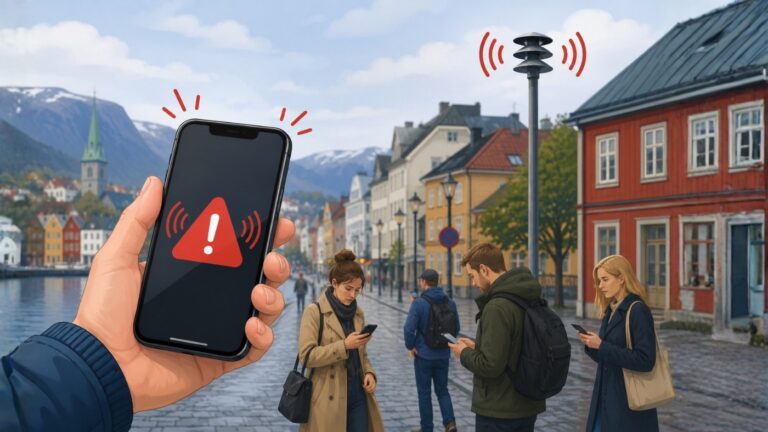
For anyone not expecting it, the experience can be unsettling, especially if you're a fan of disaster movies!
But in most cases, there is no reason to panic. Norway regularly tests its emergency warning systems, including mobile alerts and the Civil Defence sirens, to make sure the public can be reached quickly in a real crisis.
These tests are announced in advance, but it is easy to miss the information if you do not follow Norwegian news or local authority updates closely.
Norway’s Emergency Alert System
Norway’s mobile emergency alert system is known as Nødvarsel. It is designed to warn people about serious incidents that pose an acute threat to life and health.
Unlike an SMS, the alert is sent through the mobile network to devices within a defined geographical area. That means you do not need to sign up, download an app, or register your phone number.
If your phone is compatible, updated, located in Norway, and connected to the 4G or 5G network, you may receive the warning.
When an alert arrives, the phone vibrates and plays a loud siren-like sound. The warning appears on the screen with text explaining what is happening and what you should do. During tests, the message clearly states that it is only a test.
The alert can be especially surprising because it may sound even if your phone is set to silent. This is deliberate. In a real emergency, the system needs to attract attention quickly.
Why Sirens Still Matter
Alongside mobile alerts, Norway still uses physical warning sirens operated by the Norwegian Civil Defence.
These are the old-fashioned sirens, sometimes still thought of as air raid sirens, found in many towns, cities and larger populated areas. They are not everywhere, so not everyone will hear them during a test.
The most common test signal is “Viktig melding – søk informasjon,” which means “Important message – seek information.” The signal consists of three rounds of siren sounds, with a pause between each round.
If you hear this signal during a real incident, the point is not to evacuate immediately or take a specific action based only on the sound. Instead, you should seek official information from sources such as NRK, police updates, municipal websites, government channels, or other reliable media.
Norway also has other siren signals, including one for danger of attack and one to indicate that the danger is over, but the regular public test is the “important message” signal.
When Are The Tests Held?
The sirens are normally tested twice a year, at 12 noon on the second Wednesday in January and the second Wednesday in June.
In recent years, these tests have often been coordinated with a nationwide test of the mobile emergency alert system. When this happens, phones across Norway may vibrate and sound at roughly the same time as the sirens.
The exact timing can vary slightly. Tests are usually announced as taking place around noon, sometimes within a short window either side of 12.00.
This regular schedule is useful to know, especially for newcomers, tourists, people with pets, people working in quiet environments, and anyone who may be startled by sudden loud noises.
How To Find Out About The Next Test
The best place to check is the official Nødvarsel website, which is also available in English as Emergency Alert. The site publishes information about active alerts, past alerts, and planned national tests.
Information is also commonly published by the Directorate for Civil Protection, known as DSB, the Norwegian Civil Defence, police districts, county governors, and local municipalities.
Many municipalities post reminders on their websites and social media channels in the days before a national test. If you live in Norway, following your municipality’s official channels can be a useful way to stay informed about local preparedness messages as well as national tests.
Norwegian media usually cover the tests too, especially when mobile phones and sirens are tested together. However, relying only on news headlines is not always ideal, as visitors and newcomers may not see the announcements in advance.
What Should You Do During A Test?
During a test, you do not need to do anything. The message on your phone should make clear that it is only a test.
You can usually swipe the alert away or press “OK,” depending on your phone and operating system. On some phones, the alert may remain available afterwards in the notification centre or emergency alert settings.
If you are in a meeting, recording audio, giving a presentation, or working in an environment where a sudden loud alert would cause problems, it is worth keeping the test schedule in mind.
Setting the phone to silent is not enough to avoid the sound. During official tests, the alert may override ordinary sound settings. If you genuinely need to avoid receiving the test, the official advice is to switch the phone off or put it in flight mode before the test period.
Who Receives The Mobile Alert?
Most newer mobile phones can receive emergency alerts, provided they have updated software and are connected to 4G or 5G in Norway.
The system does not depend on your phone number, subscription, home address, or where the phone is registered. This means visitors to Norway may also receive the alert if their device is compatible and connected to a Norwegian mobile network.
Some older devices may not receive the warning. If your phone does not receive a test, it does not necessarily mean anything is wrong with the mobile network. It may be related to the phone model, software version, network connection, or alert settings.
The sound of phones and sirens across Norway can be dramatic, but that is part of the point. Emergency warnings are only useful if people recognise them, understand what they mean, and know where to look for reliable information.
Regular tests help authorities check that the systems work, while also making the public familiar with the sound and format of the warnings.