
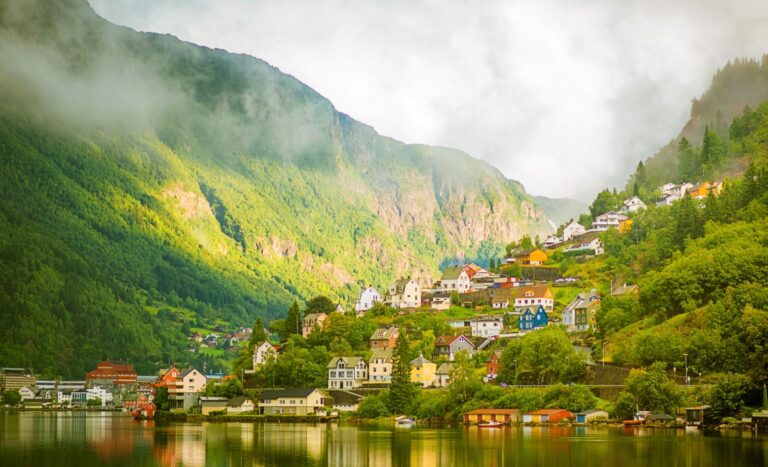
Best known as the base for the famous Trolltunga hike, Odda is an intriguing fjord town surrounded by waterfalls, glaciers and mountains. Its industrial past makes it quite unlike the picture-postcard villages elsewhere in Hardanger.
For many international visitors, Odda appears on the map for one reason: Trolltunga.
The spectacular rock formation has become one of Norway's most photographed natural landmarks, drawing hikers from around the world to this relatively small corner of Western Norway.
But Odda is worth understanding in its own right.
This is an industrial town in a spectacular setting, squeezed between steep mountains at the end of a narrow fjord. Glaciers and waterfalls are within easy reach, while the remnants of heavy industry give the town a very different character from many other destinations in the Norwegian fjords.
Odda also has a surprisingly long history of tourism. International visitors were coming here to admire the scenery long before Trolltunga became a social media sensation.
So, whether you're planning the famous hike or simply exploring the Hardanger region, here's what you need to know about Odda.
Where is Odda?
Odda is located at the southern end of Sørfjorden, a long branch of the Hardangerfjord in Western Norway.
It's surrounded by some of Norway's most dramatic landscapes. The Folgefonna glacier and national park lie to the west, while the vast Hardangervidda mountain plateau is to the east.
The town was formerly the administrative centre of Odda municipality. Since a local government reorganisation in 2020, Odda has been part of the much larger Ullensvang municipality.
Despite its relatively isolated location, Odda is an important regional centre. Shops, supermarkets, restaurants and accommodation make it a practical base for exploring this part of Hardanger.
The journey to Odda is also part of the experience. Approaching from the north takes you alongside Sørfjorden through one of Norway's most important fruit-growing regions, while roads south and west pass waterfalls, mountains and narrow valleys.
Hiking Trolltunga from Odda
Of course, there's no avoiding the main reason many people come here. Trolltunga—literally the troll's tongue—is a thin shelf of rock projecting horizontally from the mountainside approximately 700 metres above Lake Ringedalsvatnet.

The combination of the unusual rock formation and enormous mountain landscape has made Trolltunga one of Norway's most recognisable viewpoints.
But there's something important to understand before planning a visit: Trolltunga is a serious mountain hike.
The standard Trolltunga hike from the P2 parking area at Skjeggedal is approximately 27km there and back and typically takes between 8 and 12 hours. Starting from the higher P3 Mågelitopp reduces the total distance, but it remains a demanding full-day hike.
The trailhead is not in central Odda. It lies above nearby Tyssedal, with seasonal shuttle transport available between Odda, Tyssedal and the trailhead areas.
Weather conditions in the Norwegian mountains can change rapidly, even during summer. Appropriate clothing, footwear, food and water are essential, while hiking outside the main summer season requires considerably more preparation.
Guided hikes are also available and are especially worth considering during periods when snow and winter conditions remain in the mountains.
If Trolltunga is the main purpose of your trip, staying in Odda before and after the hike makes a lot of sense. You'll avoid adding a long journey to an already exhausting day.
Things to do in and around Odda
Trolltunga may get most of the attention, but the surrounding area contains enough natural attractions to justify spending longer here.
See the twin waterfall of Låtefossen
One of Norway's most distinctive roadside waterfalls is just a short drive south of Odda.
Låtefossen drops approximately 165 metres, with two streams joining shortly before the water crashes beneath an old stone bridge on Norwegian Scenic Route 13.
You don't need to hike to see it. The waterfall is right beside the road, making it one of the easiest natural attractions to visit in the region.
In fact, it's so close to the road that drivers actually cross the bottom of the waterfall as they pass.
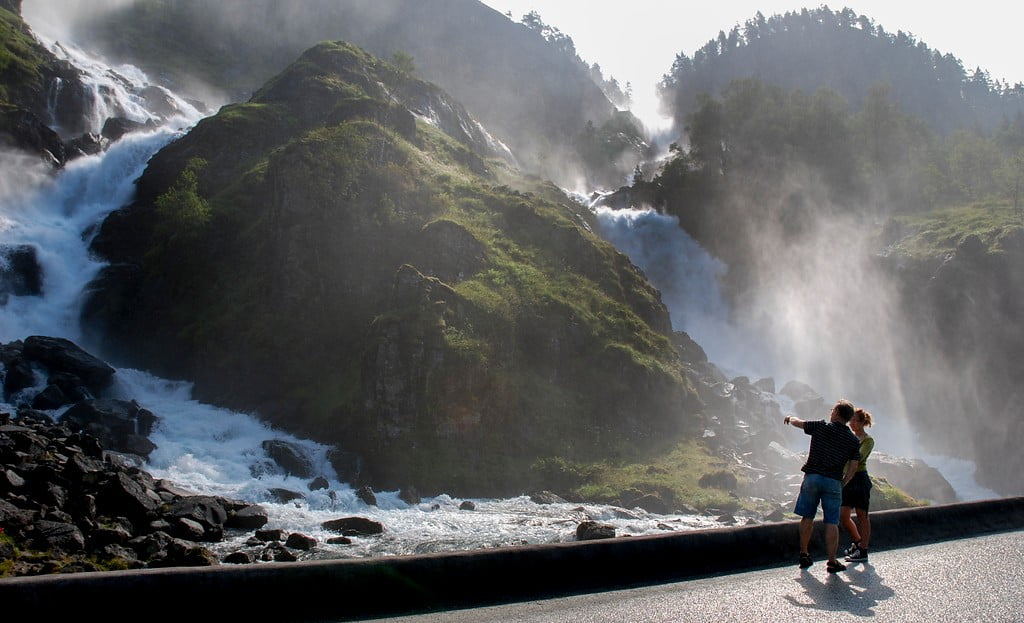
The downside is limited parking, particularly during the busy summer season. If you're driving, take extra care when stopping and crossing the road.
Get close to Folgefonna at Buer
Just a few kilometres from central Odda, the Buer valley provides access to another side of the region's spectacular landscape.
Buarbreen is an arm of Folgefonna, one of mainland Norway's largest glaciers. The valley itself is well worth seeing, with the ice visible high above farmland and steep mountainsides.
Hiking opportunities allow you to get closer to the glacier landscape, while guided glacier experiences are available in the wider Folgefonna area.
As with any glacier, don't attempt to walk onto the ice independently. Glaciers are constantly moving environments with crevasses and other hazards that may not be obvious.
Hike above Odda
If Trolltunga isn't enough hiking for you, the mountains surrounding Odda provide plenty more options.
One of the most impressive is Rossnos, which rises to more than 1,400 metres above sea level. The demanding hike involves a substantial climb but rewards experienced hikers with panoramic views across Odda, Sørfjorden and the surrounding mountains.
There are also shorter walking possibilities around the town and neighbouring valleys for those who don't fancy another full day in the mountains.
Odda's industrial heritage
Odda doesn't look quite like many other communities in the Norwegian fjords. That's largely because modern Odda was shaped by industry.
At the beginning of the 20th century, Norway's emerging hydroelectric industry transformed places where abundant water and steep mountains could provide enormous amounts of power.
Odda was one of them. Construction of the Odda Smelteverk smelting works began in 1906, with industrial production starting soon afterwards. Carbide and cyanamide production became central to the local economy.
Nearby Tyssedal was also transformed. The hydroelectric power station there was part of the pioneering development of large-scale hydropower in Norway.
The industrialisation of Odda happened extraordinarily quickly. Workers arrived, housing was built and a small tourism-focused community developed into an important industrial town.
Production at the smelting works eventually ended in 2003, leaving a substantial industrial site close to the centre of Odda.
Today, those buildings are an important part of the town's heritage rather than something to hide away.
Odda and Tyssedal were once considered as a potential UNESCO World Heritage site because of this industrial history. Although that bid didn't ultimately result in World Heritage status, the surviving industrial landscape remains nationally significant.
For visitors, it also explains something that might otherwise seem puzzling.
Why does a town surrounded by such extraordinary natural beauty look so industrial?
Because those mountains and waterfalls didn't just attract tourists. They provided the power that helped build modern Norway.
Odda was a tourist destination before it was an industrial town
There's another twist to the story. Before factories transformed Odda, tourists were already coming here.
During the 19th century, wealthy European travellers began visiting the Norwegian fjords in growing numbers. Odda became one of the fashionable destinations of the era, known for its waterfalls, mountains and access to the Folgefonna glacier.
Hotels were established to cater for international visitors arriving by fjord.
One particularly famous visitor was German Emperor Kaiser Wilhelm II, who was a frequent visitor to the Norwegian fjords during the years before the First World War.
Tourists didn't simply admire Folgefonna from below. Routes across and around the glacier became attractions in their own right.
The historic Tourist Road towards Folgefonna is a reminder of this first golden age of tourism. A formal tourist route opened in the early 20th century, allowing visitors to experience the dramatic mountain and glacier landscape.
So, while Instagram undoubtedly changed the scale and nature of tourism to Odda, the idea of international travellers coming here in search of dramatic Norwegian scenery is nothing new.
Odda became Edda in Netflix's Ragnarok
Odda's distinctive combination of mountains, fjord and heavy industry also caught the attention of television producers.
Much of the Norwegian-language Netflix series Ragnarok was filmed in Odda, which became the fictional town of Edda.
The series follows teenager Magne, who discovers he possesses extraordinary powers while confronting a wealthy industrial family amid growing environmental problems.
Viewers familiar with Odda will recognise streets and buildings around the town, along with the surrounding mountain landscape.
The location works particularly well because Odda embodies one of the central tensions of the series. Spectacular Norwegian nature surrounds a town whose identity and economy were shaped by heavy industry.
Even if you've never watched Ragnarok, wandering around Odda after seeing the series gives you a very different perspective on the town.
Exploring the Hardangerfjord from Odda
Odda is also a useful base for a wider road trip around Hardanger. Drive north along Sørfjorden and the landscape gradually changes. Fruit farms and orchards cling to the steep hillsides, especially around places such as Lofthus.
The combination of a relatively mild fjord climate, long summer days and fertile slopes has made Hardanger Norway's most famous fruit-growing region.
Apple blossom is a highlight of spring, while late summer and autumn bring roadside stalls and locally produced apples, plums, cherries and cider.
Continue farther around Hardanger and you can reach destinations including Eidfjord, Vøringsfossen and the Hardangervidda plateau.
For anyone touring Western Norway by car, Odda can therefore work as more than somewhere to sleep before hiking Trolltunga.
Is Odda worth staying in?
That depends on what you're expecting. If your mental image of the Norwegian fjords is colourful wooden houses, immaculate waterfronts and cruise ships surrounded by mountains, Odda may come as a surprise. It's a working town with a very visible industrial past.
Odda is also an extremely practical place to stay. There are shops and supermarkets, places to eat, accommodation choices and good access to some of the biggest attractions in this part of Hardanger.
If you're hiking Trolltunga, I'd strongly consider spending at least two nights in the area rather than arriving, completing the hike and immediately moving on.
With three nights, you have time to explore places such as Låtefossen or Buer without trying to squeeze everything around one exhausting day in the mountains.
And if Trolltunga isn't on your itinerary at all? Odda can still be worth a stop.
Come only for Trolltunga and the town serves its purpose extremely well. Stay a little longer, though, and Odda begins to tell a much more interesting story: one of glaciers and waterfalls, pioneering tourism, hydropower and heavy industry, all squeezed into one extraordinarily narrow corner of the Norwegian fjords.