
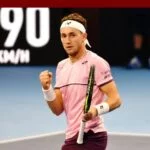
The story so far of Casper Ruud, Norway’s most successful tennis player and a trailblazer for the sport in Scandinavia.
For most of modern sporting history, Norway and tennis have existed in completely different worlds.
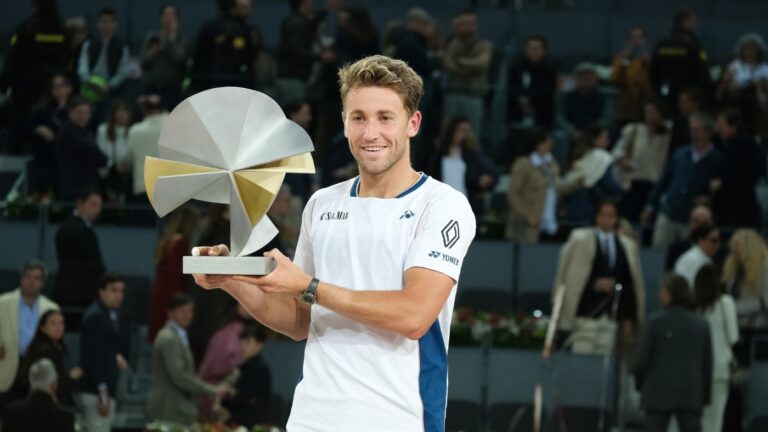
While the country has produced world-class athletes in winter sports, football, and more recently athletics, tennis has never truly taken hold.
There were occasional flashes of promise, most notably from Christian Ruud in the 1990s, but nothing that suggested Norway could compete consistently on the global stage. That changed with the arrival of his son.
Casper Ruud has not just broken records. He has reshaped expectations, turning a fringe sport in Norway into one that now commands attention, media coverage, and growing grassroots interest.
Table of Contents
Growing Up With Tennis in the Blood
Born in Oslo in December 1998, Ruud grew up in an environment where tennis was part of everyday life.
His father, Christian Ruud, had carved out a respectable career on the ATP Tour, reaching a world ranking of No. 39. That experience gave Casper something few young players have: a clear understanding of what it takes to succeed at the highest level.
But Norway was not an obvious place to develop a world-class tennis player.
The climate limits outdoor play for much of the year, and the country lacks the deep tennis infrastructure seen in nations like Spain, France, or the United States. Recognising this early, the Ruud family made a crucial decision that would shape his career.
As a teenager, Casper moved to train at the academy of Rafael Nadal in Mallorca. This was more than just a training move. It was an immersion into a culture built around clay-court tennis, discipline, and relentless work ethic.
Under the influence of Nadal and his team, Ruud developed the foundations of the game that would later define his success.
Junior Success and Early Promise
Ruud’s rise through the junior ranks was steady, but unmistakable.
He competed in all four junior Grand Slam tournaments, gaining valuable experience against the best young players in the world. His singles results were solid, but it was in doubles where he made some of his deepest runs, often partnering Miomir Kecmanović.
Together, they reached the semi-finals at both Wimbledon and the French Open in boys’ doubles, highlighting Ruud’s versatility and tactical awareness.
Yet the standout milestone came in January 2016, when Ruud became the world No. 1 junior.
For a Norwegian player, this was unprecedented. It was also a clear signal that his potential extended far beyond junior success.
Learning the Hard Way on the Pro Tour
Transitioning from junior success to the professional circuit is one of the toughest steps in tennis, and Ruud’s early years were a lesson in patience.
He began in ITF Futures tournaments, the lowest rung of professional tennis, grinding through matches on smaller courts with little attention. Results came gradually, including his first title in Spain in 2016.
Later that year, he stepped up to the ATP Challenger Tour and claimed a significant victory in Seville, defeating Taro Daniel in the final. It was an early indication that he could compete at a higher level.
Still, progress was measured rather than dramatic.
Breaking into the ATP Tour required persistence. Ruud made appearances at tournaments like the Miami Open and gradually began to test himself against more established players.
First Grand Slams and Breaking Into the Top 100
In 2018, Ruud reached a significant milestone. After battling through qualifying rounds, he secured his place in the main draw of the Australian Open. In doing so, he became the first Norwegian in 17 years to qualify for a Grand Slam main draw.
It was a moment that put him firmly on the radar back home.
Over the next two seasons, he continued to build momentum. Strong performances in Challenger events and ATP tournaments helped him break into the world’s top 100 in 2019, a key benchmark for any emerging player.
For Norway, it was already historic territory, but there was soon much more to come.
A Historic First ATP Title
The real breakthrough came in February 2020. At the Argentina Open, Ruud defeated Pedro Sousa in the final to claim his first ATP Tour title. With that victory, he became the first Norwegian ever to win an ATP title.
It was a landmark moment not just for Ruud, but for Norwegian sport more broadly. Suddenly, tennis was no longer a curiosity. It had a genuine contender.
Building a Reputation on Clay
As Ruud’s career progressed, one aspect of his game became particularly clear: his strength on clay courts.
His heavy topspin forehand, combined with excellent movement and patience, made him exceptionally effective on slower surfaces. He could extend rallies, control points, and wear down opponents over time.
Tennis analyst Jonathan from Perfect Tennis captured this perfectly during Ruud’s early rise:
“He hits with the most topspin on both his forehand and backhand than anyone else on the ATP Tour right now, which always helps on clay.”
At the time, there were legitimate questions about whether Ruud could translate that success to faster surfaces such as grass and hard courts. Those questions would soon be answered.
Reaching the Very Top of the Game
The years that followed saw Ruud evolve from a clay-court specialist into a complete player.
In 2022, he reached the final of the French Open, facing his childhood idol Rafael Nadal. Although he lost, the achievement was extraordinary.
Later that same year, he made another Grand Slam final at the US Open, proving his ability on hard courts. In 2023, he returned to the French Open final, this time taking on Novak Djokovic.
While a Grand Slam title has so far remained just out of reach, these performances established Ruud firmly among the elite.
At his peak, he climbed to world No. 2 in the ATP rankings, the highest ever achieved by a Norwegian player.
Style of Play: Controlled Power and Patience
Ruud’s playing style is built around control, consistency, and intelligent shot selection.
He operates primarily from the baseline, using heavy topspin to dictate rallies. His forehand is his most potent weapon, capable of pushing opponents deep behind the baseline.
His two-handed backhand is solid and reliable, while his movement allows him to cover the court effectively. Over time, he has added greater aggression to his game, particularly on hard courts, improving his ability to shorten points when needed.
Perhaps most importantly, he is known for his composure.
In high-pressure moments, Ruud rarely appears flustered, an attribute that has served him well in deep tournament runs.
Changing the Sporting Landscape in Norway
Ruud’s impact goes far beyond his own results.
In Norway, tennis has traditionally been overshadowed by sports more suited to the climate and culture. But Ruud’s success has sparked a noticeable shift.
Participation in tennis is growing, young players have a role model to look up to, and media coverage of the sport has increased significantly.
He now sits alongside athletes like Erling Haaland and Jakob Ingebrigtsen as part of a new generation of Norwegian stars making an impact on the global stage.
What Comes Next for Casper Ruud?
At 25, Casper Ruud is firmly in his prime.
He has already achieved what no Norwegian tennis player has managed before. Multiple Grand Slam finals, a Masters 1000 title, and a world No. 2 ranking place him among the elite of the modern game.
He is no longer an outsider or a rising name. He is an established contender.
The next step is a Grand Slam title.
Ruud has shown he can go deep into the biggest tournaments, particularly at the French Open, where his clay-court game is at its most effective. But converting those opportunities into a title is one of the hardest challenges in sport.
In his finals so far, he has come up against players like Rafael Nadal and Novak Djokovic, generational talents who have defined an era. That context matters.
Now, a new generation led by Carlos Alcaraz and Jannik Sinner is setting the pace, raising the level required to win the sport’s biggest prizes.
So is it a question of when, not if? Not quite.
The reality is more finely balanced. Ruud has the level to win a Grand Slam. He has already proved that. But in a sport as competitive as tennis, nothing is guaranteed. Timing, form, confidence, and even the draw can make the difference between a deep run and a career-defining victory.
What can be said with certainty is this: Ruud will continue to give himself chances. And if he does, one of those chances may yet become the moment that defines his career.