

The Scandinavian mountains are responsible for much of Norway's spectacular scenery. Here are the highest mountains in Norway, from Galdhøpiggen to the dramatic peaks of the Hurrungane.
Fjords and glaciers may feature heavily in the postcards, but mountains are at the heart of Norway's spectacular landscape.
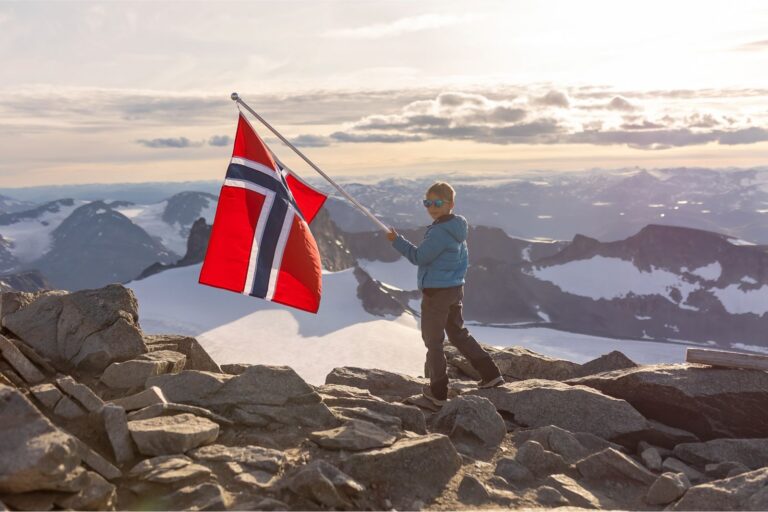
The Scandinavian mountain range runs through much of Norway, creating everything from broad mountain plateaus to the sharp peaks that rise above the country's famous fjords.
For hikers and climbers, the opportunities are almost endless.
But if you're interested purely in height, one area dominates. Almost all of Norway's very highest mountains are found in Jotunheimen, the mountainous region between eastern and western Norway.
In fact, using a prominence of 50 metres to define an individual summit, 24 of Norway's 25 highest peaks are in Jotunheimen. The sole exception is Snøhetta on Dovrefjell.
The 10 highest mountains in Norway
Mountain rankings can vary slightly depending on how much prominence a summit needs to be considered a separate mountain.
Using a 50-metre prominence definition, these are Norway's ten highest peaks:
| Rank | Mountain | Height |
|---|---|---|
| 1 | Galdhøpiggen | 2,469 metres |
| 2 | Glittertinden | 2,452 metres |
| 3 | Store Skagastølstind | 2,405 metres |
| 4 | Store Styggedalstind | 2,387 metres |
| 5 | Skardstinden | 2,374 metres |
| 6= | Vesle Galdhøpiggen | 2,368 metres |
| 6= | Surtningssue | 2,368 metres |
| 8 | Store Memurutinden | 2,366 metres |
| 9 | Gjertvasstind | 2,351 metres |
| 10 | Sentraltind | 2,348 metres |
You may already have noticed something from that list: every single one is in Jotunheimen.
Galdhøpiggen: Norway's tallest mountain
At 2,469 metres (8,100 feet) above sea level, Galdhøpiggen is the highest mountain in Norway and the highest point in Northern Europe.
Despite that impressive title, reaching the summit is more accessible than many visitors expect. There are two popular approaches, although neither should be underestimated.
The shortest begins at Juvasshytta, a mountain lodge reached by a private road that climbs all the way to about 1,840 metres above sea level. From there, the route crosses the Styggebreen glacier before the final ascent to the summit.
That glacier crossing is the crucial detail. You should not simply walk across Styggebreen independently. The standard route involves travelling roped together under the supervision of an experienced glacier guide.
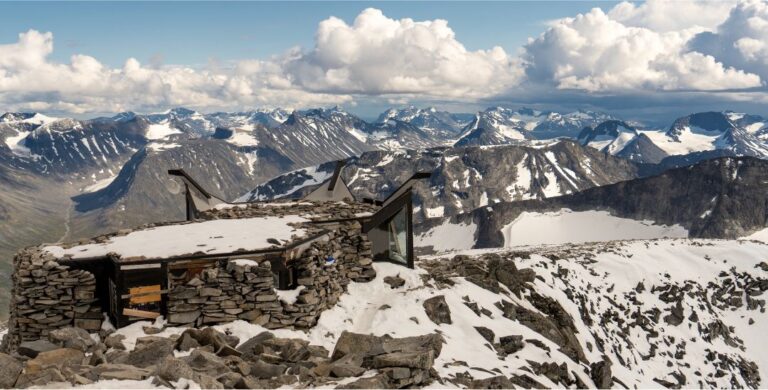
Guided trips from Juvasshytta typically take around six to seven hours for the full return journey, covering roughly 15 kilometres.
At the summit, a small stone cabin offers simple refreshments during its operating season. On a clear day, the panorama is extraordinary, with mountains and glaciers stretching across Jotunheimen and as far as Snøhetta to the north.
Hiking Galdhøpiggen from Spiterstulen
The main alternative begins at Spiterstulen in Visdalen. This route doesn't require the standard glacier crossing and can therefore be completed independently by experienced hikers in suitable summer conditions.
But don't mistake glacier-free for easy. Spiterstulen sits at 1,111 metres, meaning hikers face roughly 1,500 metres of ascent to reach the summit.
The route is about six kilometres each way and typically takes four to five hours to climb, with a total day of around eight or nine hours once the descent and breaks are included.
So while Galdhøpiggen is relatively accessible for the highest mountain in an entire region of Europe, it is still a serious mountain hike. Weather can also change rapidly at this altitude, even during summer.
Glittertinden: Norway's second highest mountain
The wonderfully named Glittertinden is Galdhøpiggen's nearest rival. Its summit stands at 2,452 metres (8,045 feet), making it Norway's second-highest mountain.
Today there is no real argument over which mountain takes first place. Historically, however, things were much more interesting.
Glittertinden was topped by a substantial cap of ice and snow. At times, that ice raised its measured height above Galdhøpiggen, leading to a long-running debate about which should be considered Norway's highest mountain. As the ice cap shrank, the debate was settled.
Measurements in 2020 found that the remaining ice was only around two metres thick. The highest point measured 2,452 metres whether the ice was included or not, when rounded to the nearest metre.
The once-prominent ice cap has continued to shrink dramatically. Glittertinden can be approached from both Spiterstulen and Glitterheim. From Spiterstulen, expect a demanding full-day hike of roughly nine hours.
Store Skagastølstind: Norway's third highest mountain
The character of the mountains changes considerably as we move west through Jotunheimen. Store Skagastølstind, usually known simply as Storen, reaches 2,405 metres (7,890 feet) and is Norway's third-highest mountain.
It forms part of Hurrungane, a particularly dramatic alpine area in western Jotunheimen. Unlike Galdhøpiggen's popular hiking routes, Storen is very much a mountaineering objective.
The mountain has steep rock faces, exposed terrain and climbing sections. Reaching its summit requires appropriate climbing experience and equipment, or the services of a qualified guide.
That difference is worth emphasising. Height alone tells you surprisingly little about how difficult a Norwegian mountain is to climb. Galdhøpiggen may be taller, but Storen presents a much more technical challenge.
Store Styggedalstind: Norway's fourth highest mountain
Nearby Store Styggedalstind reaches 2,387 metres (7,831 feet), making it Norway's fourth-highest mountain. It lies in the eastern part of Hurrungane, between several glaciers.
Together with neighbouring peaks including Gjertvasstind and Sentraltind, it forms part of one of Norway's most impressive high-mountain landscapes. Again, this is very different terrain from the standard walking routes up Galdhøpiggen.
Hurrungane is characterised by sharp ridges, steep drops, glaciers and technical routes. It's one of the most important areas in Norway for experienced climbers and mountaineers.
Why Jotunheimen has so many of Norway's highest mountains
The concentration of giant peaks in Jotunheimen is remarkable. Galdhøpiggen, Glittertinden, the Hurrungane peaks and almost every other mountain near the top of Norway's height rankings are packed into the same broad region.
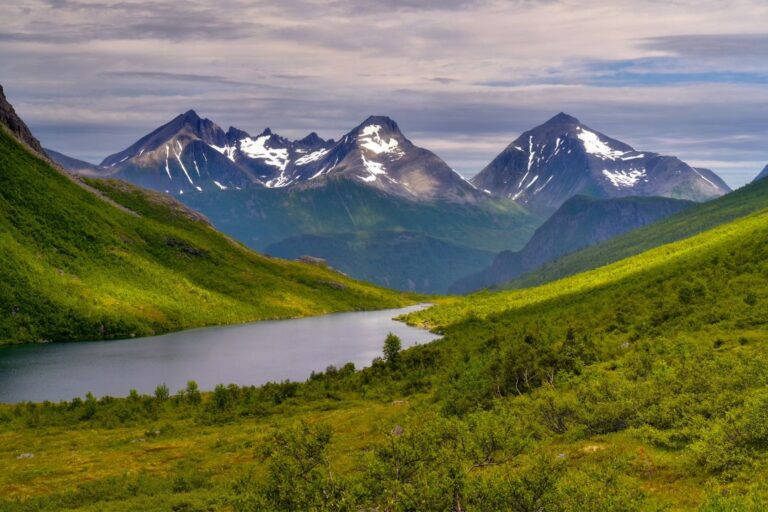
The name Jotunheimen translates roughly as “home of the giants,” inspired by the jötnar, the giants of Norse mythology. It's certainly an appropriate name.
The Galdhøpiggen massif alone contains nine summits higher than 2,300 metres, while Hurrungane has several more. For keen hikers, this concentration also means that one trip can offer a remarkable variety of routes.
Spiterstulen is particularly well located. Seventeen Norwegian peaks above 2,300 metres can be reached on day trips from the lodge.
That doesn't mean they're all straightforward, of course. Some are hiking objectives, while others require far more mountaineering experience.
Snøhetta: The giant outside Jotunheimen
Travel north from Jotunheimen and eventually another famous mountain comes into view. At 2,286 metres (7,500 feet), Snøhetta is the highest mountain on Dovrefjell and the highest mountain anywhere in Norway outside Jotunheimen.
That makes its historical reputation particularly interesting. Before Jotunheimen had been properly surveyed, Snøhetta was widely believed to be Norway's highest mountain. It isn't hard to understand why.
Dovrefjell lay on an important historic travel route between southern Norway and Trøndelag, while the highest parts of Jotunheimen remained relatively unknown.
By the early 19th century, improved surveying began to change that understanding. Galdhøpiggen was eventually established as the country's true highest peak.
The importance of Dovrefjell
Snøhetta and Dovrefjell occupy a special place in Norwegian culture that goes far beyond their height. During the constitutional assembly at Eidsvoll in 1814, representatives famously swore to remain united “until Dovre falls.”
The mountain has also lent its name to Snøhetta, the internationally known Norwegian architecture and design practice behind projects including the Oslo Opera House.
Snøhetta itself consists of several peaks. The highest is Stortoppen at 2,286 metres, followed by Midttoppen at 2,278 metres, Hettpiggen at 2,261 metres and Vesttoppen at 2,253 metres.
Hiking Snøhetta
One of the most popular routes begins at the DNT mountain lodge Snøheim. A seasonal shuttle bus carries visitors from Hjerkinn to the lodge, helping reduce traffic through the protected mountain environment.
From Snøheim, the return hike to Stortoppen is approximately 12 kilometres with more than 800 metres of ascent. DNT grades the hike as demanding and estimates around six hours.
Although no technical climbing is required on the normal route in good summer conditions, the rocky terrain and exposed mountain weather mean this should not be described as an easy hike.
There is another reason to tread carefully here. Dovrefjell is important wild reindeer habitat, and visitors are asked to minimise disturbance to the animals.
The mountains of Lofoten
Anyone who has visited the Lofoten Islands might be surprised that none of its famous mountains appear anywhere near the top of this list. After all, few places in Norway feel more mountainous.
The explanation is largely about perspective. Many of Jotunheimen's highest peaks rise from landscapes that are already more than 1,000 metres above sea level.
In Lofoten, mountains often rise almost directly from the ocean. That enormous vertical contrast makes them appear far taller than the numbers suggest.
The highest peak on Austvågøya is Higravtindan at 1,146 metres (3,760 feet). Farther west, Hermannsdalstinden is the highest mountain on Moskenesøya at 1,029 metres (3,376 feet). Its summit lies only a little over one kilometre from the open sea as the crow flies.
On Vestvågøya, Himmeltindan reaches 962 metres. Even one of Lofoten's most famous viewpoints, Reinebringen, is just 484 metres above sea level.
Yet from the summit, the combination of fjords, villages and sharp surrounding mountains creates one of Norway's most spectacular views.
It's a useful reminder that the height of a mountain doesn't necessarily determine how dramatic it feels.
Norway's highest mountain isn't actually in Norway?
Here's a geographical curiosity to finish with. Galdhøpiggen is unquestionably the highest mountain in Norway itself. But if you include Norway's dependent territories, things become more complicated.
In Queen Maud Land in Antarctica, which Norway claims as a dependency, Jøkulkyrkja reaches 3,148 metres (10,328 feet) above sea level.
That makes it considerably taller than Galdhøpiggen. Of course, an Antarctic expedition is a rather different proposition from driving up to Juvasshytta for a summer hike.
For almost every practical definition, Galdhøpiggen remains the roof of Norway.
Whether you want to stand on the country's highest point, tackle the technical peaks of Hurrungane or simply admire the mountains rising straight from the sea in Lofoten, Norway offers mountain landscapes on almost every scale imaginable.


For my 60th birthday present to myself i visited family in Norway. Part of the trip included climbing Galdhopiggen. A great experience and incomparable vista on a clear day. I made it and with some effort you can also. Now we need the travel restrictions to ease. I truly love my grandfather’s homeland.