
Flying is the most common way to get around Norway. But it isn’t the only option. Here is what you need to know about intercity bus and coach services in Norway.
Perhaps it was the stress of the time that shall not be named (2020-22) but I’ve definitely noticed an increase in independent travel in Norway over the past years. Most notably, by people who are travelling around and visiting several places.
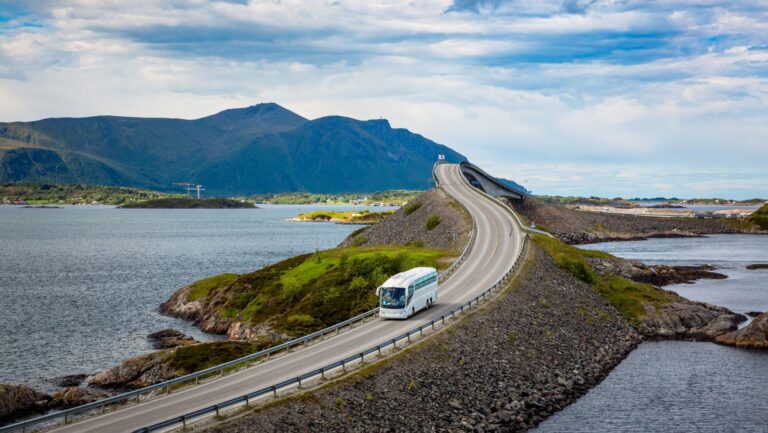
In previous years, I’ve seen such travellers use the railways. Although trains in Norway are slow and most locals choose to fly instead, they are a wonderful option for tourists.
So much so, that in the summer, some of Norway’s trains especially the famous Bergen Line are jam-packed full with tourists. But when the trains are full or inconvenient, there is another option for getting around Norway that many tourists miss.
Introducing Norway’s Intercity Bus Network
Travelling by coach is not for everyone. At busy times, Norway’s highways can be slow, and journeys are rarely as fast as flying. That said, most long-distance buses are modern, comfortable, and well-equipped, typically offering free Wi-Fi, charging ports, and basic toilet facilities.
For many travellers, the biggest advantage is price. Long-distance buses are often the cheapest way to travel between cities, particularly when booked in advance.
The main drawback is complexity. Norway does not have a single nationwide coach operator. Instead, services are split between several companies, with routes that vary widely in frequency and coverage. Smaller towns are often served, but departures may be limited.
For most travellers, two operators form the backbone of intercity coach travel in southern Norway: Vy Express and Nor-Way Bussekspress.
Vy Express
Vy Express buses are double-deckers, with wider seats than a regular bus. Seats have more legroom and fold-out leg rests. Most buses offer free wi-fi and charging ports, either regular outlets or USB.
On some services, there are “plus” seats available, which are more spacious and located on the top floor. These are ideal for longer journeys, and on journeys where you plan to enjoy the scenic views.
Lillehammer to Bodø: Norway's longest bus route
One of the most striking services in Vy’s long-distance network is Vy express VY710, a cross-country coach route linking Bodø, Trondheim, and Lillehammer, effectively tying Northern Norway into the southern long-distance coach system.
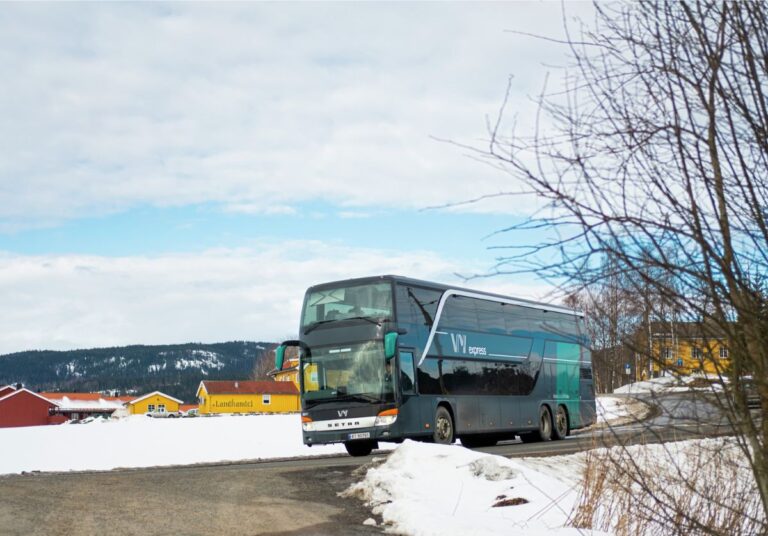
Covering around 1,288 km with about 50 stops, VY710 is often described as one of Norway’s longest direct express bus journeys, with a total trip time of roughly 17 hours. The route operates several times per week in both directions, using modern double-deck buses.
VY710 stops at a mix of regional centres and scenic towns such as Fauske, Mo i Rana, Mosjøen, Grong and Levanger, and even calls at Trondheim Airport.
More buses serve the Trondheim to Lillehammer portion of the route throughout the week.
Other notable Vy Routes
The Vy Express bus network offers a variety of routes that cater to different tourist interests, from scenic fjord views to access to popular hiking trails. Here's a summary of some notable routes:
Interested in long-distance bus travel? Check out the route network, timetables, and prices of Vy Express (affiliate link)
Oslo – Bergen (via Kristiansand, Stavanger, Haugesund): One of the country's longest bus routes, taking around 13.5 hours and covering about 850 km, including two ferry crossings between Stavanger and Bergen. Double-decker buses offer spacious seating and excellent views, particularly from the upper deck front seats.
Oslo – Ulsteinvik/Måløy: Approximately 10 hours of travel from Oslo through Lillehammer and Øyer, past Gudbrandsdalen to Lom, Strynefjellet, and on to Stryn in Nordfjord and Måløy on the Fjord coast. Highlights include access to Jotunheimen from Lom and adventure sports in Loen.
Oslo – Førde (via Sogndal): Travelling for about 8.5 hours, this route highlights the stark contrasts between Norway's eastern plains and the western fjords. Ideal for those aiming for an active mountain holiday, with stops like Gol and Hemsedal for mountain enthusiasts, and Lærdal and Sogndal for those drawn to the fjord landscapes of the Sognefjord.
Bergen – Ålesund (via Førde): About 9 hours and 45 minutes, providing extensive fjord views and including three ferry crossings. The journey crosses the Sognefjord and the Nordfjord, offering a gateway to coastal areas.
Nor-Way Bussekspress
The other main option in the southern half of Norway is Nor-Way Bussekspress. Many of the services serve popular skiing and hiking resorts.
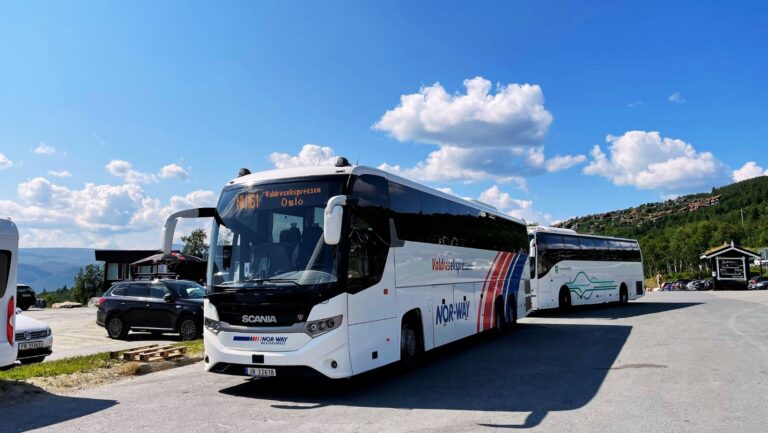
Some buses are double-decker but there are also smaller buses, yet all offer comfortable seating. On some routes, some premium options are available including more comfortable and spacious seating.
Notable Nor-Way Bussekspress Routes
Although primarily designed for locals, the Nor-way Ekspress bus network offers routes that also serve tourists. From scenic fjords to mountain views, here's some of the best routes for visitors:
Oslo – Haugesund/Bergen: Travel time is approximately 8.5 hours to Bergen and 8 hours and 15 minutes to Haugesund. This route connects Oslo with Seljestad, and from Seljestad, passengers can continue to Odda and Bergen. Odda is basecamp for the Trolltunga hike, and it's the reason that many travellers use this service.
Oslo – Stavanger (via Arenal, Kristiansand, Flekkefjord): A 9.5-hour journey that connects Oslo with Kristiansand, offering over 100 weekly departures and continuing to the beautiful coastal town of Flekkefjord and Stavanger. This route is ideal for families, with a recommendation to stop in Kristiansand for activities suitable for all ages.
Oslo – Valdres: This route known as the ‘Valdres Express' connects Oslo with three destinations in the hiking paradise of Valdres, offering daily departures throughout the year. The journey from Oslo to Årdalstangen takes around 5 hours, and to Beitostølen about 3 hours and 47 minutes.
Bergen – Sogndal (via Voss, Flåm, Lærdal): Takes around 5 hours, stopping at Voss, Flåm, and Lærdal. The route offers a combination of bus and train travel via the famous Flåmsbana and possible boat trips between Flåm and Bergen.
Bergen – Førde: A 3-hour and 25-minute trip that offers both mountain and fjord views, with two ferry crossings included.
Bergen – Stavanger (via Stord, Haugesund): Roughly 4.5 hours, connecting Bergen with Haugesund and Stavanger and featuring scenic views of fjords and rural landscapes along the way.
Long-Distance Travel in Northern Norway
In Northern Norway, intercity bus travel is structured differently from the south. The large networks like Nor-Way Bussekspress don’t extend into the Arctic regions, with the exception of the Vy route to Bodø.
Instead, long-distance routes are generally part of the regional public transport network. This means it can usually be planned via the national planner Entur, which covers buses, ferries and trains across counties.
In addition to regional bus services, a growing tourist-oriented option launched in recent years is The Arctic Route, which connects major destinations above the Arctic Circle.
The Arctic Route operates a series of seasonal and year-round bus lines centered on Tromsø. It’s a collaboration between Norwegian and Finnish operators that lets travellers reach places that would otherwise require complicated combinations of buses and ferries.
Winter services typically run from roughly December through March, covering links such as Tromsø to Narvik, Lyngen, Skjervøy, Storslett and even Rovaniemi in Finnish Lapland.
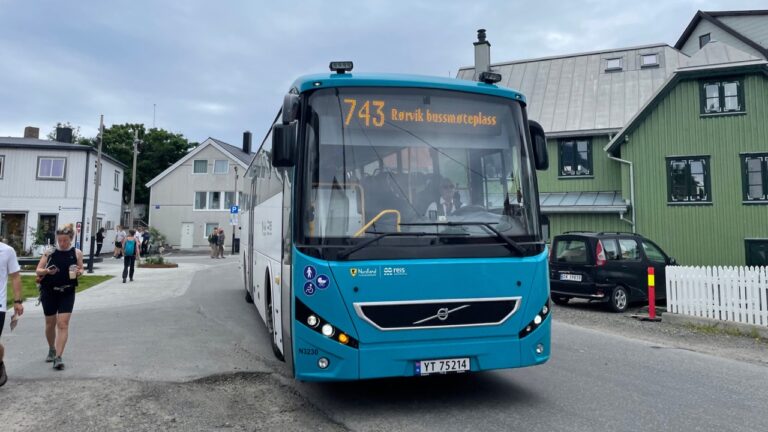
Summer routes (usually mid-June to August) include scenic runs from Tromsø to Senja, Andøya, Vesterålen and the Lofoten islands, often combining bus and ferry travel as part of one ticket.
These routes are ideal for travellers who want to explore the Arctic without renting a car. For journeys fully within Northern Norway, local and regional buses—searchable through Entur—are the backbone of public transport.
International Bus Routes
From Oslo Bus Terminal, it's possible to travel internationally by bus to places in Denmark, Sweden, and Germany. Onward connections are also available, depending on the operator.
Vy Express operates a regular service between Oslo and Copenhagen, while companies including Flixbus also offer international routes.
FAQ: Bus Travel in Norway
Here are some answers to common questions about long-distance bus and coach travel in Norway.
Interested in long-distance bus travel? Check out the route network, timetables, and prices of Vy Express (affiliate link)
Do I need to reserve a seat? On most long-distance services you should reserve a seat in advance, especially on popular corridors like Oslo–Bergen, Oslo–Ålesund, or northern routes with limited departures. Some regional services allow open seating for short hops. Booking ahead guarantees the seat you want and often better prices.
Can I bring food and drink onboard? Yes, you are welcome to bring your own snacks and drinks. Coaches do not sell food or beverages onboard; drivers are not permitted to serve passengers while the bus is moving. Comfort stops are made on long journeys, and some ferry crossings (on routes that include them) have food service.
Are overnight buses available? Yes. Many Vy long-distance services include overnight departures, letting you sleep through most of a long route. These are especially useful to maximise daylight hours at your destination.
What about luggage? Long-distance coaches have luggage holds under the bus and small storage above seats. There are usually no strict weight limits for normal travellers, but oversized items may incur a surcharge or require advance notice.
Is Wi-Fi reliable? Most long-distance buses operated by Vy and the Arctic Route offer free Wi-Fi and USB/AC charging — but signal quality depends on mobile coverage. In remote areas (e.g., during Arctic travel), connectivity may drop.
What if my coach is delayed? Norwegian operators don’t typically guarantee connections on separate tickets. If you miss a train or bus connection because the coach was late, you’ll usually need to rebook — unless you purchased a through-ticket that includes connection guarantees (check when buying).
How do I plan multi-leg bus travel? Use the national planner Entur (entur.org) to combine buses, trains, ferries, and city transit into one itinerary. It’s particularly useful in the north where multiple regional carriers operate under one timetable.
Are these coaches wheelchair accessible? Most long-distance coaches in Norway have wheelchair access and priority seating, but accessibility can vary by route and operator. Always check when booking.


Very interesting article, I have been following your site for over a year – we had the pleasure of listening to your talks on a Fred.O cruise a couple of weeks ago – our first ever cruise and we enjoyed and would love to visit Norway again. the dog sledding was fantastic, the arctic train likewise – sadly we didn’t get to see the sea eagles and the maelstrom near Bodo due to cancellation of docking. I am definitely going to explore the bus services – in particular visiting Forde – my namesake 🙂 (and I apparently have Scandinavian DNA)! Keep up the excellent information you provide. thank you
Thanks! And welcome back to Norway anytime 🙂