
Following the death of King Harald V, his son Haakon has become King of Norway. Here is the story of the man who spent more than three decades preparing for the throne.
Norway has a new king.
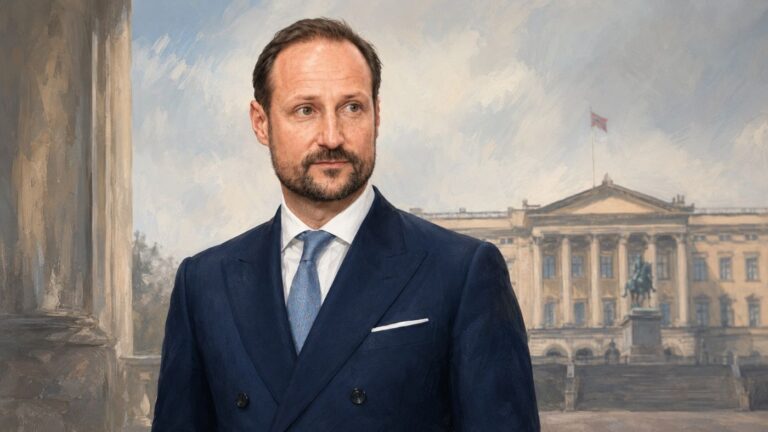
King Harald V died peacefully at Oslo University Hospital, Rikshospitalet, on 28 August 2026 at the age of 89. His son Haakon immediately succeeded him as Norway’s monarch.
For most Norwegians, Haakon has been a familiar figure for decades. He became Crown Prince at just 17 years old and gradually took on a greater share of royal duties as his father grew older.
Yet becoming king marks a major change, both for Haakon himself and for the Norwegian Royal Family.
He takes the throne at the age of 53 after a lifetime spent preparing for the role. But he also inherits a monarchy facing perhaps its most difficult period of public scrutiny in decades. So, who is Norway’s new king?
Born into Norway’s Royal Family
Haakon Magnus was born at Rikshospitalet in Oslo on 20 July 1973, the second child of the then Crown Prince Harald and Crown Princess Sonja.
His older sister, Princess Märtha Louise, had been born almost two years earlier.
However, the succession rules in place at the time gave preference to male heirs. This meant Haakon was placed ahead of his older sister in the line of succession, although his father Harald remained first in line to the throne.
Norway changed its constitution in 1990 so that the eldest child would take precedence regardless of gender. Transitional rules meant the change did not alter Haakon’s position.
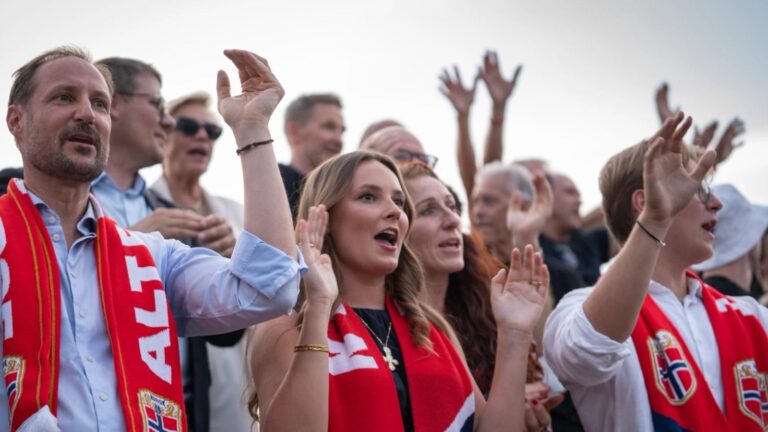
That change can be seen in the next generation. Haakon’s daughter, Princess Ingrid Alexandra, takes precedence over her younger brother, Prince Sverre Magnus. With Haakon’s accession, Ingrid Alexandra is now first in line to the Norwegian throne.
Haakon grew up at the Skaugum estate in Asker. King Harald and Queen Sonja wanted their children to experience as ordinary an upbringing as possible, and both attended local schools rather than being educated privately at the palace.
Becoming Crown Prince at 17
Haakon had not even finished secondary school when his grandfather, King Olav V, died on 17 January 1991.
His father immediately became King Harald V and 17-year-old Haakon became Crown Prince of Norway and heir to the throne.
He completed school the following year before beginning his military education.
Unlike his father, whose military training was primarily with the army, Haakon chose the Royal Norwegian Navy. He attended the Royal Norwegian Naval Academy in Bergen and became a naval officer.
Military service has remained part of his official role, although his education would soon take him much farther from home.
Studying in California
In 1996, Haakon moved to the United States to study political science at the University of California, Berkeley. It was an interesting choice for someone expected to become King of Norway.
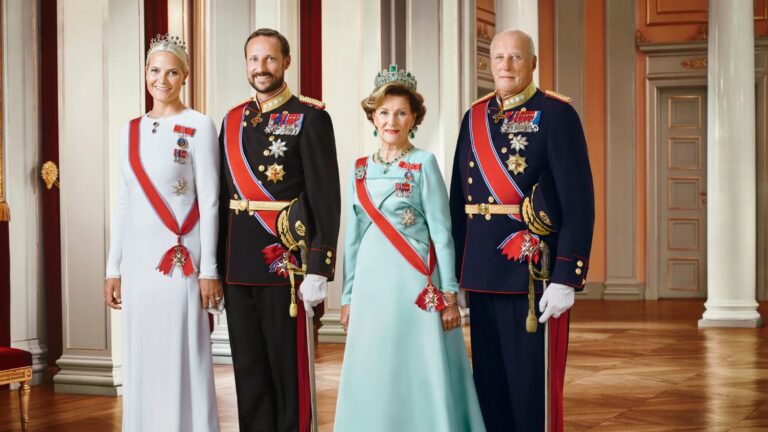
Haakon has spoken openly about being uncomfortable with aspects of his royal identity when he was younger. California provided some physical and psychological distance from royal life, together with opportunities to pursue interests including music and surfing.
He graduated with a bachelor’s degree in political science in 1999.
Haakon later studied at the London School of Economics, where he gained a master’s degree in development studies. He also completed the Norwegian Ministry of Foreign Affairs’ trainee programme and spent time with Norway’s delegation to the United Nations in New York.
That international education would influence many of the causes he later championed as Crown Prince.
Haakon’s Royal Duties
Haakon began carrying out royal duties while still a young man and acted as regent on numerous occasions when King Harald was abroad or unable to perform his constitutional duties.
Over time, his public role expanded considerably. He represented Norway on official visits around the world, often travelling with delegations from Norwegian business, culture, science and academia.
International development has long been a particular interest. Haakon became a Goodwill Ambassador for the United Nations Development Programme in 2003.
He has also been closely associated with environmental issues, particularly the health of the oceans, climate change and sustainable development.
As King Harald experienced increasing health problems during his later years, Haakon regularly stepped in as Regent.
That gradual transition means that although becoming king is an enormous personal and constitutional moment, many of the duties of Norway’s head of state are already very familiar to him.
Marriage to Mette-Marit
One of the defining events of Haakon’s life was his relationship with Mette-Marit Tjessem Høiby.
The pair first met during the 1990s and began a relationship after meeting again at the Quart music festival in her hometown of Kristiansand in 1999. Their engagement proved controversial.
Mette-Marit was a commoner and single mother whose earlier life had included connections to Oslo’s party scene. Her background prompted intense scrutiny from the Norwegian media.
For the Royal Family, however, there was a certain historical echo. King Harald had himself spent years waiting for permission to marry Sonja Haraldsen, also a commoner. Harald and Sonja ultimately supported their son’s choice.
Shortly before the wedding, Mette-Marit publicly addressed her past at an emotional press conference and expressed regret over some of her earlier choices.
Haakon and Mette-Marit married at Oslo Cathedral on 25 August 2001.
They have two children together: Princess Ingrid Alexandra, born in 2004, and Prince Sverre Magnus, born in 2005. Haakon also became stepfather to Mette-Marit’s son from a previous relationship, Marius Borg Høiby.
A Difficult Period for the Royal Family
Haakon takes the throne at an unusually challenging time for Norway’s monarchy.
Mette-Marit’s past association with the late American financier and convicted sex offender Jeffrey Epstein first became public in 2019.
The issue returned with considerably greater force in 2026 following the release of further documents in the United States. Mette-Marit subsequently expressed deep regret over the relationship and acknowledged that she should have investigated Epstein’s background more thoroughly.
At the same time, criminal proceedings involving her son Marius Borg Høiby have subjected the family to further intense media scrutiny.
Høiby has never been a member of the Royal House, held a royal title or carried out official duties on behalf of the monarchy.
Nevertheless, the controversies have affected perceptions of an institution that enjoyed exceptionally high levels of public support for much of King Harald’s reign.
How Haakon handles that scrutiny may prove one of the first significant tests of his time as king.
Mette-Marit’s Health
The family has also faced serious health concerns. Mette-Marit was diagnosed with pulmonary fibrosis, a chronic lung disease, in 2018. Her condition worsened significantly, and in 2026 she underwent a lung transplant.
Her health is likely to affect the number and type of official duties she is able to perform during the early part of Haakon’s reign.
It also means Norway’s new king begins his reign at a difficult time personally, just as he assumes the biggest responsibility of his public life.
Haakon Becomes King of Norway
Haakon became king automatically at the moment of his father’s death on 28 August 2026.
There is no gap between monarchs in Norway and no coronation is required before a new monarch takes up the role. The transition nevertheless involves several important constitutional and ceremonial events.
An extraordinary Council of State is held following the death of a monarch. The new king also takes an oath before the Storting, promising to govern in accordance with Norway’s constitution and laws.
Norway no longer holds coronations.
King Harald and Queen Sonja instead took part in a consecration ceremony at Nidaros Cathedral in Trondheim in 1991, following the example of King Olav V. Whether Haakon chooses to continue that tradition will become clear in the weeks and months ahead.
What Kind of King Will Haakon Be?
Haakon becomes Norway’s fourth monarch since the country gained independence in 1905, following Haakon VII, Olav V and Harald V. In many respects, continuity is likely to be important.
Like his father, Haakon has spent decades working within the restrained traditions of Norway’s constitutional monarchy. The king is head of state, but political power rests with the country’s elected government and parliament.
Haakon’s generation and interests may nevertheless give his reign a different character.
He has spent much of his public life discussing international development, environmental issues, young people and the oceans. His education in the United States and United Kingdom, together with decades of international travel, has also given him a strongly international outlook.
There is another significant difference. King Harald inherited a monarchy enjoying considerable goodwill and largely untouched by personal scandal. Haakon begins his reign while the institution faces uncomfortable questions surrounding members of his family.
The challenge will be to preserve the stability and broad public appeal that characterised much of his father’s reign while establishing his own identity as monarch.
For more than 35 years, Haakon was Norway’s Crown Prince. The period of preparation is over. Norway now has a new king.


Nice overview with open facts. Indeed, hard period for new King Haakon is coming. Wish him goodluck and to you David, many articles.
cheers