
Norway’s currency is the Norwegian krone, but understanding how it works goes far beyond exchange rates. From its history to how people actually pay for things today, here’s what you need to know about money in Norway.
When people think about money in Norway, the high cost of living is usually the first thing that comes to mind. That reputation is well earned.
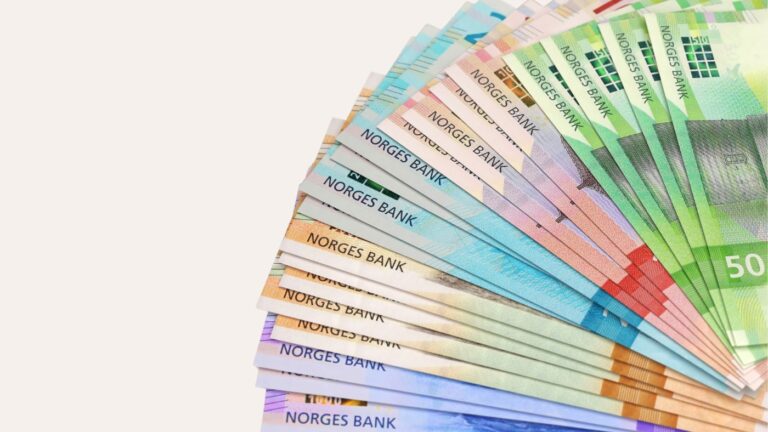
But understanding the Norwegian krone, how prices are displayed, and how payments are made can help visitors and newcomers avoid confusion and unnecessary expense.
Norway may be expensive, but it is also one of the most digitally advanced economies in the world, and the way money is used reflects that.
Norway Does Not Use the Euro
Across Europe, the number of national currencies fell sharply when the euro was introduced as physical cash in 2002. Today, the euro is the official currency of 20 of the 27 EU member states.
Norway is not a member of the European Union. Instead, it participates in the EU’s internal market through the European Economic Area, alongside Iceland and Liechtenstein. Because of this arrangement, Norway has retained full control over its own currency.
That currency is the Norwegian krone, often abbreviated as NOK. Like its Scandinavian neighbours, Norway uses a currency whose name literally translates as “crown”.
A Brief History of the Norwegian Krone
The Norwegian krone was introduced in 1875, when Norway joined the Scandinavian Monetary Union. It replaced the speciedaler, a currency that had been used since 1816.
The monetary union linked Norway, Sweden, and Denmark through a gold standard, with compatible currencies. When the union dissolved during the First World War in 1914, all three countries chose to keep their respective “crowns”.
That is why Norway, Sweden, and Denmark still use similarly named but separate currencies today.

Over time, Norway’s coinage evolved as inflation and changing payment habits made small denominations impractical. Øre coins were gradually phased out, with the final 50-øre coin withdrawn from circulation in 2012.
Sending money to or from Norway?
International transfers through traditional banks can be expensive and opaque. Many expats and travellers use Currency Fair for transparent fees and real exchange rates when moving money across borders (advertisement)
Current Denominations and How Prices Work
The Norwegian krone is divided into 100 øre, but the øre no longer exists as a physical unit. Today, it is used only electronically.
This often confuses visitors. Prices are still displayed with øre in shops and supermarkets, but cash transactions are rounded to the nearest whole krone. Card payments, however, are charged to the exact amount.
For example, a price of 9.50 kroner will be charged as 9.50 if you pay by card. If you pay with cash, you will pay either 9 or 10 kroner depending on rounding rules, with no physical change given.
Coins in circulation: 1, 5, 10, 20 kroner
Banknotes in circulation: 50, 100, 200, 500, 1,000 kroner
The Norwegian Krone and Exchange Rates
One aspect of the Norwegian krone that often surprises visitors is how much its value can fluctuate against other major currencies.
In recent years, the krone has frequently been weaker than the euro, US dollar, and British pound, sometimes making Norway feel noticeably cheaper for foreign visitors than its reputation suggests.
These fluctuations are driven by several factors, including global oil and gas prices, interest rate differences, and Norway’s relatively small currency market.
Importantly, prices inside Norway do not adjust quickly in response to exchange rate changes. A weaker krone may improve value for visitors, but it does not mean domestic prices fall overnight.
For travellers, the key takeaway is simple: exchange rates can have a meaningful impact on how expensive Norway feels from one year to the next, even though the underlying cost structure remains largely the same.
Transferring Money To and From Norway
If you’re moving money between Norway and another country, exchange rates and bank fees can make a bigger difference than many people expect. Traditional banks often add hidden margins to exchange rates or charge high international transfer fees.
For many international residents and travellers, services such as Currency Fair offer a simpler alternative. Currency Fair shows fees upfront, making it easier to see exactly how much money will arrive at the other end.
Currency Fair is commonly used by people living in Norway to transfer salaries, savings, or pension payments, as well as by visitors managing larger expenses such as accommodation deposits or long stays.
While it won’t change Norway’s high prices, it can help avoid unnecessary losses when moving money across borders.
Norway’s Modern Banknotes
Norway’s current series of banknotes was introduced between 2017 and 2019 by Norges Bank, and they are among the most distinctive in the world.
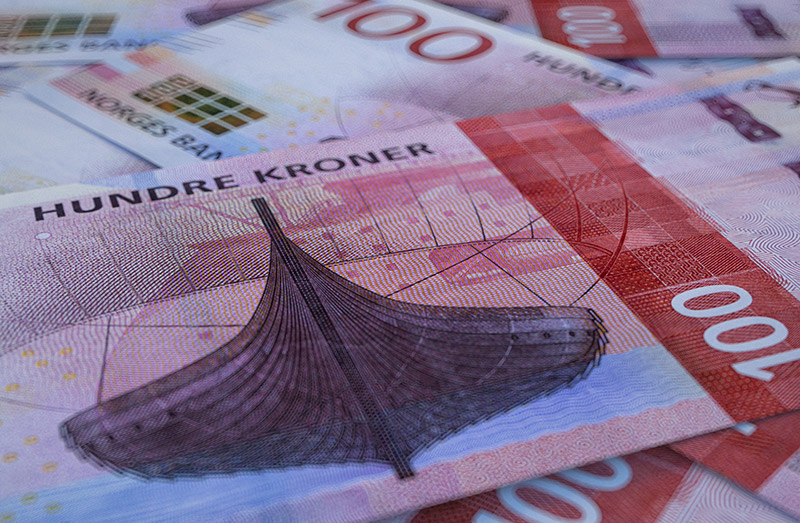
Rather than portraits of kings or politicians, the notes celebrate Norway’s long relationship with the sea. Each denomination represents a different aspect of that connection:
- The 50-kroner note features Ulvær Lighthouse, symbolising the sea that binds the country together.
- The 100-kroner note shows the Gokstad ship, representing the sea that carried Norwegians out into the world.
- The 200-kroner note features cod, reflecting the sea that has fed the nation for centuries.
- The 500-kroner note depicts a rescue vessel, symbolising the sea that has brought prosperity, including modern oil and gas wealth.
- The 1,000-kroner note shows a powerful wave, representing the sea that carries Norway forward.
The reverse side of each note uses a pixelated, abstract version of the same theme, a deliberately bold design choice reflecting a future-focused approach at a time when physical cash is becoming less common.
Paying for Things in Norway Today
Norway is often described as a “cashless society”, but the reality is more nuanced.
Most people rarely use cash, and many businesses do not actively encourage it, but cash is still legal tender and widely accepted in practice. That said, visitors should expect card payments to be the default almost everywhere.
Debit and credit cards are accepted in shops, cafés, taxis, accommodation, and even many rural businesses. Contactless payments are ubiquitous, and terminals support international cards as standard.
Contactless Payments and Apple Pay
Mobile wallets such as Apple Pay and Google Pay are widely accepted wherever contactless card payments are available. For most visitors, Apple Pay works exactly as it does at home and can be used confidently for everyday purchases.
Norway’s domestic mobile payment app, Vipps, dominates person-to-person payments and small transactions. Residents use it for everything from splitting restaurant bills to paying at school events and flea markets.
However, Vipps generally requires a Norwegian bank account and phone number, so it is not always accessible to short-term visitors.
For travellers, this simply means that while locals may ask “Can you Vipps me?”, cards and contactless payments remain fully sufficient.
Withdrawing Cash and Using ATMs in Norway
Although cash use is declining, ATMs remain available in cities, towns, and transport hubs. In rural areas, however, they can be sparse, and some villages may have no ATM at all.
Norwegian ATMs typically do not charge local withdrawal fees, but your home bank may apply its own charges or exchange margins. Currency exchange offices are relatively rare in Norway and usually offer poor rates compared with card payments or ATM withdrawals.
For most visitors, withdrawing small amounts of cash is straightforward but rarely necessary. Many travellers complete entire trips without handling physical money at all.
Paying for Transport, Parking, and Public Services
Public transport in Norway is overwhelmingly app-based. Buses, trams, ferries, and trains typically do not accept cash, and tickets are purchased using card payments, mobile apps, or in advance using ticket machines.

In some regions, buses do still accept cash. It's well worth checking this in advance, as policies do vary.
The same applies to parking. In cities and tourist areas, parking is usually managed via apps or card-only machines, with little or no option to pay in cash.
This digital-first approach is efficient, but it can surprise travellers from countries where cash is still commonly used for everyday services.
Online Banking and Digital Infrastructure
Norwegian banks offer highly developed online and mobile banking platforms. Bills are paid digitally, subscriptions are automated, and authentication typically uses national digital ID systems such as BankID.
This digital infrastructure is one of the main reasons cash usage has declined so sharply. For many residents, handling physical money has become unusual rather than normal.
Sending money to or from Norway?
International transfers through traditional banks can be expensive and opaque. Many expats and travellers use Currency Fair for transparent fees and real exchange rates when moving money across borders (advertisement)
The Future of Money in Norway
Norway is moving steadily towards a more digital financial system, but claims that cash will disappear entirely are often overstated.
While political discussions have taken place about reducing reliance on cash, Norwegian authorities have also emphasised the importance of keeping cash available for resilience, inclusion, and emergency preparedness. In recent years, regulations have been strengthened to ensure that certain businesses continue to accept cash.
Norges Bank has also explored the idea of a central bank digital currency, sometimes referred to as a digital krone. These discussions remain exploratory rather than a concrete plan to replace existing money.
For most people, the likely future is one where cash exists as a backup, while digital payments dominate everyday life.
What This Means for Visitors
Understanding the Norwegian krone is less about memorising denominations and more about understanding habits.
Prices are high, payments are digital, and systems are efficient. Bring a card, expect to use it everywhere, and don’t worry too much about carrying cash unless you have a specific reason to do so.
Once you adapt to how money works in Norway, managing everyday expenses becomes straightforward, predictable, and often refreshingly friction-free.


Had a 1901 10 Krone note on a cruise in Norway in 2016 that I wanted to give to Sissel as a gift. Nobody could help me find her and her online manager never gave her a copy I sent. Bought it for $40 US in the US and subsequently auctioned in the US for $750 US. I guess I was lucky, but, I still would have given it to her.
Useful information, thank you. Treating cash the way you do might make you feel cool and modern or urbane, but it’s not as great as you think. Witness the Swiss, famously independent people. They are sticking with cash, for anonymity and convenience. Digital seems great, and it is, until there are problems. And there are problems: hackers, lost phones, new releases of software, more passwords to remember; dead batteries, technical glitches. Simple rule of thumb: “If it’s wireless, it CAN be hacked. Period.” Dependencies and vulnerabilities. Also, realize that corporate marketing departments have every iota of everything you do, all saved, sorted and packaged for data brokers to sell. Everything. Every medicine you buy, what time of day you did what, where, with whom, …all for sale. Sometimes digital simply does not work. ex. hotel door cards, OVER and over they won’t work, …hassles, back to the front desk… more wasted time. At a graduation ceremony in Germany last month the entry to the venue was by phone, and long queues were held up by the staff being unable to electronically “read” some guests’ passes on the phone.
Is Vipps easy for foreign travelers to access when in Norway? Can I just download the app if my bank is in the US? I lived in Tromsø in the late 70s and I remember putting a 10 øre in my “penny loafers”
(not inside my shoe but on the leather part in front where you could see it) it was a tradition from what I understood
We are planning a Cruise to Norway. Do we convert dollars to Kroner. I need information on this issue….Thank you
You can use your American bank cards fine in 99.99% of circumstances. There will however be a fee for conversion at the register. See if your bank has a travel card, so you can convert money cheaper in digital format before you travel .
But your American cards will work fine 🙂