
This is how a low-cost airline turned its fleet into a flying gallery of boundary-breakers and history-makers.
A Norwegian Air aircraft is easy to spot. The bright red nose has become one of Europe’s most recognisable airline liveries, visible on runways from Tromsø to Tenerife.
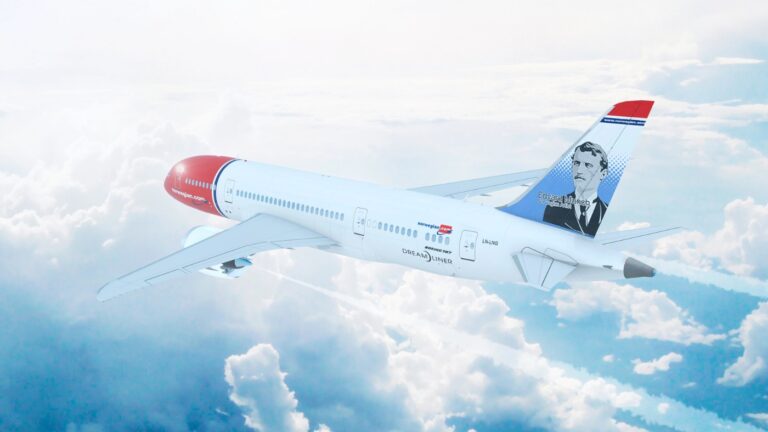
But it is the aircraft’s tail that often draws the longest look. Each fin carries a large portrait, a human face staring out across the sky.
These are Norwegian’s “tail-fin heroes,” a long-running design concept that turns the airline’s fleet into a flying gallery of writers, artists, explorers, scientists, activists and cultural figures.
Some are globally famous, others far better known in their home countries. All were chosen because they challenged norms, expanded knowledge, or left a lasting cultural legacy.
The idea dates back to Norwegian’s earliest years as a low-cost challenger airline. When the company began operating jet aircraft in the early 2000s, it wanted to signal that it was not just another budget carrier.
The portraits were intended to reflect ambition, curiosity and independence, values the airline wanted associated with its brand as it expanded across Scandinavia and later Europe.
More than two decades on, Norwegian Air looks very different. The airline no longer operates long-haul routes, its fleet is smaller and more focused, and its network has returned to a European and Nordic core. Yet the tail-fin heroes remain, quietly reinforcing a sense of continuity through years of dramatic change.
A Norwegian Idea With International Reach
In the beginning, the faces on Norwegian’s aircraft were almost exclusively Norwegian.
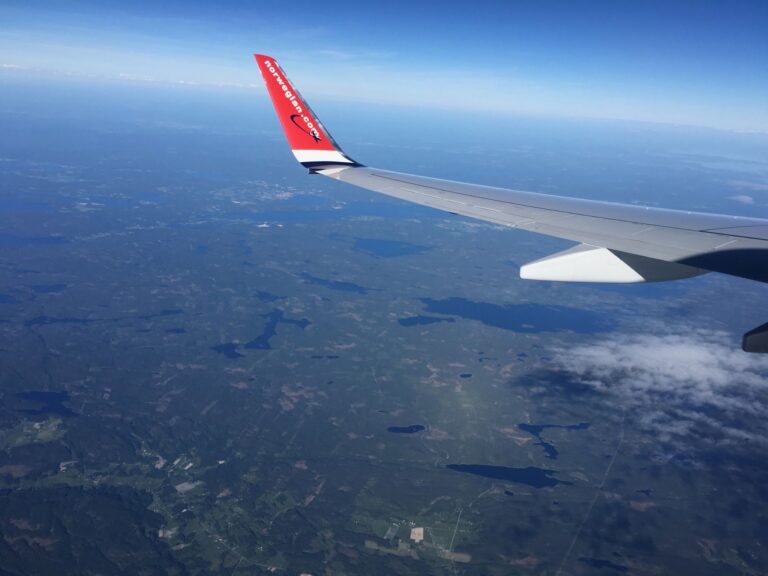
Cultural figures, national icons and historical pioneers dominated the early fleet, creating a distinctly Norwegian visual identity at a time when the airline was still establishing itself at home.
As Norwegian expanded into Sweden, Denmark, Finland, the UK, Spain, France and beyond, the portraits followed. The concept evolved into something broader, with each base country reflected on the aircraft that flew from it. This gave the airline a way to localise its brand without abandoning its Scandinavian roots.
By the late 2010s, Norwegian aircraft featured personalities from across Europe and the wider world. Authors, political reformers, scientists, artists and aviation pioneers appeared alongside Nordic explorers and resistance heroes.
The portraits became conversation starters for passengers and a subtle reminder that Norwegian’s ambitions extended well beyond its home market.
Even after restructuring in the early 2020s, when Norwegian scaled back operations and refocused on short-haul flying, the airline kept the concept intact.
Newer aircraft entering the fleet continued to carry portraits, and many of the older tail fins were preserved rather than replaced with a generic design.
Norway’s Cultural and Historical Icons
Norwegian figures remain at the heart of the tail-fin collection. Some choices are immediately recognisable, even to visitors with only a passing knowledge of Norwegian culture.
Composer Edvard Grieg, playwright Henrik Ibsen and artist Edvard Munch represent Norway’s outsized contribution to European art and literature.
Composer Edvard Grieg helped define a distinctly Norwegian musical voice in the late 19th century, weaving folk traditions into classical compositions that are still performed worldwide.
Playwright Henrik Ibsen reshaped modern drama with psychologically complex plays that challenged social norms and continue to influence theatre today.
Artist Edvard Munch, best known for The Scream, captured universal human anxiety and emotion in a body of work that made him a central figure in European modernism.
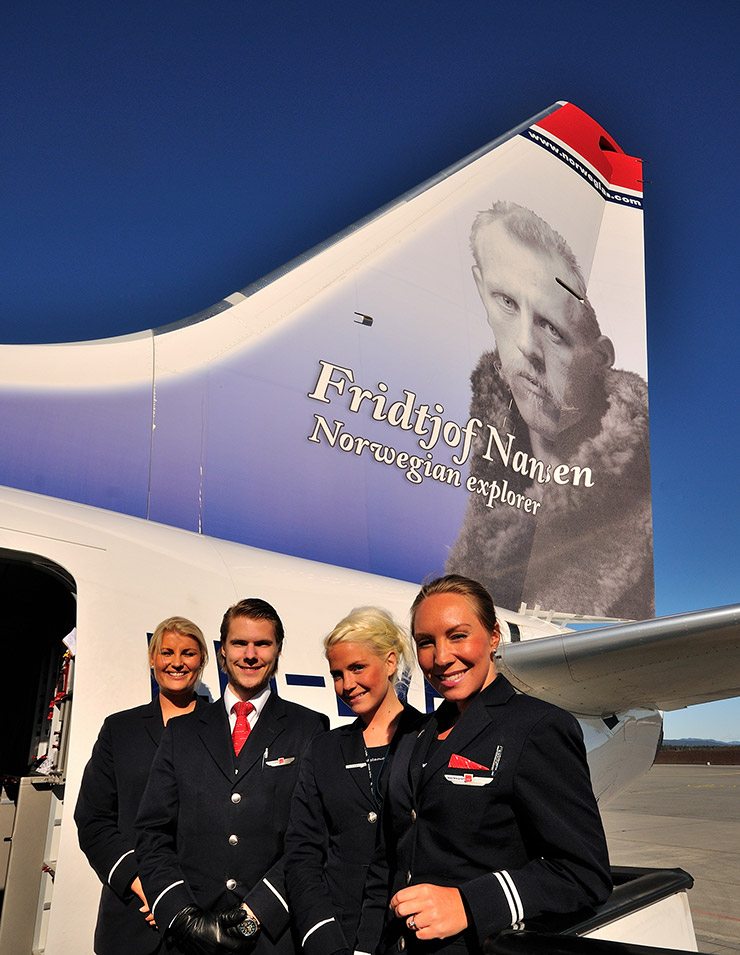
Exploration is another recurring theme. Figures such as Fridtjof Nansen and Thor Heyerdahl feel particularly well suited to aircraft tail fins. Their work took them across oceans and into unknown regions, making them natural symbols for an airline built on movement and connection.
Norwegian’s selection is not limited to the most obvious names. Several tail fins honour individuals who are highly respected within Norway but less familiar internationally.
These include women’s rights campaigner Fredrikke Marie Qvam, Nobel Prize-winning author Sigrid Undset, and actress Wenche Foss, who was also a prominent public voice in post-war Norway.
The airline has also chosen to honour Norwegian resistance figures from the Second World War, including Gunnar Sønsteby. Their inclusion adds a more sombre historical layer to the fleet, acknowledging their roles in shaping modern Norway.
Scandinavian Neighbours in the Spotlight
Norwegian’s tail fins also reflect a broader Scandinavian identity. Swedish cultural figures appear prominently, including actress Greta Garbo, whose Hollywood career made her one of the most famous Europeans of the twentieth century.
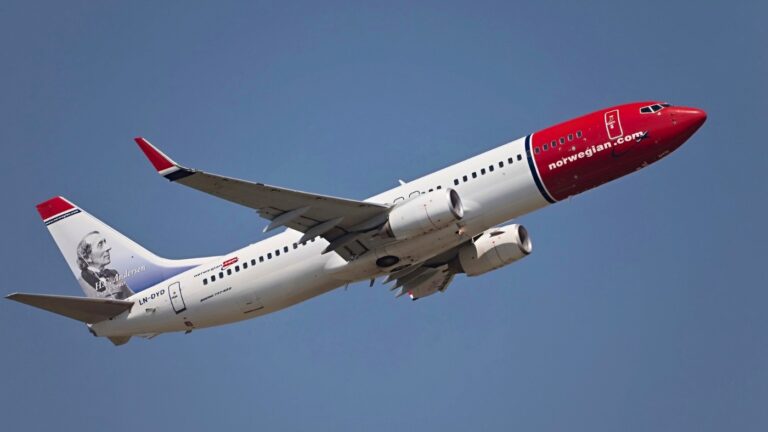
Artists such as Carl Larsson and opera singer Jenny Lind represent Sweden’s cultural influence beyond its borders.
Denmark is similarly well represented. Storyteller Hans Christian Andersen is perhaps the most internationally recognised name, but Norwegian’s selection also includes author Karen Blixen, comedian Victor Borge, and architect Jørn Utzon, best known for designing the Sydney Opera House.
From Finland, the airline has highlighted figures such as writer and social reformer Minna Canth and national poet Johan Ludvig Runeberg, reinforcing the shared cultural history of the Nordic region.
Heroes From Further Afield
As Norwegian opened bases outside Scandinavia, the portraits became increasingly international. One of the most fitting choices from the UK is Roald Dahl, born in Wales to Norwegian parents and raised with strong ties to Norway and the Norwegian language.
British literature is further represented by Jane Austen, whose work has shaped modern storytelling despite modest recognition during her lifetime.
The airline has also used its tail fins to highlight pioneering women from the UK, including Ada Lovelace and Emmeline Pankhurst, particularly around International Women’s Day campaigns.
Spain’s importance as a base is reflected in portraits such as poet Gloria Fuertes, women’s rights activist Clara Campoamor, and explorer Juan Sebastián Elcano, the first person to complete a circumnavigation of the Earth by sea.
From the United States, Norwegian has chosen figures including aviator Charles Lindbergh, writer Mark Twain, and civil rights pioneer Harvey Milk, alongside lesser-known innovators such as radio engineer Arthur Collins.
A Tradition That Outlived Transformation
Few airline branding ideas have lasted as long, or remained as recognisable, as Norwegian’s tail-fin heroes. Through rapid growth, financial turbulence, a pandemic-era crisis and a strategic reset, the portraits have stayed in place.
Today, as Norwegian focuses on efficient short-haul flying across Europe and the Nordic region, the tail fins serve as a reminder of the airline’s original ambition.
They connect modern air travel with history, culture and human achievement, often prompting passengers to look up a name they do not recognise or notice a familiar face in an unexpected place.
For an airline built on movement, the idea of carrying stories as well as passengers feels particularly fitting.
So next time you see a Norwegian aircraft taxi past, take a moment to look at the tail. There is a good chance you are looking at a writer, an explorer, an activist or an artist whose influence reached far beyond their own lifetime.
And you may just discover a new hero at 35,000 feet.


Mark Twain! (of the ones you’ve mentioned)
What about Snowshoe Johnson?
Are the tail-heroes still the same or have some been removed or added?