
The Nordic cross features on the flags of all three Scandinavian countries and their Nordic neighbours. Let's take a closer look at what's behind the design.
A national flag is a small piece of cloth with a great deal of power. Colours and lines can stir patriotism, pride, nostalgia and, occasionally, controversy.
They also act as cultural shorthand. The stars and stripes instantly conjure up the United States. The green field and Arabic script of Saudi Arabia carry very different connotations. Flags communicate before a single word is spoken.
Scandinavia is no exception. Norway, Denmark and Sweden share many traits: intertwined histories, close linguistic ties, familiar foods, and an instinctive understanding of each other’s humour.
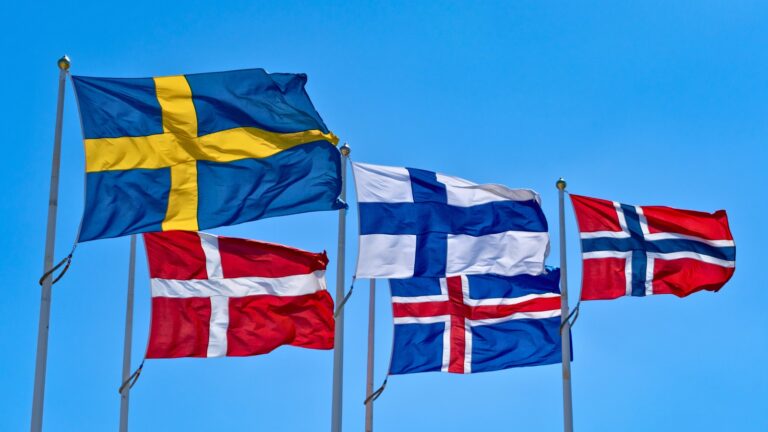
Look skyward in any of the three capitals and you’ll notice another shared symbol snapping in the wind. Their flags all follow the same distinctive pattern.
That pattern is known as the Nordic cross. It appears not only on the flags of Norway, Denmark and Sweden, but also across the wider Nordic region, from Finland and Iceland to the Faroe Islands and Åland.
Once you recognise it, you start seeing it everywhere. But why do so many northern European flags look alike? And what does the design actually mean?
What Is the Nordic Cross?
The Nordic cross is a flag design featuring a horizontal cross that extends to the edges of the flag, with the vertical bar shifted towards the hoist. In other words, the upright part of the cross sits closer to the flagpole than to the outer edge.
That off-centre placement is the detail that makes the design so recognisable. It gives Nordic flags their familiar sense of movement and balance, even when the colours are completely different.
The cross itself is widely understood as a Christian symbol, reflecting the religious history of the Nordic countries. Today, however, most people in the region see the design more as a historical and cultural motif than an active religious statement.
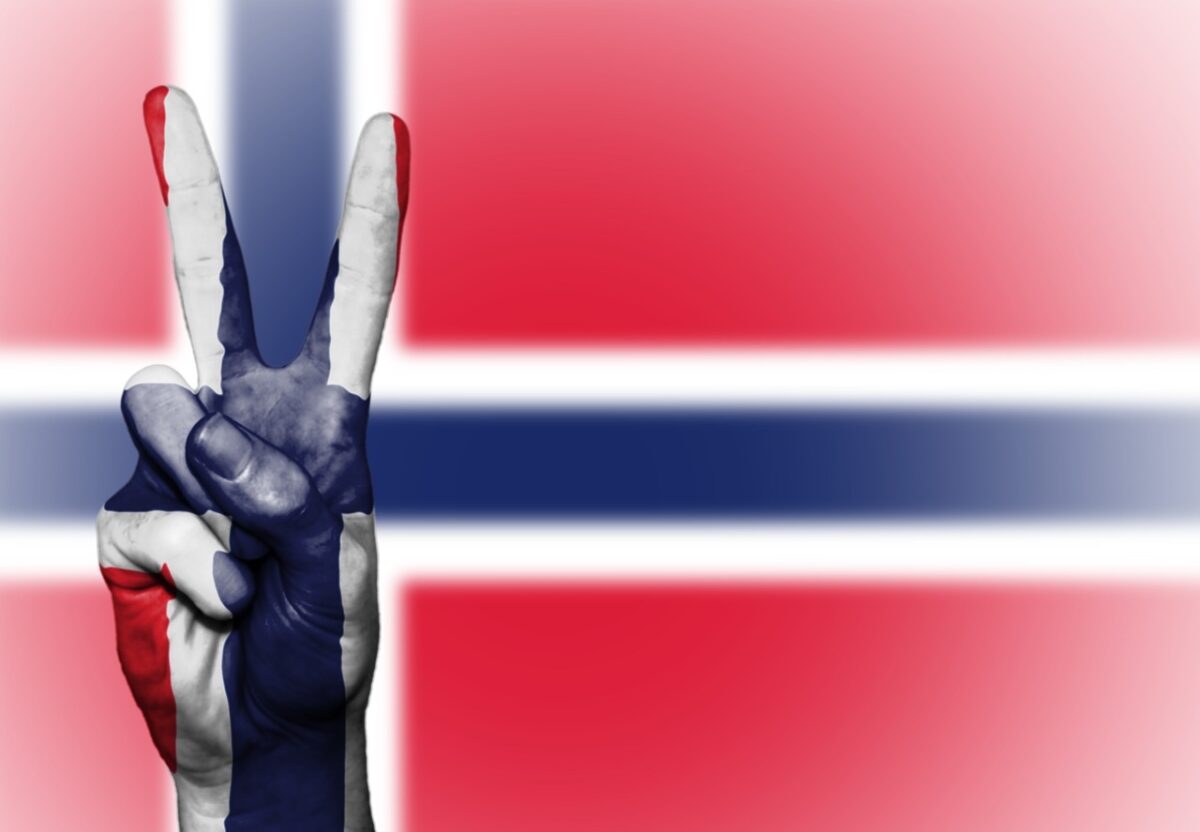
The Nordic cross is sometimes also called the Scandinavian cross, but “Nordic” is the better term if we are talking about all the flags that use it.
Scandinavia usually refers to Norway, Sweden and Denmark. The Nordic region is broader, covering those three countries plus Finland, Iceland, the Faroe Islands, Greenland and Åland. The Sámi homeland, Sápmi, also stretches across parts of northern Norway, Sweden, Finland and Russia.
That distinction matters, because the Nordic cross is not just a Scandinavian design. It has become a visual language for much of northern Europe.
Denmark’s ‘Dannebrog': Where the Story Begins
The story of the Nordic cross begins with Denmark.
The Danish flag, known as the Dannebrog, is a simple white cross on a red field. It is often described as the world’s oldest national flag still in use, although its early history blends legend, symbolism and later documentation.
According to Danish tradition, the Dannebrog fell from the sky during the Battle of Lyndanisse, near present-day Tallinn in Estonia, on 15 June 1219. The dramatic story says the flag appeared at a desperate moment and helped inspire Danish victory.
As with many medieval origin stories, the historical record is more complicated. But the legend remains a powerful part of Danish identity, and the Dannebrog has become much more than a state symbol.
In Denmark, the flag appears everywhere. It is used for birthdays, anniversaries, Christmas decorations, cakes, table settings and family celebrations. You will see it in official contexts, of course, but also in the most domestic and cheerful corners of Danish life.
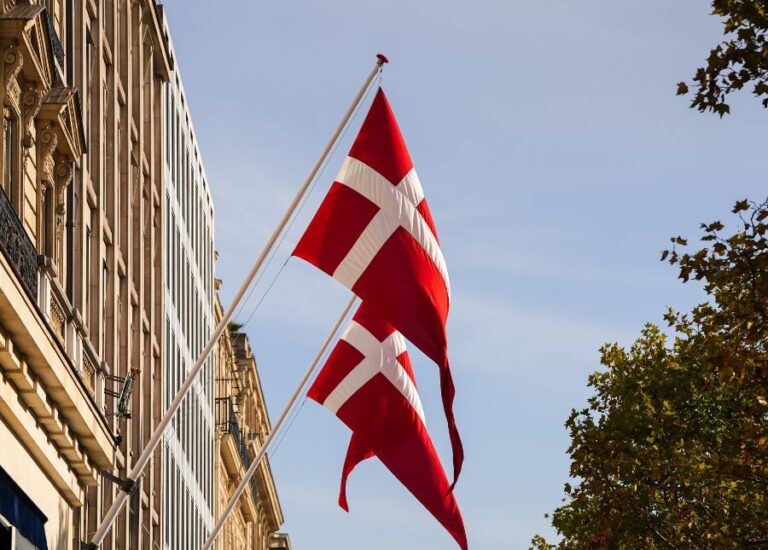
This everyday use makes Denmark unusual. In some countries, flag-waving can feel formal or political. In Denmark, it can simply mean someone is turning seven.
The Scandinavian Flags
The Danish flag set the template, but each Scandinavian country adapted the Nordic cross in its own way.
Sweden’s flag consists of a yellow cross on a blue field. The exact origins of the design are uncertain, but the first confirmed examples of a yellow cross on blue date from the middle of the 16th century. Blue and yellow have long been associated with Sweden and Swedish heraldry.
The result is one of Europe’s most recognisable flags. Bright, clear and bold, the Swedish flag looks simple at first glance, but it carries centuries of royal, military and national symbolism.
Norway’s flag tells a different story. The current Norwegian flag was designed in 1821, during the period when Norway was in a union with Sweden after more than four centuries of Danish rule.
That history is visible in the flag itself. Its red field and white cross echo Denmark’s Dannebrog, while the blue cross is often interpreted as a nod to Sweden. The colours red, white and blue also fitted the political mood of the 19th century, when many new or reimagined national symbols drew on ideas of freedom and constitutional government.
For Norwegians today, the flag is especially associated with 17 May, Norway’s Constitution Day. On that day, streets all over the country fill with flags, bunads, schoolchildren, marching bands and ice cream.
It is a deeply national symbol, but one with a family resemblance to its neighbours.
Finland and Iceland Join the Nordic Family
Finland and Iceland are not Scandinavian countries in the strict sense, but both are firmly part of the Nordic region. Their flags show how the Nordic cross became a wider regional symbol.
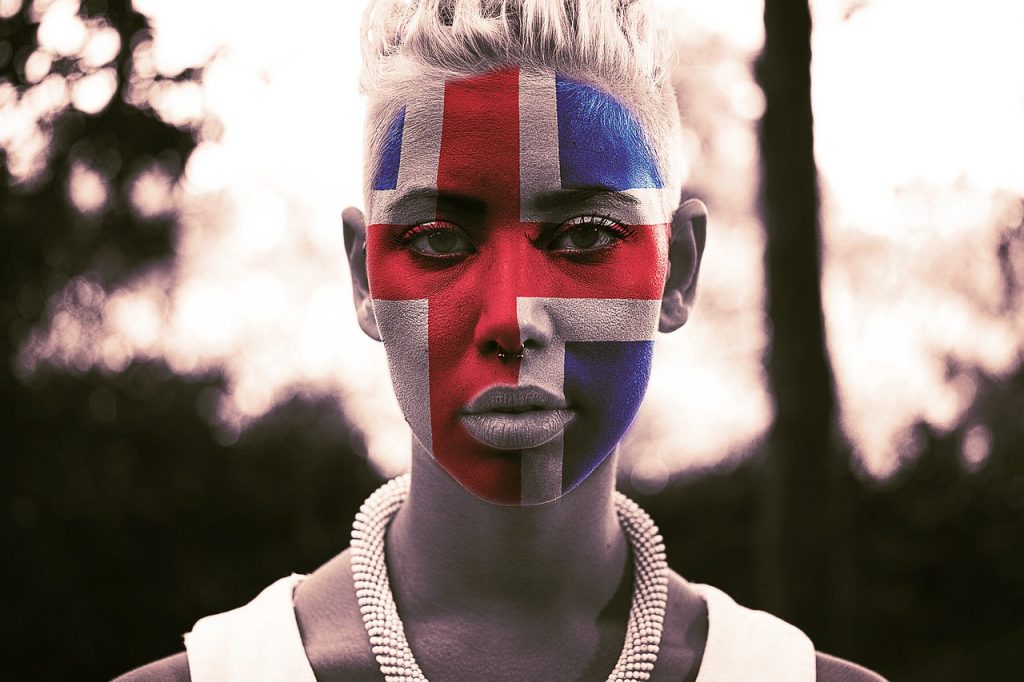
Finland’s flag, the Siniristilippu, has a blue cross on a white field. It was designed by artists Eero Snellman and Bruno Tuukkanen after Finland declared independence from Russia.
The symbolism is easy to understand. The white is often said to represent snow, while the blue represents water in the “land of a thousand lakes.” Just as important, the cross design links Finland visually with the other Nordic countries.
That matters because Finland’s history differs from that of its western neighbours. It was part of Sweden for centuries, then an autonomous Grand Duchy within the Russian Empire before independence in 1917. The flag helped express a modern Finnish identity while also placing the country within a Nordic frame.
Iceland’s flag is another variation on the theme. Its blue field, white cross and red inner cross make it look closely related to Norway’s flag, but with the colours arranged differently.
The Icelandic flag was first adopted as a regional flag in 1915. It became a national symbol when Iceland gained sovereignty from Denmark in 1918, and it remained the flag when Iceland became a republic in 1944.
It was designed by Matthías Þórðarson, who said the colours represented the elements that shaped Iceland: mountain blue, ice and fire.
It is hard to imagine a more fitting palette for Iceland. The flag manages to connect the country to the Nordic family while also evoking a landscape of volcanoes, glaciers and dark northern seas.
The Faroe Islands and Åland
Two of the most interesting Nordic cross flags belong not to independent states, but to autonomous territories.
The Faroe Islands flag is called Merkið, meaning “the banner” or “the mark.” It is a white flag with a red cross outlined in blue. The flag was designed by Faroese students in Copenhagen and first raised in the islands in 1919.
Its recognition came in dramatic circumstances. During the Second World War, Denmark was occupied by Germany while the Faroe Islands came under British occupation.
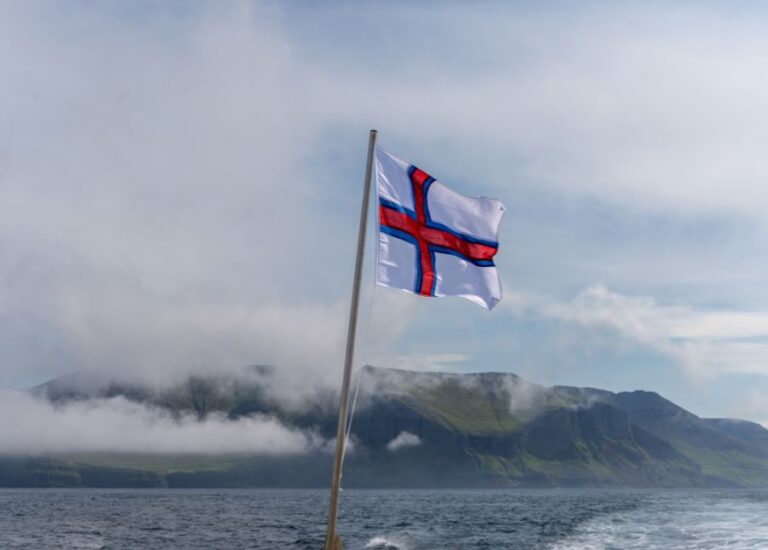
In 1940, the British authorities recognised Merkið for use by Faroese vessels, allowing them to sail under their own flag rather than the Danish one.
That history gives the Faroese flag a special weight. It is not just a neat variation on the Nordic cross. It is a statement of Faroese identity, maritime life and self-government.
Åland’s flag is another layered symbol. Åland is an autonomous, Swedish-speaking region of Finland, located between Finland and Sweden in the Baltic Sea. Its flag has a red cross inside a broader yellow cross on a light blue background.
The design neatly captures Åland’s position between worlds. The blue and yellow recall Sweden, while the red cross adds a Finnish element. In one simple design, the flag expresses language, history, autonomy and geography.
This is one reason the Nordic cross has proved so durable. Within a strict visual framework, there is still room for local identity.
The Nordic Exceptions: Greenland and the Sámi Flag
Not every Nordic flag uses the Nordic cross. That is an important part of the story.
Greenland is part of the Kingdom of Denmark and belongs to the Nordic political and cultural world, yet its flag does not use a cross at all. Greenland’s flag, Erfalasorput, was designed by Thue Christiansen and adopted on 21 June 1985. The name means “our flag.”
The design uses red and white, linking it to Denmark, but replaces the cross with a circle. The circle is usually interpreted as the sun setting on the horizon, and as the return of light and warmth at midsummer.
That choice is striking. Greenland could have selected a Nordic cross design, and such designs were part of earlier discussions. Instead, it chose something different: a flag rooted more directly in Greenlandic landscape, light and identity.
The Sámi flag also stands apart from the Nordic cross tradition. Designed by Astrid Båhl, it was first used in 1986 and approved as an official Sámi flag in 1992.
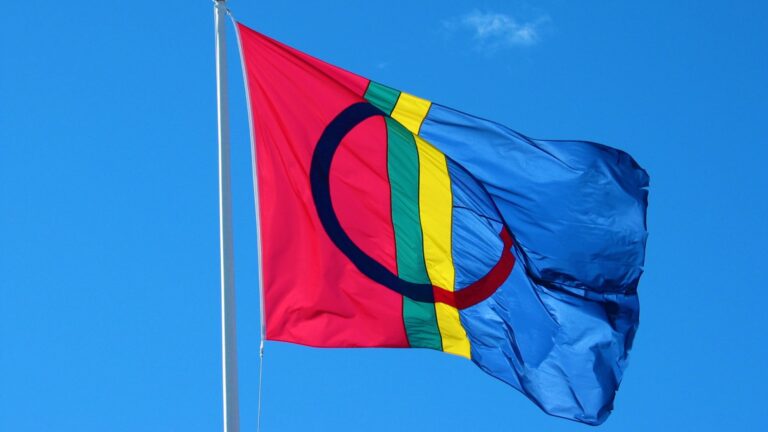
It is used by Sámi people across Sápmi, which stretches through northern Norway, Sweden, Finland and the Kola Peninsula in Russia.
Its strong colours and circular motif are very different from the national flags of the Nordic states. That difference matters.
The Sámi flag is a reminder that the Nordic region is not only a collection of nation states. It is also home to Indigenous identity, cross-border cultures and histories that do not fit neatly inside national lines.
Nordic Crosses Beyond the Nordic Region
The Nordic cross is most strongly associated with the Nordic countries, but the design appears beyond them too.
In the British Isles, the flags of Shetland and Orkney both use Nordic cross layouts. That is no coincidence.
Shetland’s flag is a white Nordic cross on a blue field. It uses the colours of Scotland but the form of the Nordic cross, reflecting the islands’ long historical and cultural ties with Scandinavia. The design was created in 1969 and became official in 2005.
For centuries, Shetland was part of the Norse world. Place names, dialect words, folklore and local identity still reflect that deep northern connection. The flag manages to say two things at once: Scottish colours, Nordic form.
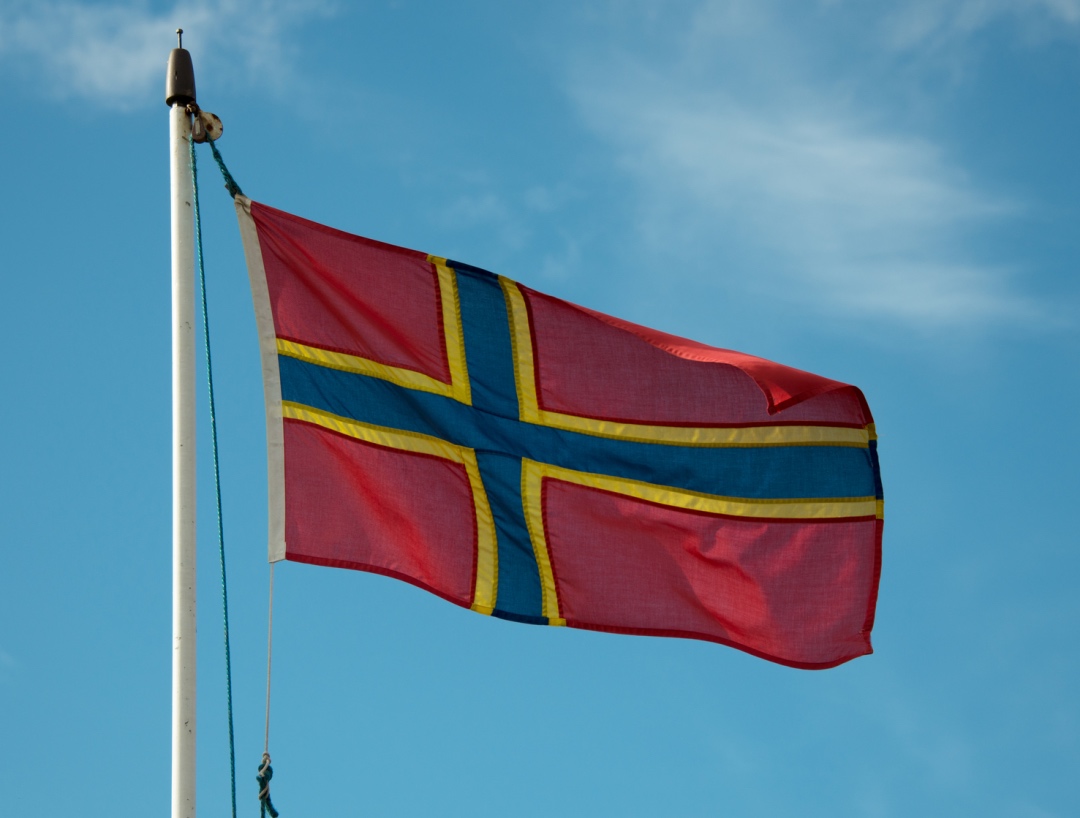
Orkney’s flag does something similar, but with a bolder palette. Chosen through a public consultation in 2007, it features a blue Nordic cross outlined in yellow on a red field. The colours are used to reflect both Scottish and Norwegian heritage.
On both island groups, the Nordic cross is not an imported aesthetic flourish. It is a statement about history.
The design has also appeared in debates about Estonia’s identity. Estonia’s official flag is the blue, black and white tricolour, but in the early years of Estonian independence there were serious discussions about adopting a Nordic-style cross flag instead.
Between 1919 and 1922, some argued that a Scandinavian-inspired cross would better express Estonia’s Nordic ambitions.
The idea never replaced the tricolour. Even so, it reveals something important about the Nordic cross. It does not merely decorate a flag. It can signal belonging, aspiration and cultural orientation.
Why Do Nordic Flags Look So Similar?
The obvious answer is history. Denmark, Norway, Sweden, Finland, Iceland and the wider Nordic territories have been tied together through unions, kingdoms, trade, war, migration, religion and cultural exchange. But the deeper answer is identity.
The Nordic cross provides a shared design language. Each flag belongs to the same visual family, but none is identical.
Denmark is red and white. Sweden is blue and yellow. Norway combines red, white and blue. Finland turns to snow and lakes. Iceland adds fire and ice. The Faroe Islands and Åland use the same structure to express autonomy and local history.
That is the cleverness of the design. It creates both unity and difference.
The cross itself may come from Christian symbolism, but in modern Nordic life its meaning has broadened. For many people, it now represents history, place and belonging more than religion.
It is also simply good design. The Nordic cross is clean, flexible and instantly recognisable. It works at a distance, on a ship, outside a town hall, on a birthday cake, on a football shirt, or in a tiny emoji on a phone screen.
If you’re fond of the Nordic cross, or simply love the crisp aesthetic of Nordic flags, feel free to share this article on Pinterest. There’s a pin ready and waiting for you.


That makes me want to visit even more nordic countries than I thought ! ‘^_^
Now I’m curious. If the cross symbolizes Christianity what about their Viking heritage, how come it is absent from the flag?
I’m wondering the same thing! We are not Christian based people?????
Hi Lorianna, No, from what I have read about the Vikings in the past, they were not Christian based people. They had their own gods w/ their own heaven (Valhalla) also their own hell to which I do not recall the name.
Randi McKinnon(born Larssen from Norway)
Even during the viking era the nordic coutries were christianized. When the flag was constructed it was more or less death penalty to have faith in heathen “viking gods”. So: no heathen symboles there.
I just like history and I have the Internet. So with the stuff I think I know, I googeled to check my facts, and then I’m just freestyling :D. The age of the vikings took place between 793–1066 AD. And probably ended when Christian missionaries got too influential. Ca 150 years later In 1219 Denmark 🇩🇰 got their flag. Supposedly the oldest national flag. Fiddling with norse beliefs were not encouraged at the time. But has seen an increase since 1990:ies. Maybe that will result in a Danish flag in Mammen style, Swedish flag in Urnes style and a Norwegian flag in Oseberg style. But I doubt that since the Scandinavian countries are very proud of their functional design style that strips away all decorations in favour of functionality. But then it might be time for a reaction on that style.
I got carried away. The wiking herritage is probably absent since the Skandinavian countries has been christian for 800 years. So the culture is based on christianity with some small remains of the time before that. Like Christmas 🎄 is still Jul or Juletid in Scandinavia. And it originates from Yule or Yuletid. The pronunciation is pretty much the same. And then we have Midsummer in the middle of the summer. On both occasions we sing about animals like goats (Alle mine gede blocker), foxes (Räven raskar över isen), frogs (Små grodorna) and crows (Prästens lilla kråka).