
The Vikings are remembered for their raids, their gods, and their fearsome reputation across medieval Europe. But behind every raid, every trading journey, and every distant settlement stood something far more practical: a ship.
Viking longships were not merely instruments of war. They were the backbone of an entire society.
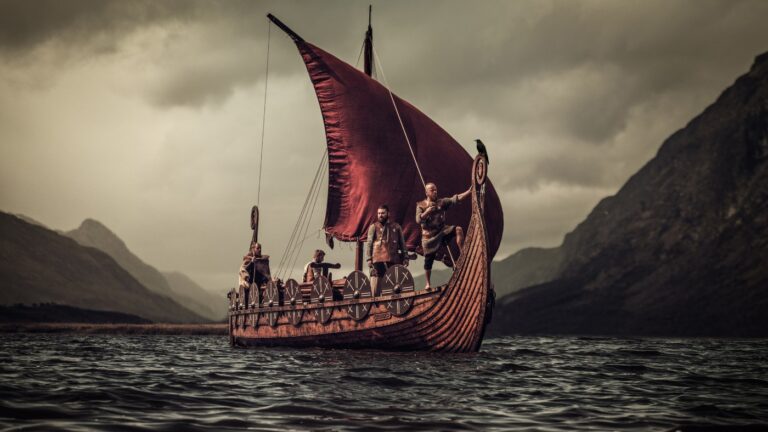
These vessels carried merchants across the Baltic, farmers along the Norwegian coast, warriors into foreign rivers, and explorers across open ocean. Without longships, the Viking Age as we understand it would not have existed.
Developed in Scandinavia between roughly the late eighth and mid-eleventh centuries, longships were perfectly adapted to the landscapes the Norse people called home.
Norway’s deeply indented coastline, its long fjords, and its countless islands made water travel faster, safer, and often more reliable than overland routes. While much of Europe still relied on poor roads and slow land transport, the Viking world moved by sea.
The longship was the solution. Light, fast, flexible, and astonishingly seaworthy, it allowed crews to sail across the North Sea, row deep inland, and land directly on open beaches.
This unique combination of speed and access gave the Vikings their advantage, not only as raiders, but as traders, settlers, and explorers.
The Sea as a Highway in the Viking World
To understand the importance of Viking longships, it helps to forget modern ideas of borders and roads.
In the Viking Age, water connected communities far more effectively than land. Rivers functioned as highways, coastlines as corridors, and sheltered fjords as natural harbours.
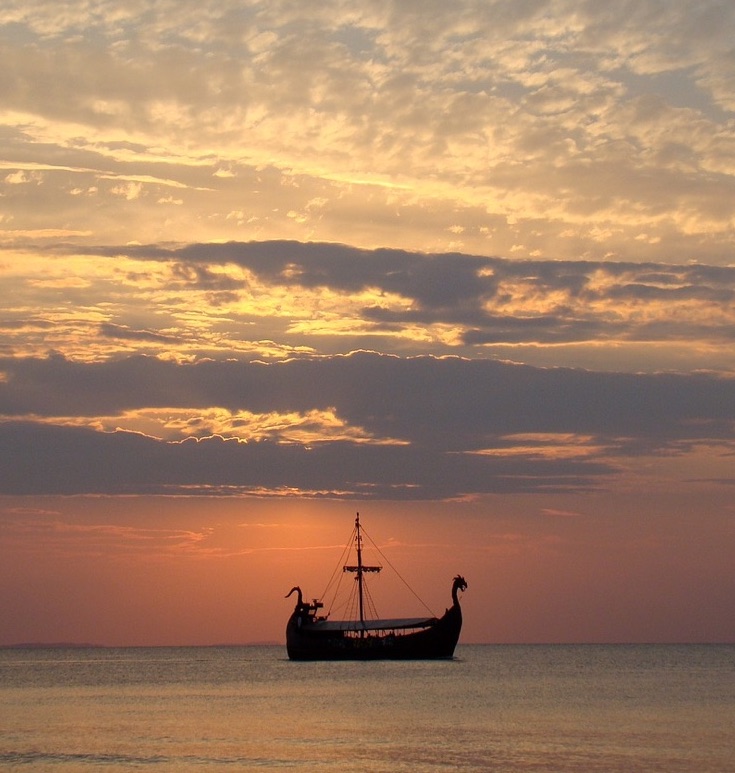
In Norway in particular, longships were essential. Steep mountains and narrow valleys made overland travel slow and dangerous, especially in winter. Coastal sailing, by contrast, allowed people to move efficiently between settlements, transport goods, and maintain social and political ties across long distances.
This maritime orientation shaped Viking society. Ship ownership conveyed status. Kings and chieftains measured power not only in land or wealth, but in the number and quality of ships they could command. Control of ships meant control of movement, trade, and military force.
Longships were therefore not exceptional objects reserved for war. They were everyday tools of mobility in a world defined by water.
What Makes a Viking Longship a Longship
What sets Viking longships apart is not a single feature, but a carefully balanced combination of design choices that made them uniquely versatile.
Longships were clinker-built, meaning their wooden planks overlapped like scales and were fastened with iron rivets. This method produced a hull that was both light and flexible. Rather than resisting waves with brute strength, the ship moved with the sea, reducing the risk of catastrophic damage in rough conditions.
A shallow draft allowed longships to sail in surprisingly little water. They could move up rivers, cross shallow bays, and be pulled directly onto beaches. This eliminated the need for ports or harbours and made sudden landings possible almost anywhere along a coastline.
Longships were symmetrical, with similar bow and stern shapes. This meant they could reverse direction quickly without turning, a valuable advantage in confined waters or during combat.
Combined with oars and a square sail, crews could switch seamlessly between rowing and sailing depending on wind and conditions.
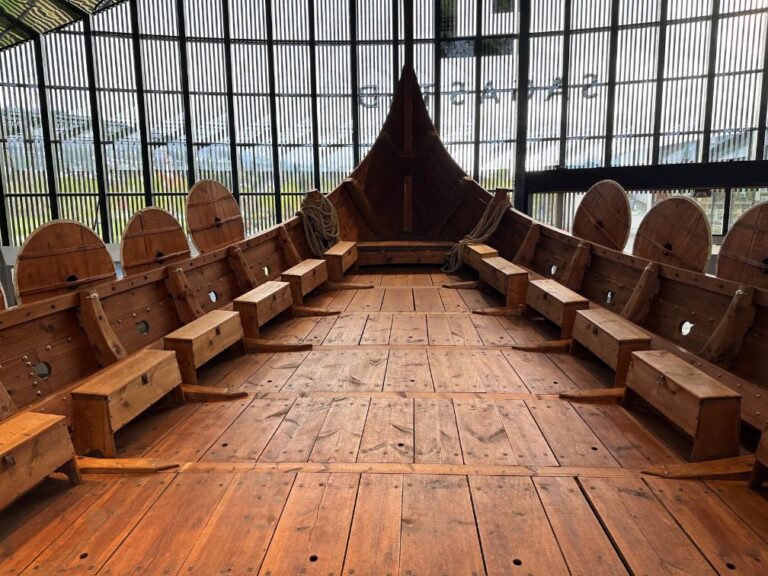
The result was a vessel capable of coastal hopping, river travel, and open-sea voyages, something few contemporary ships could match.
Types of Viking Longships (And Why the Labels Are Complicated)
Modern discussions of Viking ships often divide longships into neat categories such as karvi, snekkja, skeid, and drakkar. These terms are useful, but they simplify a more complex reality.
The Vikings themselves did not work from a strict classification system, and ship designs varied depending on purpose, region, and period.
That said, archaeologists and historians generally group longships into broad types based on size, capacity, and use.
Karvi
The karvi was among the smaller longships and one of the most versatile. These vessels were commonly used for coastal travel, fishing, transport, and local trade.
Their relatively modest size made them easy to crew and well suited to shallow waters. Some karvi may also have been used for military purposes, particularly in regional conflicts.
One of the most famous Viking ships ever discovered, the Gokstad ship, is often associated with this category despite being larger than many typical karvi.
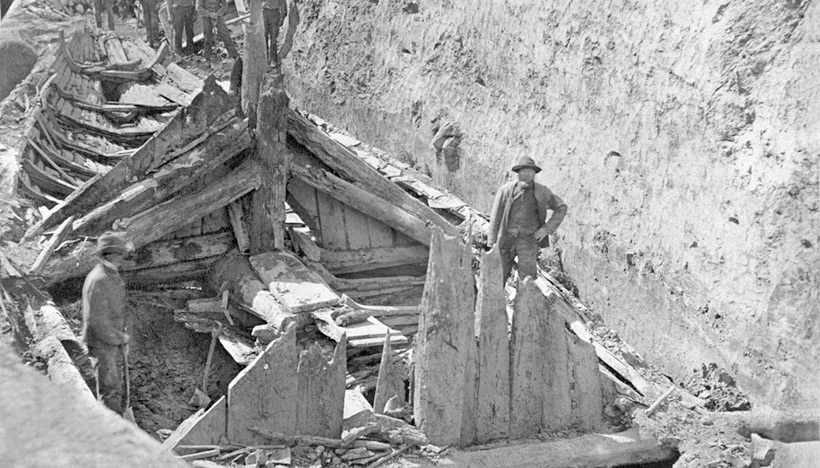
Excavated in Norway in 1880, it dates to around the late ninth century and demonstrates just how capable even medium-sized Viking ships could be. Its seaworthiness suggests it was fully capable of long ocean crossings.
Snekkja
The snekkja was a sleeker, faster vessel, often associated with warfare and long-distance expeditions.
Longer and narrower than many karvi, it carried larger crews and excelled in deeper waters. These ships were fast under both sail and oar, making them ideal for surprise attacks and rapid movement along coastlines and through fjords.
Skeid
Larger still was the skeid, a type of warship associated with kings and powerful chieftains. These vessels carried substantial crews and projected power as much through their presence as through their military capability.
One of the most impressive examples ever found, Roskilde 6, discovered in Denmark in the 1990s, measured around 37 metres in length and dates to the very end of the Viking Age. Ships of this scale represent the peak of Viking shipbuilding.
Drakkar
The drakkar, or dragon ship, occupies a more ambiguous place in history. Often described as being adorned with carved dragon heads and elaborate decoration, these vessels loom large in popular imagination.
While such carvings did exist, especially for ceremonial or elite ships, the term itself may have been more symbolic than technical. Dragon imagery likely served to intimidate enemies and invoke protection rather than define a specific ship type.
Built by Experience, Not Blueprints
Viking shipbuilders did not work from written plans or technical drawings. Instead, shipbuilding knowledge was passed down through generations by practice, observation, and memory. Each vessel was shaped by eye and experience rather than measurement alone.
Timber selection was crucial. Oak was highly valued for keels and structural elements due to its strength and durability, while pine and other softwoods were often used elsewhere.
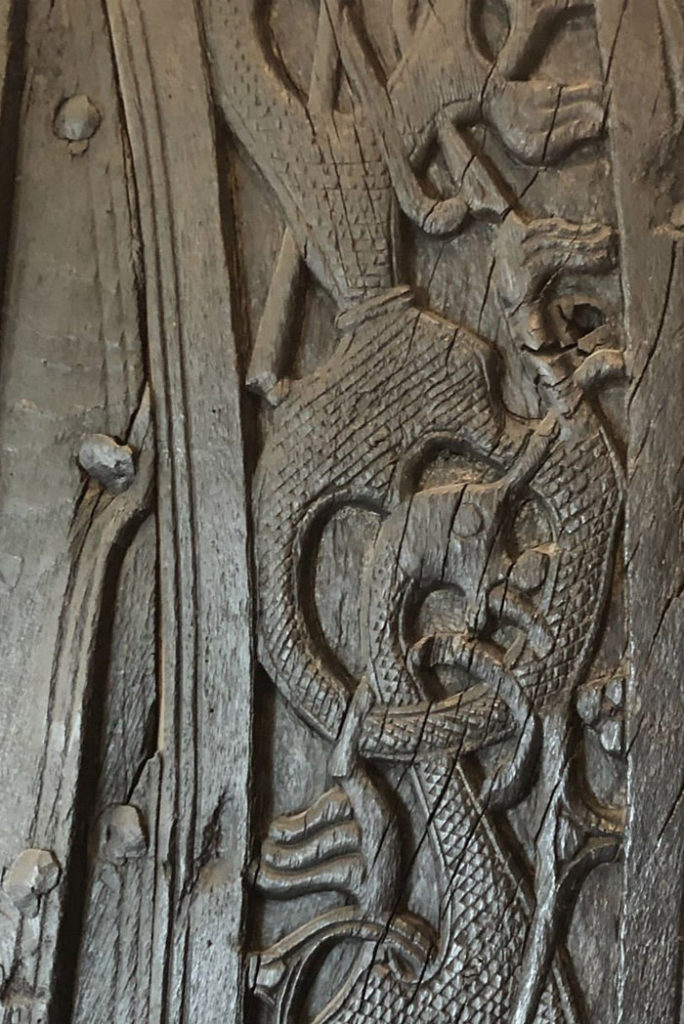
Trees were chosen carefully, sometimes shaped while still growing, to produce naturally curved timbers suited to specific parts of the hull.
Construction began with the keel, the backbone of the ship, followed by the stem and stern posts. Planks were added gradually, riveted together and caulked with wool or animal hair soaked in tar. The finished hull was light but strong, capable of flexing under strain rather than breaking.
Sails were made from wool and required enormous labour to produce. Although no complete Viking Age sails survive, experimental archaeology suggests they were large, heavy, and highly effective, allowing ships to travel long distances with relatively small crews.
Life On Board a Longship
Life aboard a Viking longship was demanding and uncomfortable by modern standards. There were no cabins, no bunks, and little shelter. Crew members sat on rowing benches that doubled as storage chests for personal belongings.
Rowing was exhausting work, particularly on long journeys or in calm conditions. When sailing, crew members still had to manage rigging, steer, and remain alert to changing weather. Sleeping was done wherever space allowed, often wrapped in cloaks for warmth.
Food was simple and preserved for long voyages. Dried fish, meat, grain, and butter formed the basis of onboard meals. Fresh water was carefully rationed, and stops along the coast were often necessary to resupply.
Despite these hardships, longships fostered a strong sense of shared purpose. Crews relied on each other completely, whether trading abroad, exploring unknown waters, or heading into battle.
Sailing Without Maps: Viking Navigation
One of the most remarkable aspects of Viking seafaring is how effectively longships were navigated without maps or compasses.
Viking sailors relied on an intimate knowledge of the natural world. They observed the sun, stars, wind patterns, sea colour, wave behaviour, and wildlife. The presence of certain birds or the smell of land carried on the wind could indicate proximity to shore.
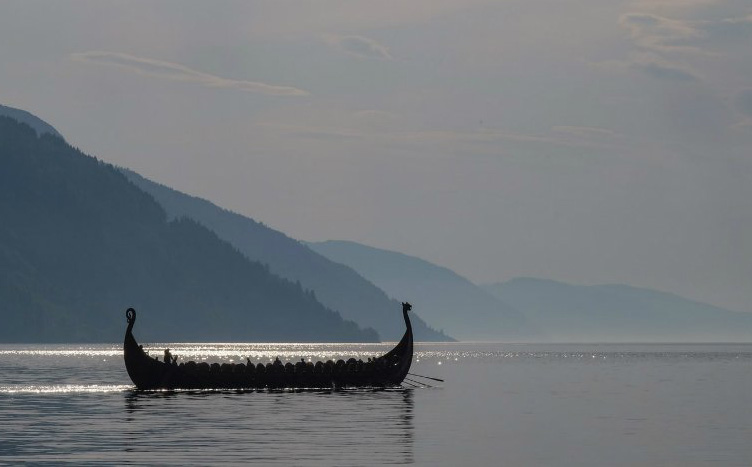
Archaeological finds suggest that simple sun compasses or sundials may have been used to track direction during daylight hours.
There is also ongoing debate about the use of sunstones, crystals that may have helped locate the sun in cloudy conditions. While intriguing, such theories remain contested and should be treated with caution.
What is clear is that Viking navigation depended on accumulated experience and oral knowledge rather than instruments alone. Routes were learned, shared, and refined over generations.
From Fjords to Open Ocean
Perhaps the greatest achievement of Viking longships was their ability to operate across vastly different environments.
These ships navigated Norway’s narrow fjords, crossed the North Sea to the British Isles, followed rivers deep into continental Europe, and carried settlers to Iceland, Greenland, and beyond. The same fundamental design worked in sheltered waters and open ocean alike.
This adaptability explains how relatively small Scandinavian communities exerted such a wide influence during the Viking Age. Longships did not merely enable raids. They enabled sustained contact, trade networks, and migration on a scale previously unimaginable.
What Archaeology Has Revealed
Much of what we know about Viking longships comes from archaeological discoveries, particularly ship burials and submerged wrecks. In Norway, finds such as the Gokstad and Oseberg ships have provided invaluable insight into construction techniques, decoration, and symbolism.
These ships, now displayed at the soon-to-be-reopened Museum of the Viking Age in Oslo, reveal both the practical and ceremonial roles ships played in Viking society. Ship burials in particular highlight how closely vessels were associated with status, identity, and the afterlife.
One of the most dramatic Viking ship burials ever discovered in Norway is the Myklebust ship, found at Nordfjordeid on the west coast.
Unearthed in 1874, the burial mound contained the remains of a vast longship believed to have belonged to a powerful local ruler, possibly a king. Although the ship itself had been burned as part of the burial ritual, thousands of rivets and fragments allowed archaeologists to reconstruct its size and form.
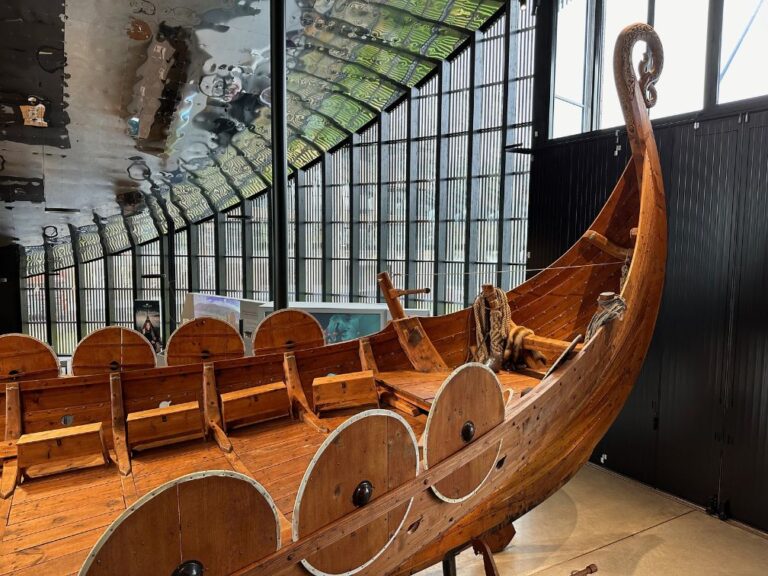
Based on these findings, the Myklebust ship is thought to have been around 30 metres long, making it one of the largest Viking ships ever identified in Norway.
A full-scale reconstruction now dominates the visitor centre at Sagastad Viking Center, where the ship has been brought back to life as a powerful reminder of both Viking craftsmanship and the ceremonial importance of ships in Norse society.
Unlike museum displays behind glass, the reconstructed vessel offers a visceral sense of scale, ambition, and prestige, reinforcing the idea that longships were symbols of authority as much as practical tools.
Experimental archaeology, including full-scale replicas sailed across historic routes, has further demonstrated the remarkable seaworthiness of longships. These reconstructions consistently confirm that Viking ships were not crude or primitive, but highly refined tools shaped by centuries of maritime experience.
Why Longships Still Matter in Norway Today
Longships remain one of the most enduring symbols of Norway’s past. They appear in art, literature, festivals, and national iconography, representing exploration, resilience, and connection to the sea.
Modern Norwegians may travel by ferry, cruise ship, or offshore vessel rather than longship, but the maritime mindset endures. The same coastline that once shaped Viking shipbuilding still defines how people live, work, and move through the country.
Understanding Viking longships is therefore about more than appreciating ancient engineering. It is about understanding how geography, technology, and culture combined to create a society that looked outward, embraced the sea and left a lasting mark on European history.
Did you enjoy this article? If so, why not share it on Pinterest so others can find and enjoy it to? We've even made this awesome pin to make your account shine:


Very interesting article on the Viking Ship construction and kind. Ot is common knowledge now of how the propulsion was made to get from A-B and of course their skill in navigation with little help from instruments.
However, I have made a lot of research in trying go find the kind of shop that would stow booty, valuable articles. food & water and of course extra clothes for rough or change of weather.
It seems that most vessels were single deck with personal chests that the oarsmen sat on with stowage. But this is of course just like having a Drawer! So not much would be held in there exceptionally rough weather clothes. As if everything was on the single deck there would be no space to prepare for attack nor defend.
Stuff was stored below deck with the ballast.
Well written and researched article on those magnificent ships.