
Norway’s iconic Preikestolen hike is one of the most popular day trips from Stavanger, especially among international visitors. Here are your options for getting to Pulpit Rock.
Hiking in the mountains and fjords of Norway has long attracted visitors from across the world. But few places have captured the imagination quite like Preikestolen.
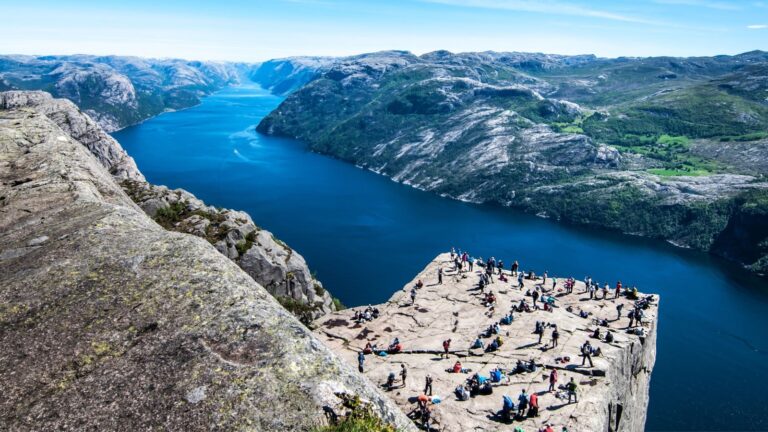
Known in English as Pulpit Rock, the famous flat-topped cliff rises 604 metres above the Lysefjord. Photos of hikers standing on the edge have been shared around the world, making it one of Norway’s best-known natural attractions.
Preikestolen is often described as a Stavanger day trip, and that’s fair enough. It’s one of the most popular excursions from the city. But the hike itself is not in Stavanger, and getting there requires a little planning.
The good news? These days, reaching the trailhead is much easier than it used to be.
Preikestolen Or Pulpit Rock?
Before we get into the travel details, a quick word about the name.
The Norwegian name is Preikestolen, which translates roughly as “the pulpit.” In English-language travel guides and tour descriptions, you’ll often see the name Pulpit Rock.
Both names are widely used, including by tour operators, cruise lines and visitors. In this article, I’ll use both.
🇳🇴 Preikestolen Travel Resources: Make the most of your trip to Stavanger and Pulpit Rock with these recommended resources.
🛏️ Book Accommodation in Stavanger
🚘 Car Rental in Stavanger
👣 Book Tours & Experiences in Stavanger
🚨 Don't Forget Travel Insurance
Where Is Pulpit Rock?
Preikestolen overlooks the Lysefjord in Rogaland, to the east of Stavanger. Although it is commonly marketed as one of the best things to do in Stavanger, the trailhead is some distance from the city.
By road, the journey from central Stavanger to the Preikestolen parking area is around 39km. Depending on traffic, tolls and exactly where you start from in Stavanger, the drive usually takes around 40 minutes.
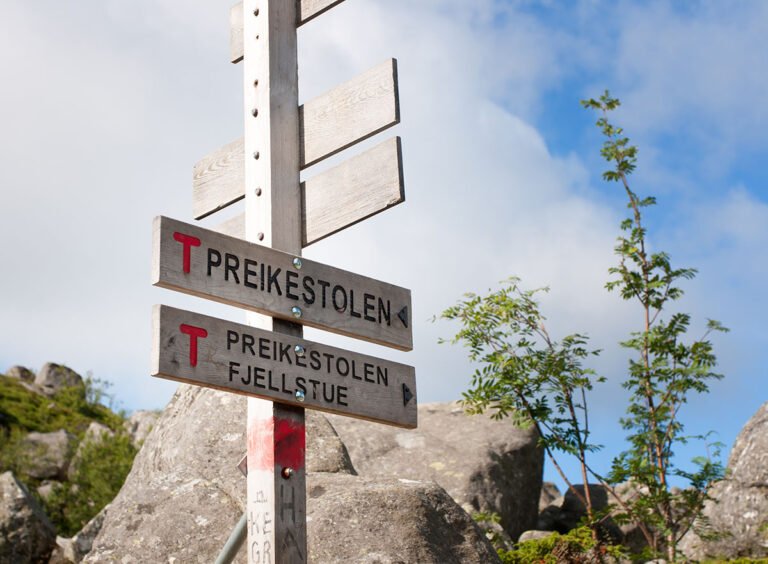
The trail begins at Preikestolen BaseCamp, formerly known by many as Preikestolen Fjellstue. This is the main hub for hikers, with parking, toilets, accommodation, food and information.
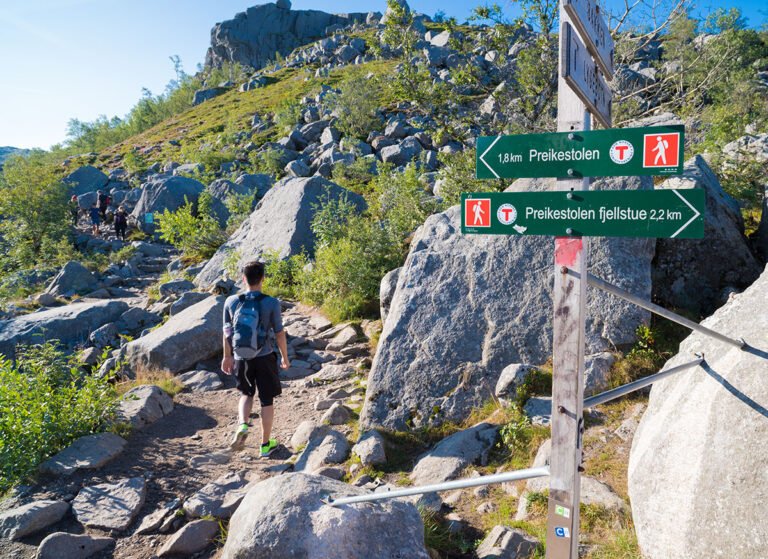
From there, the hike to the famous clifftop is about 8km in total, there and back. Official guidance suggests allowing around four hours for the round trip. That estimate does not include long photo stops, a picnic on the plateau, or extra time needed in poor weather.
The hike is not considered extreme by Norwegian standards, but it is not a casual stroll either. The path includes rocky sections, uneven ground and around 500 metres of total elevation gain. Good footwear and sensible clothing are essential.
How To Get From Stavanger To Preikestolen
Most international visitors planning the hike will base themselves in Stavanger. That makes sense, as the city has plenty of hotels, restaurants, museums and transport connections.
If you have researched this trip before, you may have seen old advice involving a ferry from Stavanger to Tau. That used to be the standard route.
Today, most visitors no longer need to take a ferry. Since the opening of the Ryfast road project, including the 14.4km Ryfylke Tunnel, the road journey from Stavanger to the Preikestolen area has become much more straightforward.
That said, there are still several ways to reach the trailhead. The best option depends on your budget, your timetable, the season, and whether you want to combine the hike with a Lysefjord cruise.
Driving To Preikestolen From Stavanger
If you have a car, driving is the most flexible way to reach Preikestolen. From central Stavanger, the route takes you through the Ryfast tunnel system towards Tau and Jørpeland.
From there, continue through Jørpeland and follow signs for Preikestolen and Preikestolen BaseCamp. The drive is relatively simple, but there are two important things to know: tolls and parking.
The Ryfast tunnels carry road tolls. These are automatic, so rental car drivers should check how tolls are handled by their rental company. Depending on your exact route, you may pass more than one toll point.
Parking at Preikestolen is also charged. At the time of writing, parking for cars costs NOK 275 for more than two hours. Short stops are cheaper, while motorcycles and buses have their own rates. Bicycles can be parked free of charge.
There are two main parking areas at Preikestolen, with around 1,000 spaces in total. The main area, P1, is closest to the start of the trail. P2 at Moslimyrå is used when the main parking area fills up.
There are also electric car chargers at P1, but you should not rely on charging being available at busy times.
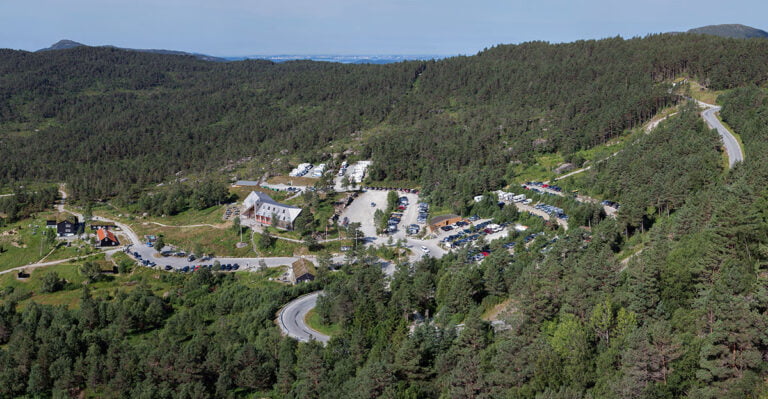
In the peak summer season, especially on sunny weekends, the parking areas can fill up. The busiest period is generally between 8am and 4pm. On very busy days, the parking areas may be temporarily closed.
If you are driving in summer, it is worth starting early or planning a late afternoon hike. Both options also give you a better chance of a quieter experience on the trail.
Taking The Bus To Preikestolen
For many visitors, the easiest option is to take a direct bus from Stavanger to Preikestolen BaseCamp.
Several operators run seasonal bus services aimed at hikers. These are not guided hikes. In most cases, the bus simply takes you from Stavanger to the trailhead and brings you back later in the day. That may sound simple, but it is exactly what many visitors need.
The direct buses save you the hassle of driving, paying tolls, finding parking, and worrying about whether the car park will be full when you arrive. They are especially useful for solo travellers and anyone who does not want to rent a car just for one day.
Two of the best-known options are Go Fjords and Pulpit Rock Tours. Both operate between Stavanger and Preikestolen, although their timetables vary by season.
Pulpit Rock Tours typically offers multiple departures during the main hiking season, with several return options from the trailhead. This can be useful if you want more flexibility, or if you are staying overnight near Preikestolen.
Go Fjords also operates seasonal bus transport to the trailhead, with more frequent services in the busiest summer months.
Whichever operator you choose, book in advance online. Tickets are generally not bought on the bus, and return tickets are not usually transferable between companies.
Always check the current timetable before making plans, especially outside the main summer season.
Before you book, I recommend checking out Stavanger tours on Viator to see if you can find a tour that suits you better.
Can You Get To Preikestolen By Public Transport?
It is possible to get most of the way to Preikestolen using ordinary public transport, but it is not usually the most convenient option.
Kolumbus bus 100 runs from Stavanger towards Jørpeland. This can be useful if you are travelling outside the direct bus season, or if you are staying in Jørpeland rather than Stavanger.
However, the public bus does not take you all the way to the Preikestolen trailhead. From Jørpeland, you still need to reach Preikestolen BaseCamp. That means taking a taxi or arranging another form of onward transport.
In theory, you could walk from Jørpeland to the trailhead, but it is not something I would recommend for most visitors. The walk adds several kilometres before you have even started the actual hike, including uphill sections.
For most people, the direct seasonal bus from Stavanger is a better choice when it is running. Outside that season, the public bus to Jørpeland plus a taxi to the trailhead is a more realistic option.
Taking A Fjord Cruise & Hiking Preikestolen
One of the best options for first-time visitors is to combine a Lysefjord cruise with the Preikestolen hike.

Several visitors see photos from the clifftop but forget that the Lysefjord itself is a major part of the experience. A cruise from Stavanger lets you see the fjord from water level, including the towering cliff from below.
Some operators offer combined packages that include a fjord cruise from Stavanger, onward transport to the Preikestolen trailhead, and time to complete the self-guided hike.
This is not the cheapest way to visit Preikestolen, but it can be a memorable one. You get both classic perspectives in one day: looking up at the cliff from the fjord, then looking down from the top.
It is also a good option if you want a more complete Lysefjord experience without organising several separate pieces of transport yourself.
Seeing Pulpit Rock Without Hiking
Not everyone wants to hike to Preikestolen, and that is perfectly fine.
If you want to see Pulpit Rock without taking on the trail, a Lysefjord sightseeing cruise from Stavanger is the best option. These cruises sail into the fjord and usually pass beneath the famous cliff.
You will not get the famous view from the top, of course. But you will see the scale of the cliff, the narrowness of the fjord, and some of the scenery that makes this part of Rogaland so dramatic. Just bear in mind the clifftop appears tiny from water level!
Staying Overnight Near Preikestolen
Preikestolen does not have to be a day trip from Stavanger. Staying near the trailhead can make a big difference to your experience, especially in summer.
The best-known accommodation is Preikestolen BaseCamp, right by the start of the trail. The mountain lodge has a striking design and a superb location, making it ideal for an early morning or evening hike.
Staying here allows you to avoid the busiest part of the day. You can start the hike before many day-trippers arrive, or head up later in the afternoon once the largest crowds have begun to leave.
BaseCamp also offers practical services for hikers, including food and equipment rental. This can be helpful if the weather changes or if you realise you have not packed quite as well as you thought.
Another option is Hikers’ Camp, also connected with BaseCamp. This offers simple wooden tent-style accommodation close to the trailhead. It is a more outdoorsy experience, but with more comfort than wild camping.
There is also accommodation in and around Jørpeland, including campsites, cabins and guesthouses. Staying in Jørpeland can work well if you have a car, or if you are using a combination of public transport and taxi.
If you are travelling by campervan or motorhome, check the rules carefully before arrival. The main Preikestolen parking area is for day parking, not overnight camping in vehicles.
Can You Camp Near Preikestolen?
Wild camping is part of Norway’s outdoor tradition, but that does not mean you can camp anywhere without thought.
Norway’s right to roam allows camping in uncultivated land, but you must keep a respectful distance from houses and cabins, avoid damaging nature, and leave no trace. Around a popular trail such as Preikestolen, responsible behaviour is especially important.
If you want a simple and stress-free option, use an official campsite or stay at Hikers’ Camp. This reduces pressure on the landscape and gives you access to basic facilities.
When Is The Best Time To Visit Preikestolen?
Preikestolen can be hiked year-round, but conditions vary enormously.
For most visitors, the main hiking season runs from spring to autumn. June, July and August are the busiest months, with the best chance of mild weather but also the biggest crowds.
In summer, start early if you can. Beginning the hike before 8am gives you a better chance of finding parking and enjoying a quieter trail. A late afternoon hike can also be rewarding, but only if you have enough daylight and are confident about the conditions.
Spring and autumn can be excellent times to visit, but weather and trail conditions are less predictable. You may encounter wet rocks, mud, wind, fog or even icy patches depending on the date and recent weather.
Winter is a different matter. The hike is possible, but it requires more preparation and the right equipment. Snow, ice, limited daylight and rapidly changing weather can make the trail much more challenging.
If you want to hike Preikestolen in winter and you are not experienced with Norwegian winter hiking, consider booking a guided hike.
What To Bring For The Hike
Although Preikestolen is one of Norway’s most accessible famous hikes, it is still a mountain hike.
Wear proper walking shoes or hiking boots. The trail includes stone steps, rocky sections and uneven ground, which can be slippery in wet weather.
Bring a windproof and waterproof outer layer, even if the weather looks fine when you leave Stavanger. Conditions can change quickly in the mountains and beside the fjord.
You should also bring enough food and water. There are no shops or water refill points along the trail itself. Once you leave BaseCamp, you need to be self-sufficient until you return.
In summer, sun protection can be useful. In spring, autumn and winter, extra warm layers are sensible. A fully charged phone is also important, but don’t rely on it as your only source of navigation or safety.
How To Avoid The Crowds At Preikestolen
There is no way around it: Preikestolen is popular. On sunny summer days, you should expect a steady stream of hikers on the trail and plenty of people at the top. The famous photo spot can also develop informal queues. If that sounds unappealing, timing is everything.
Stay overnight near the trailhead and hike early in the morning. Alternatively, arrive later in the afternoon once the busiest wave of day-trippers has passed. Outside peak season, weekdays are generally quieter than weekends.
You can also manage your expectations. Preikestolen is famous for a reason, and you are unlikely to have the place to yourself in July. But even on a busy day, the view across the Lysefjord is still extraordinary.
🇳🇴 Preikestolen Travel Resources: Make the most of your trip to Stavanger and Pulpit Rock with these recommended resources.
🛏️ Book Accommodation in Stavanger
🚘 Car Rental in Stavanger
👣 Book Tours & Experiences in Stavanger
🚨 Don't Forget Travel Insurance
Other accommodation close to the trailhead includes Hikers' Camp, which is managed by Basecamp and offers 24 wooden tents. Mattresses are provided but guests must bring their own sleeping bags.
There's also some accommodation farther away in Jørpeland. About 4km away from the trailhead, Preikestolen Camping offers year-round space for pitching your tent or parking your campervan, caravan or RV.


Hello, would you recommend visiting Preikestolen in late November, or will the weather and snow make it not worth visiting?
Hi, if we were to be arriving by ferry from Bergen are there any options apart from taxi for getting from the ferry arrival/Risavika direct to Preikestolen base camp?