

Norway is one of the world’s most important countries for Atlantic puffins, but these beloved seabirds are not as easy to see as many visitors expect.
Aside from penguins, puffins must surely be among the world’s most smartly dressed birds.
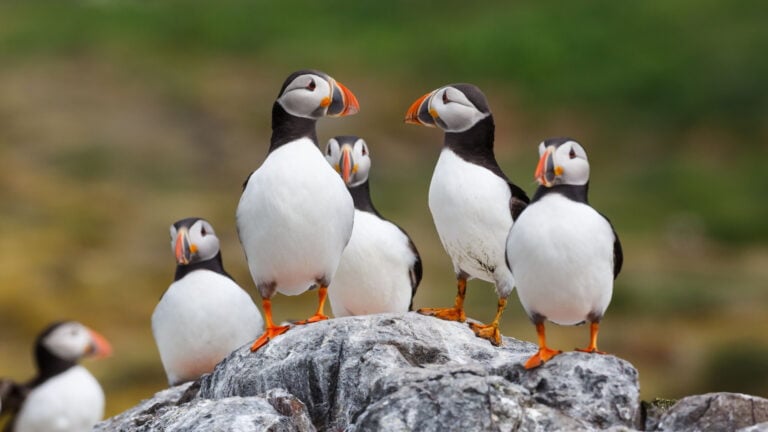
With their black and white plumage, bright orange feet, expressive eyes and colourful beaks, they have become a favourite of birdwatchers, photographers and casual wildlife fans alike.
But while puffins are some of the most beloved birds in Norway, they are not especially easy to find. For much of the year, Atlantic puffins live far out at sea. They come ashore mainly during the breeding season, when they return to steep bird cliffs, grassy slopes and rocky islands along the coast.
That means seeing puffins in Norway takes a little planning. You need to know where to go, when to go, and in many cases, how to visit responsibly.
There is another reason to plan carefully. Puffins may appear abundant in some places, but the Atlantic puffin is considered endangered on the Norwegian mainland because of a steep long-term decline in the population.
That makes a puffin encounter in Norway not just a memorable wildlife experience, but also a reminder of how fragile life along the coast can be.
Introducing The Atlantic Puffin
The species found in Norway is the Atlantic puffin, known in Norwegian as lunde. Its scientific name, Fratercula arctica, hints at its northern distribution, although “Atlantic puffin” is the common English name.
Puffins spend most of their lives at sea. They are strong swimmers and use their wings to “fly” underwater in search of small fish. Their webbed feet act almost like a rudder, helping them steer while diving.
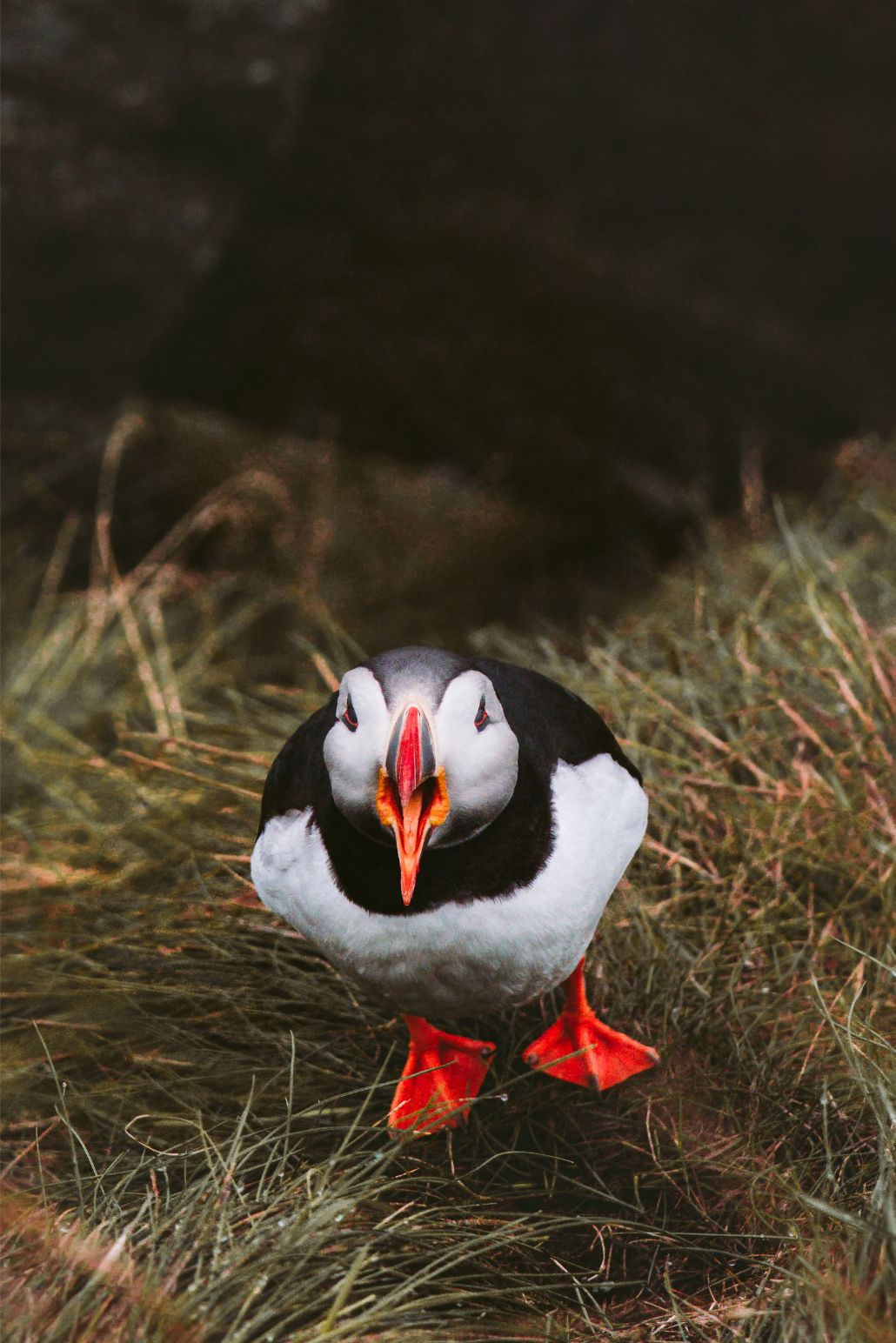
On land, puffins are much less graceful. Their upright stance, waddling walk and slightly comic expression are a big part of their appeal. But behind the charming appearance is a remarkably well-adapted seabird.
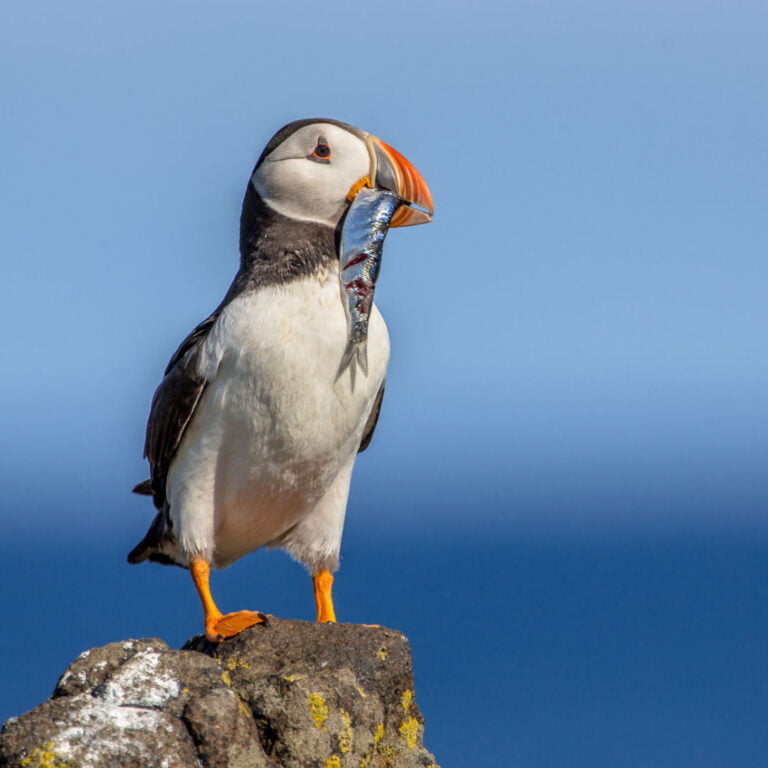
Puffins nest in burrows, crevices or among rocks, depending on the colony. They typically return to the same breeding areas year after year, often with the same partner. During the breeding season, adults make repeated trips out to sea to catch fish for their chick.
This connection between land and sea is crucial. If the right fish are not available close enough to the colony at the right time, breeding can fail. That is one reason why puffins have become such an important species for scientists studying changes in the marine environment.
Are There Still Plenty Of Puffins In Norway?
The answer is yes and no. Norway does remain one of the most important countries for Atlantic puffins.
Artsdatabanken, the Norwegian Biodiversity Information Centre, has noted that Norway’s puffin population is still large in absolute terms, with close to three million mature individuals estimated in the country.
But the Red List is not simply a list of rare species. A species can be numerous and still be in serious trouble if the population is declining quickly.
That is the case with the Atlantic puffin on mainland Norway. The species is listed as endangered because monitoring data show a decline of 50 to 80 percent over the last three generations.
The reasons are complex, but food availability plays a major role. Puffins rely on small fish to feed their chicks, and changes in ocean temperature, fish stocks and marine ecosystems can all affect breeding success.
Research from SEAPOP has linked poor breeding performance in declining puffin populations to food availability and wider changes in the marine environment.
This does not mean visitors should avoid puffin sites. In many places, organised boat trips and marked trails are designed to let people experience bird cliffs without disturbing the birds. But it does mean visitors should take local rules seriously, keep to paths, avoid approaching nests and never use drones near colonies.
When To See Puffins In Norway
The best time to see puffins in Norway is usually from late spring to summer.
Exact dates vary by location, but puffins generally come ashore for the breeding season from April and remain close to the colonies through early August. June and July are typically the safest months for visitors planning a trip around puffin watching.
Some places have famous local timings. On Lovund, the puffins are traditionally said to return around 14 April, a date known locally as Lundkommardagen. At Bleiksøya in Vesterålen, local tourism sources also describe the birds as arriving around mid-April and departing in August.
Even so, nature does not run to a tourist timetable. Weather, sea conditions and local regulations can all affect access. Before making a long journey specifically to see puffins, check with local tourism offices, tour operators or accommodation providers.
Runde
Runde is the best-known puffin location in southern Norway and one of the most practical options for many visitors.
The island lies off the Sunnmøre coast, south-west of Ålesund. It is small, windswept and home to only a small year-round population, yet during the breeding season the cliffs attract huge numbers of seabirds.
Puffins are the main draw for many visitors. The classic Runde puffin experience involves hiking up to the bird cliffs in the evening, when the birds are most active around the colony.
Local operators also offer boat trips and puffin safaris, which can be a good alternative for visitors who prefer not to hike. Runde tourism sources describe April to August as the puffin season, with evening often the best time of day to see them.
Runde is relatively accessible by Norwegian puffin standards. Thanks to road connections and bridges, you can reach the island by car. That said, it still takes more planning than the map might suggest.
The drive from Ålesund is usually more than two hours, so many visitors choose to stay closer to Runde, perhaps in Ulsteinvik, Fosnavåg or on the island itself.
The island is also known for the Akerendam shipwreck. The Dutch ship sank near Runde in 1725, and when the wreck was rediscovered by divers in the 1970s, tens of thousands of coins were found.
If you visit Runde, keep to marked paths. The island is a protected and sensitive bird area, and burrows can be surprisingly close to walking routes.
Lovund, Helgeland
ALovund is one of Norway’s most distinctive puffin destinations, partly because the birds are so deeply woven into local identity.
The island lies off the Helgeland coast in Nordland, and the puffin colony is among the largest in the region. Visit Helgeland describes Lovund as having Helgeland’s largest puffin colony, with around 200,000 to 300,000 birds.
The puffins usually arrive around Lundkommardagen, 14 April, when they return from the open sea to settle in the scree below Lovundfjellet.
For visitors, Lovund is a wonderful addition to a longer journey along the Helgeland coast. The island combines coastal scenery, a strong island community and a very specific wildlife experience.
However, this is not a place for a rushed stop. Getting to Lovund takes planning. There are ferry and express boat connections from the mainland, including routes linked with Sandnessjøen and other Helgeland communities. Schedules vary by season, so check current timetables before building an itinerary around the island.
Once on Lovund, seeing the puffins usually involves walking. The colony is not something you simply view from a car park. That is part of the appeal, but it also means visitors should be prepared with proper footwear, weatherproof clothing and respect for local guidance.
Røst, Lofoten
Røst, at the far end of Lofoten, is one of Norway’s most important puffin places. The island municipality is remote, flat and deeply connected to the sea.
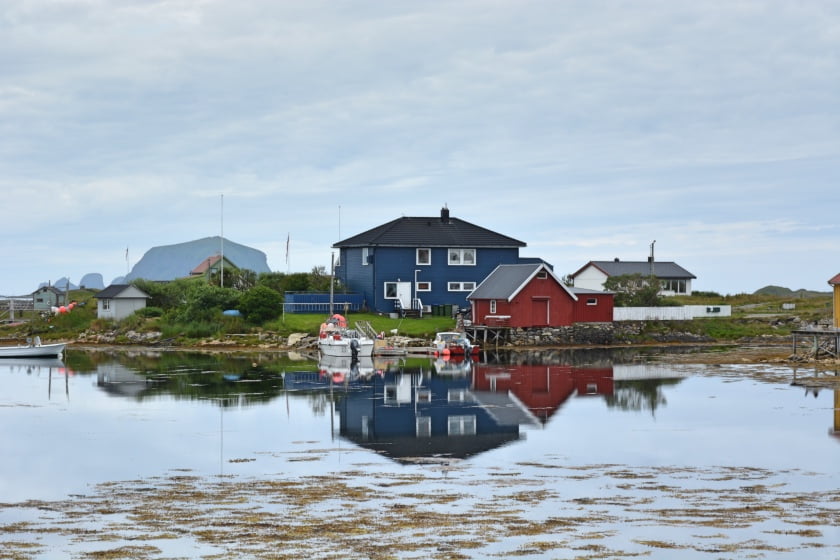
It is best known as a fishing community, but birdlife has long been central to its identity. The bird cliffs around Røst were once home to one of the world’s great puffin colonies.
That remains true in historical and ecological terms, but the population has suffered a dramatic decline.
Research and monitoring from Røst have shown major long-term reductions in puffin numbers and repeated problems with breeding success, especially linked to food availability for chicks. SEAPOP has described Røst as a key site for understanding the decline of Atlantic puffins in the north-east Atlantic.
For visitors, Røst is still a fascinating birding destination, but it is a place where the history of abundance and the reality of decline sit side by side.
Getting to Røst requires effort. There are ferry connections from the Lofoten road system and flights from Bodø, but neither option is something to leave until the last minute. Once there, you will generally need a local boat trip or organised tour to experience the bird cliffs properly.
Røst suits travellers who are already interested in remote coastal Norway, fishing culture, seabirds and the outer edges of Lofoten. If your only goal is an easy puffin photograph, there are simpler choices.
Bleik, Vesterålen
Bleik is one of the most appealing puffin options in northern Norway because the bird cliffs are so close to the village.
The fishing village sits on Andøya in Vesterålen, north of Lofoten. It is known for its long white beach, mountain backdrop and proximity to rich marine wildlife. Offshore, the steep island of Bleiksøya rises from the sea and provides nesting space for large numbers of seabirds.
Puffins are the headline attraction. Visit Vesterålen and Visit Norway describe Bleiksøya as one of Norway’s famous bird cliffs, with around 80,000 pairs of puffins. Local puffin safari operators take visitors out by boat from Bleik, with the crossing to the bird rock taking about ten minutes.
This short travel time is a big advantage. Instead of spending hours simply reaching a remote island, visitors can spend more of the trip watching birds. Boat tours also offer the chance to see other seabirds, and white-tailed sea eagles are often part of the experience.
Bleik works especially well as part of a longer itinerary. Andøya is also known for whale watching, coastal scenery and the Norwegian Scenic Route Andøya. For travellers who want wildlife without the summer crowds of Lofoten, Vesterålen deserves serious consideration.
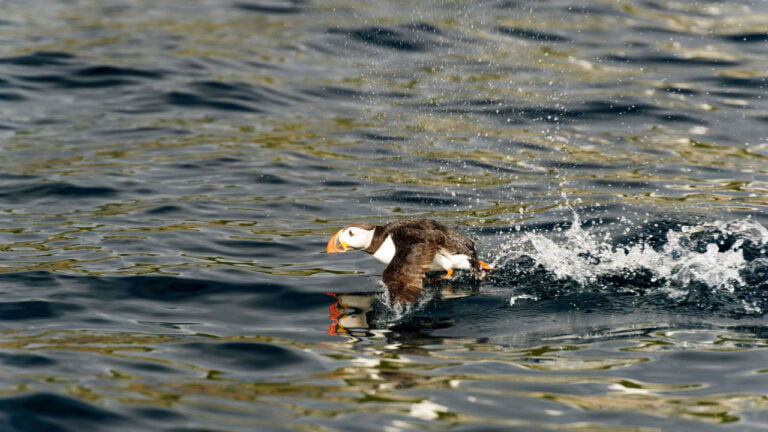
As always, book ahead in the main summer season and be prepared for weather changes. Even a short boat trip can be affected by wind and sea conditions.
Gjesværstappan near the North Cape
Located off the coast of Magerøya, not far from the North Cape, Gjesværstappan is one of Norway’s largest bird cliff areas.
Northern Norway tourism sources describe the islands as home to hundreds of thousands of birds, including tens of thousands of puffins, along with gannets, cormorants, kittiwakes, guillemots and fulmars.
For visitors, the big advantage is accessibility. Boat trips run from the fishing village of Gjesvær to Gjesværstappan Nature Reserve. BirdSafari describes the tour as a two-hour boat trip to the reserve, which lies about 15 kilometres west of the North Cape cliff.
This makes Gjesværstappan a strong option for travellers already heading to the North Cape, Honningsvåg or Magerøya. It can also work for some cruise passengers, depending on port times and available excursions.
If you are visiting the North Cape in summer and want more than the famous globe monument and cliff viewpoint, a bird safari to Gjesværstappan is one of the best ways to add real depth to the trip.
Hornøya, Varanger
Hornøya is one of Norway’s great bird islands and a dream destination for keen birders.
It lies off Vardø, in the far north-east of Norway, close to the Varanger Peninsula. This is a long way from the classic tourist routes, but for birdwatchers, Varanger is one of the most exciting regions in the country.
Hornøya is reached by boat from Vardø harbour. The crossing is short, but the experience feels remote and dramatic. Once on the island, the bird cliff rises above you, with thousands of seabirds nesting, calling and flying overhead.
Puffins are one of the stars, but not the only attraction. Visit Norway says Hornøya has about 7,800 pairs of Atlantic puffins, alongside species such as razorbills, European shags, common guillemots, Brünnich’s guillemots and black-legged kittiwakes.
Hornøya is perhaps the most intense bird cliff experience on this list. It is not just about spotting a puffin through binoculars. It is about being surrounded by seabird life.
That intensity comes with responsibility. Visitors must follow local rules, stay on marked paths and avoid disturbing nesting birds. Weather can also be a major factor in this part of Norway, so build flexibility into your plans.
Svalbard
Svalbard does have Atlantic puffins, but it should not be the main reason for planning a trip there.
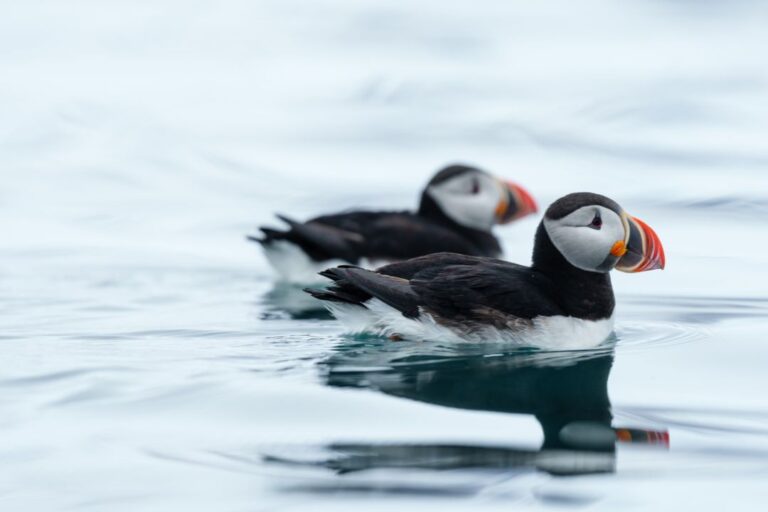
Puffins breed in parts of the archipelago, including along the western coast of Spitsbergen and on Bjørnøya, but the numbers are small compared with the major mainland colonies.
The Norwegian Polar Institute notes that less than one percent of the Atlantic puffin population breeds in the high-Arctic marine zone.
That does not mean you will never see a puffin in Svalbard. You might, especially on boat trips or expedition cruises in the right areas.
But Svalbard is better known for other wildlife experiences, including walrus, seals, Arctic foxes, whales, seabird cliffs and, for some visitors, the possibility of seeing polar bears from a safe and legal distance.
If you are already visiting Svalbard, keep an eye out for puffins. But if puffins are your priority, you will generally have better chances elsewhere.
How To See Puffins Responsibly
Puffins may look relaxed and approachable, but breeding colonies are sensitive places.
Many puffins nest in burrows, often in grassy slopes that can be damaged by footsteps. A visitor leaving a marked path may not realise they are walking above nests. Disturbance can also cause stress to birds that are already working hard to feed chicks.
The basic rules are simple. Keep to marked paths. Follow local signs. Do not approach burrows. Keep dogs away from bird cliffs unless they are explicitly allowed, and even then keep them under close control. Use binoculars or a telephoto lens rather than trying to get close.
Drones are a particular problem. Even where drone flying is not explicitly banned, it can disturb birds and other wildlife. Around seabird colonies, the responsible choice is to leave the drone packed away.
Boat trips also require care, which is one reason to choose experienced local operators. They know where boats can go, how close is too close, and how weather and nesting conditions affect the experience.
The reward for this care is a better encounter. Watching puffins come and go naturally, without disturbing them, is far more satisfying than forcing a close-up.
Have you seen puffins in Norway? If so, where? What tips would you give keen birdwatchers? Let us know in the comments below.


Thank you I found the article on the puffins very interesting. I had no idea that they landed in so many inaccessible places. I am just starting to learn about Norway as my Fiancee was born in Oslo but left as a 9/10 ur old child and he hasn’t had the opportunity to go back. We are hoping to visit in the future and he still speaks Norwegian, which he is going to teach me. We intend to reconnect with his Norwegian family. So as a newcomer to the Norwegian way of life, I am enjoying these articles on Norway. Thank you so much.
Hi, I am interested on visiting next June to see puffins. Can you give me some good advise on which location to view puffins. Would like to be able to drive to a location to see the puffins. If I need to take a Ferry or boat can you give me info so I can make reservations, please.
Thank you,
Helen
Hurtigruten offers a Gjesværstappan “birdwatching safari”: https://www.hurtigruten.com/en/extras/excursions/birdwatching-safari