
Norway's Atlantic Road is one of the country's most photographed drives. Its sweeping bridges and exposed coastal setting are impressive, but is it really one of Norway's best road trips?
Few Norwegian roads have achieved the international fame of the Atlantic Road. Here's what to expect and how to make the most of a visit.
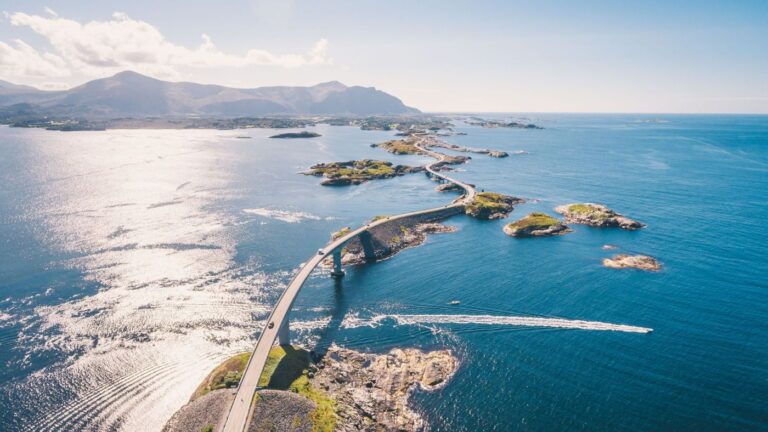
Officially known as Atlanterhavsvegen, this stretch of road on Norway's northwest coast twists across tiny islands, skerries and bridges with the open ocean never far away.
Its distinctive appearance has made it a favourite of photographers, advertisers and television producers. It received perhaps its biggest dose of international publicity when it appeared in Daniel Craig's final James Bond film, No Time To Die.
But there's something worth clearing up before you plan an entire Norwegian holiday around it. The Atlantic Road is impressive, but it's surprisingly short.
Personally, I think its reputation as one of the ultimate Norwegian road trips is a little overblown. There are many longer and, in my view, even more spectacular road trips in Norway.
That doesn't mean you should skip it. Far from it. The trick is to think of the Atlantic Road as one memorable part of a wider journey through this beautiful part of Norway rather than the road trip itself.
Where is the Atlantic Road?
The Atlantic Road is in Møre og Romsdal, roughly between the coastal towns of Molde and Kristiansund.
The famous section forms part of County Road 64 and connects Averøy with the mainland near Vevang, crossing a chain of low islands and skerries on a series of bridges.
This original Atlantic Road is approximately 8.3km (5.2 miles) long. Without stopping, you'll be across it remarkably quickly. However, there is an important distinction.
The Norwegian Scenic Route Atlanterhavsvegen covers a much longer 36km (22-mile) stretch between Kårvåg and the fishing village of Bud. This incorporates the famous bridges together with coastal landscapes, viewpoints, walking trails and other places of interest.
It's one of Norway's 18 National Scenic Routes, a collection of roads where architecture, viewpoints, rest areas and artwork have been developed alongside the natural landscape.
That wider route is a much better way to experience the Atlantic Road.
Is the Atlantic Road worth driving?
Yes, with realistic expectations. The Atlantic Road is undoubtedly an impressive engineering achievement.
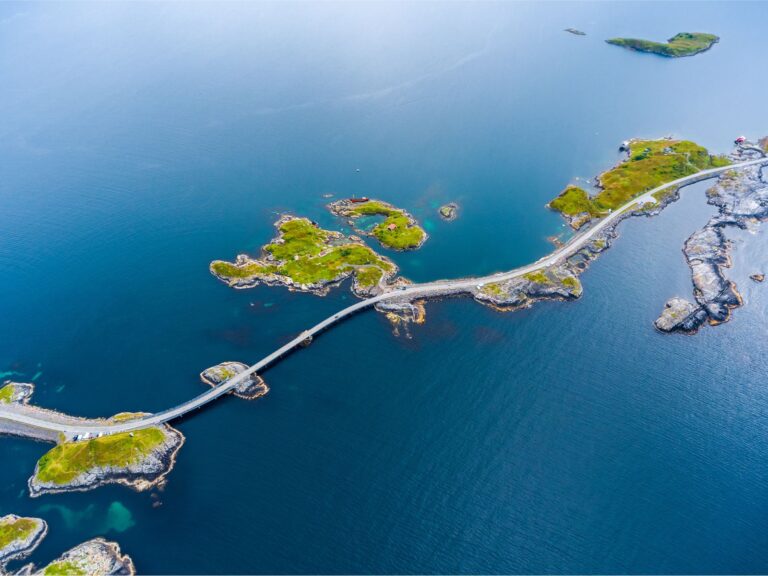
The road seems to leap from island to island across an exposed stretch of coastline, and in rough weather you quickly understand just how challenging building a permanent road connection here must have been. It's also highly photogenic.
What it isn't is a long, epic drive through constantly changing Norwegian scenery.
If you've imagined spending several hours negotiating dramatic bridges above the Atlantic, you may be surprised at how quickly the famous section passes beneath your wheels.
That's why I'd hesitate to describe it as one of Norway's greatest road trips on its own. For me, the Atlantic Road works best as just one highlight of a longer journey through northwest Norway.
Allow time to stop, walk, explore the coastline and visit some of the surrounding communities. Do that, and the experience becomes far more memorable than simply driving across the bridges and turning around.
Storseisundet Bridge
The instantly recognisable symbol of the Atlantic Road is Storseisundet Bridge, the sweeping concrete bridge that appears in most photographs of the route. At 260 metres long, it is the longest of the eight bridges on the original Atlantic Road.
Its curved design and changing gradient mean its appearance alters dramatically depending on where you view it from. From certain angles, the road appears to climb towards nothing at all, earning the bridge its popular nickname of the ‘road to nowhere.'
The reality behind the photographs is slightly less terrifying, of course. When actually driving across it, Storseisundet feels like a perfectly normal modern Norwegian bridge.
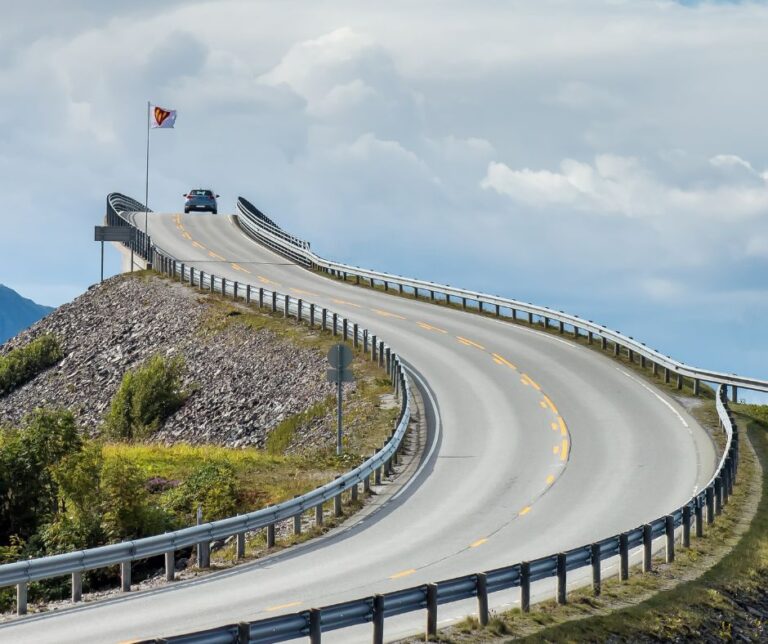
Nevertheless, seeing its unusual shape against the open ocean is one of the unquestionable highlights of the trip.
Stop rather than simply drive
One of the best features of Norway's National Scenic Routes is the development of carefully designed viewpoints, walking trails and rest areas. The Atlantic Road has several that are worth using.
Eldhusøya
Eldhusøya is probably the most worthwhile stop on the famous bridge section. An elevated walking path loops around the small island, giving visitors time to appreciate the coastal landscape away from the car.
The 700-metre-long path provides views of the ocean, bridges and surrounding skerries and is a good example of why I recommend allowing much longer for the Atlantic Road than the driving time suggests.
There's also an architect-designed service building and seasonal café. Getting out of the car is a big part of the experience here.
Fishing from Myrbærholm Bridge
Fishing has always been central to life along this coastline, and specially designed walkways beside the Myrbærholm bridge give visitors somewhere to try it for themselves.
Thanks to the strong tidal currents, species including cod, pollock, mackerel and coalfish can be caught here.
Even if you have no intention of fishing, it's another good place to stop and see the Atlantic Road from a different perspective.
Håholmen island
You don't have to remain beside the road either. Just offshore lies Håholmen, a historic fishing and trading settlement made up of traditional buildings scattered across a small island.
Today, Håholmen Havstuer operates accommodation, dining and other visitor facilities on the island. Boat transport runs from Geitøya beside the Atlantic Road during the main season.
This makes it possible to turn a quick driving stop into a considerably longer coastal experience.
Even if you don't make the trip across to Håholmen, Geitøya itself is a good place to stop, stretch your legs and enjoy the surrounding sea and mountain views.
Continue towards Bud
Another reason not to turn around immediately after crossing the famous bridges is that the official scenic route continues south towards Bud.
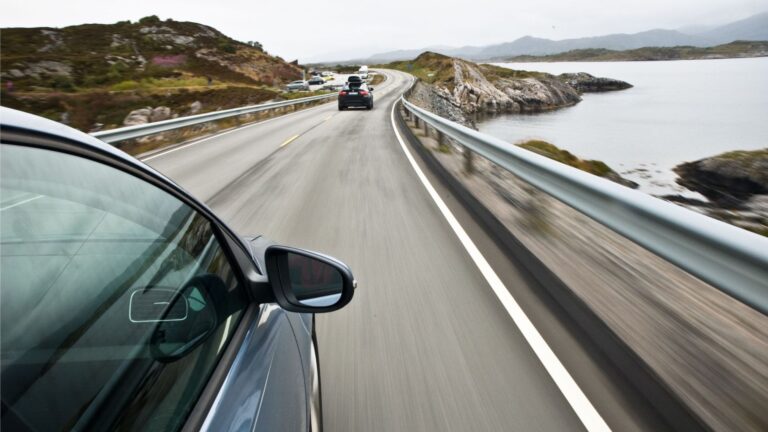
The landscape here is different from the dramatic imagery normally associated with the Atlantic Road.
Instead, the road follows a low, exposed coastline facing the notorious waters of Hustadvika. There are small communities, walking opportunities and purpose-built viewpoints along the way.
Vevang and coastal art
Near Vevang, the artwork Columna Transatlantica provides one of the route's more unusual stops.
Created by Norwegian artist Jan Freuchen, fragments of white marble have been positioned through the coastal landscape as if parts of a giant classical column have washed ashore.
It's a good example of another feature of the National Scenic Routes project. The journeys aren't simply about driving. Architecture, landscape design and public art have deliberately been incorporated into many of them.
Askevågen
At Askevågen, a small viewing platform extends to the end of a breakwater.
Glass walls provide some protection from the wind and sea spray while maintaining an almost uninterrupted panorama of the Atlantic, nearby islands and mountainous coastline.
On a calm day, it's a beautiful place for a break. In rough weather, you'll get a much better sense of why this stretch of coastline has such a formidable maritime reputation.
Bud fishing village
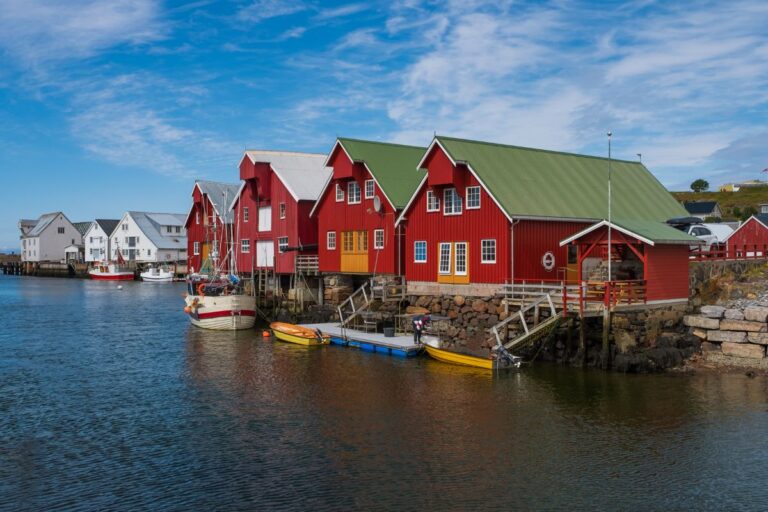
At the western end of the Scenic Route is Bud, a small fishing village that's well worth more than a drive-through.
Colourful buildings cluster around the waterfront, while the surrounding coastline provides expansive views across Hustadvika. Bud also has an important wartime story.
The Ergan Coastal Fort was constructed by the German occupying forces during the Second World War and today forms part of a museum devoted to the fort and the region's wartime history.
A coastal trail continues around the headland, making Bud another good place to leave the car behind for a while.
Exploring Averøy
At the opposite end of the Atlantic Road, don't overlook Averøy. Many visitors hurry across the island on their way between the bridges and Kristiansund, but there are several reasons to slow down.
One of the most interesting is Kvernes Stave Church, an unusual example of Norway's historic wooden church architecture. If these distinctive buildings interest you, take a look at our guide to Norway's stave churches.
The nearby Kvernes rural museum adds more local history, while the surrounding coastal landscape offers plenty of opportunities simply to stop and explore.
Small communities elsewhere on Averøy also give you an insight into everyday life in a part of Norway heavily influenced by the sea.
Kristiansund and Molde
The two towns at either end of a wider northwest Norway itinerary also deserve some time.
Kristiansund is strongly associated with klippfisk, the dried and salted cod that became one of Norway's major exports. Its island setting and colourful harbour districts make it an interesting destination in its own right.
The Atlantic Ocean Tunnel provides the road connection between Averøy and Kristiansund, making it straightforward to incorporate the Atlantic Road into a journey through the town.
To the south, Molde is another useful base for exploring the region, especially if you're combining the Atlantic Road with the fjords and mountains farther inland.
The Atlantic Road is also commonly offered as an excursion for cruise passengers calling at either town.
Cycling the Atlantic Road
For those who prefer two wheels to four, the Atlantic Road also forms part of a much longer coastal cycling route. That sounds idyllic, but cyclists should be prepared for the conditions.
This is exposed coastline. Strong winds can make cycling difficult, and the Atlantic Road itself can be busy with cars and motorhomes during the summer season. The bridges also offer very little shelter.
Experienced touring cyclists may relish the challenge, but casual cyclists shouldn't assume that beautiful photographs mean an easy ride.
Making the Atlantic Road part of a Norway road trip
This is where I think the Atlantic Road makes the most sense. Don't travel halfway across Norway solely to spend ten minutes driving over a handful of bridges.
Instead, incorporate it into a broader journey through Møre og Romsdal. You could combine Kristiansund, Averøy, the Atlantic Road and Bud with Molde before continuing inland towards Åndalsnes and the dramatic mountain and fjord scenery of Romsdal.
Or you could continue farther south into the fjord region, where some of Norway's other Scenic Routes provide very different driving experiences.
If driving is going to be a major part of your Norway holiday, take a look at the other National Scenic Routes before deciding which ones to include.
For example, Aurlandsfjellet climbs from the fjords into a stark high-mountain landscape on the seasonal ‘Snow Road' between Aurland and Lærdal.
Nearby, Gaularfjellet offers 114km of mountain roads, waterfalls, lakes and hairpin bends between the Sognefjord and Sunnfjord.
There's also Gamle Strynefjellsvegen, a historic mountain road that feels completely different again.
Farther north, the National Scenic Route on Senja runs through some of Northern Norway's most dramatic coastal scenery.
That's not to say any of these roads are objectively ‘better' than the Atlantic Road. They simply underline how much variety there is for anyone planning a driving holiday in Norway.
The Atlantic Road deserves its fame as a remarkable piece of engineering in an extraordinary coastal setting. Just don't expect the famous bridges themselves to fill your day.
Slow down, stop along the way, explore Averøy and Bud, and make the Atlantic Road one highlight of a much bigger Norwegian road trip.
Have you driven Norway's Atlantic Road? Did it live up to the hype, or did another Norwegian road impress you more? Let us know in the comments below.


How much toll you have to pay to drive on this road?
There is no toll on this road.
Good morning from Canada
It was great to see my home town and Averoya featured
Really useful info, thanks. Planning a post-retirement trip and unsure where to go in the world. A friend suggested Norway … and I found your site. Busy thinking about where to go and what to see in 18 days of travel by car. The Atlantic road looks like a must do!
I don’t suppose you have any resources for sea/fjord swimming in Norway. My wife and I swim in the North Sea every day so are used to cold water and would love to swim in Norway too.
Is there a book or map I can buy to plan this journey.
i like to visit this place once in my life time